



English version of the interview here.
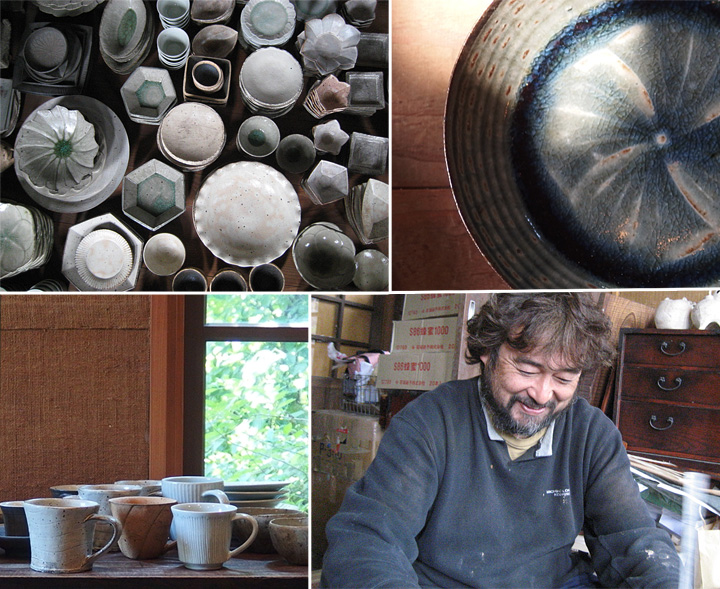
Interview with Yuichi Yukinoura, on the Eve of His Upcoming Exhibition
Hanada: Have you been interested in making things since you were a child? You studied mathematics at university, didn’t you?
Yuichi Yukinoura: I loved drawing and making things from a young age. But I enrolled in the sciences at university because at the time I planned to become a teacher. I was also interested in studying art, but I chose the sciences since it made it easier to become a teacher.
However, I took art as a minor. Most people choose something like English or sociology as a minor.
So during university, I was studying classical painting and mathematics at the same time.
Yuichi Yukinoura: When we look at something and think it’s beautiful, I believe there are mathematical aspects involved, such as the golden ratio.
And even in mathematics, recognizing the beauty of a sequence of numbers relies on one’s sensibility.
I felt that mathematics, too, possesses both a digital and an intuitive side.
Hanada: I come from a humanities background, but many of the science-minded people around me—mathematicians especially—seem to be pure romantics.
Yuichi Yukinoura: I can’t speak for others, but I certainly am (laughs).
In the end, after graduating from the mathematics department, I entered an art program.
I studied fresco and tempera painting.
Hanada: So your focus was mainly Western-style painting.
Yuichi Yukinoura: Yes, at first I was interested in Western painting. These days, though, I’m more drawn to Japanese painting in general.
Hanada: And from there, you moved into ceramics.
Yuichi Yukinoura: I encountered ceramics at university and became interested in it. After graduating, I returned to my hometown in Hokkaido.
Just at that time, the ceramics division of the Industrial Research Institute in Nopporo was looking for trainees, so I wrote them a letter and they immediately told me to come. I remember writing quite passionately about my enthusiasm for ceramics (laughs).
Hanada: And that’s when you began making tableware.
Yuichi Yukinoura: Even if I made artistic, object-like pieces, they wouldn’t easily reach ordinary people. I wanted to remain within the world of craft, and to be connected to the everyday lives of regular people.
Hanada: Were you aiming for your current style from the beginning?
Yuichi Yukinoura: I wanted to create work that is easy to use and contains a balanced degree of my own expression, and to use as much as possible local glazes and clay from Iwate, where I chose to base my studio.
Hanada: Kazuhiko Kudo also places great importance on using local materials.
Yuichi Yukinoura: I believe there are forms of expression that can only emerge from a particular place.
Hanada: No matter how advanced distribution systems or information technology become, the climate and character of a region have an enormous influence on the people and things there—and of course, that cannot be ignored.
Rather than trying to eliminate or control those elements, I think it suits the Japanese temperament to coexist with them and make the most of them. Each region’s climate and character naturally inspire affection and attachment. You use ash from Morioka apples, don’t you?
Yuichi Yukinoura: That’s right. I blend clay from around Morioka, Hanamaki, and Tono. Occasionally I mix in some Shigaraki clay as well.
Hanada: You don’t often hear about clay from Iwate, do you?
Yuichi Yukinoura: It may sound strange, but Iwate clay is simply unassuming. It’s not pure white, nor is it especially sticky or easy to handle.
And yet… I feel a certain attachment to it.
I love researching both clay and glazes. I’ve accumulated quite a bit of data over time.
Hanada: That’s the researcher in you. With your ash glaze, using conventional methods probably wouldn’t achieve that clarity, brightness, and depth.
Yuichi Yukinoura: I apply three to four layers of glaze, each with a slightly different composition.
The base layer uses apple ash from Shizukuishi. For the second layer, I add a bit of feldspar and use apple ash from Shiwa. The third layer is almost the same, but with a slightly different type of feldspar. Some pieces require two bisque firings.
Hanada: It must have been difficult to achieve that look consistently.
Yuichi Yukinoura: At first, I mixed things rather casually and worked by feel. As a result, the outcome was completely different each time. Looking back, that was only natural—but eventually I began recording data and following it carefully.
Hanada: In time, you also developed your indigo-blue glaze. It’s clearly different from traditional lapis glazes.
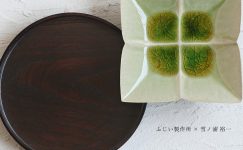
Yuichi Yukinoura: Japanese people have always loved the color of indigo dye. Rather than the vivid brightness of a lapis glaze, I wanted to maintain the translucency that comes from melted ash, while bringing out a color that seems to gently seep to the surface.
Hanada: You’ve also introduced an olive tone.
Yuichi Yukinoura: Yes, that’s a nice one too.
Hanada: And what about the amber glaze you’ve mentioned before?
Yuichi Yukinoura: I can see it clearly in my mind, but iron is a delicate material… I hope it will be ready in time for the February exhibition.
Hanada: Well, you do work quickly. You produce a large number of pieces as well.
Yuichi Yukinoura: I’m often praised for my planning. I think I’m good at working backward from the final goal and allocating each step of the process efficiently.
Hanada: I see. The combination of your powerful energy and your researcher’s mindset is very compelling. Let’s continue to explore new ideas together.
Yuichi Yukinoura: I look forward to continuing our work together (laughs). Requests from the shop are always welcome. Let’s keep creating beautiful, functional tableware together. After all, what matters most is that our customers are delighted.
Hanada: We won’t hold back—we’ll keep the requests coming!
Yuichi Yukinoura: Thank you. I look forward to February as well.
≪ END ≫
企画展直前インタビュー 雪ノ浦裕一
花田:小さい頃からもの作りには興味があったのですか。大学はたしか数学科ですよね。
雪ノ浦:小さい頃から絵をかいたり、物を作ったりすることが好きでした。
でも、大学は理数科。というのも、当時、教師になるつもりでした。
大学は美術系にも興味がありましたが、先生になりやすい理数系を選びました。
ただ、副専攻で、美術を取りました。普通、副専攻って英語とか社会学とかを選ぶんですけどね。
それなので、大学時代は古典絵画と数学を同時に勉強していた。
-: 数学と美術は相通ずるところ、多いですよね。
雪ノ浦:物みてきれいって思うことって、黄金比などといった、数学的側面も含まれていると思います。
そして、数学でも、数字の並びの美しさを認識するのは感性の部分。
数学もデジタルと感性の二面性を備えていることを感じていました。
-: 僕は文系ですが、僕の周りの理系の人たちをみると、数学者、理系の人たちって純粋なロマンチストが多いです。
雪ノ浦:他の人は分からないけど、ぼくはそうだよ(笑)
結局、数学科を卒業したあと、美術科に入るんです。
フレスコ、テンペラなんかを勉強していました。
-: 洋画中心だったんですね。
雪ノ浦:そう、最初は洋画に興味がありました。今はどちらかというと、日本画全般が好きです。
-: そこからやきものへ。
雪ノ浦:大学でやきものに出会って、興味を持ちました。
卒業後、地元の北海道に戻るんですが、
丁度、研修生を募集していた野幌の工業試験所の窯業分所に手紙書いたら、すぐ来てくれって。
なんか、陶芸について情熱的に書いた覚えがあるな(笑)
-: それで食器作りを始める。
雪ノ浦:芸術的なオブジェっぽいものを作っても、一般の人たちにはなかなか行き渡らない。
工芸の世界に身を置いていたかったし、普通の人の普段の生活に関わっていきたかったんです。
-: 元々、今のスタイルを目指していたのですか。
雪ノ浦:使いやすくて、自分の表現が適度に含まれていて、
そして出来るだけ仕事場に選んだ岩手でとれる地元の釉薬や土を使っていきたい、そう考えていました。
-: 工藤和彦さんも同様に、地元の材料を活用することに意を注いでいます。
雪ノ浦:その土地でしかできない表現というものがあると思うんです。
-: どんなに物流や情報技術が発達しても、風土が、その土地の人や物事に及ぼす影響は
非常に大きいし、勿論無視できません。
それらを排除したりコントロールしようとしたりするより、
うまく共存して活かす方向が日本人には向いていますね。
それぞれの風土や土地柄って、人が思い入れや愛着を持ちやすいものだと思います。
灰は盛岡のりんごを使っていますよね。
雪ノ浦:そうです。土も盛岡や花巻、遠野のあたりのブレンドです。たまに信楽のものを混ぜますが。
-: 岩手の土ってあまり聞きませんよね。
雪ノ浦:変な言い方になるけど、岩手の土って、ただただ素朴なんです。
真っ白とか、ねばりがあってこしがあって扱いやすいとかってわけじゃない。
でもね・・・なんか愛着を感じるんです。
土も釉薬も研究するのは大好きです。随分、データも蓄積されてきました。
-:そういうところは研究者ですね。
灰釉なんかも、おそらく普通の方法だと、あの透明感や明るさ、奥行きは出てきませんよね。
雪ノ浦:釉薬も三層から四層に分けて、配合を変えたものをかけています。
ベースになる一層目は雫石のりんご。二層目は長石を少し加えて紫波のりんごを使う。
三層目もほとんど同じだけど、長石の質を少し変えている。
素焼きが二回必要なものもあります。
-: あの感じを安定的に実現するの大変だったのでは。
雪ノ浦:最初は適当に混ぜて、適当にやっていた。
そうすると、いつも出来がぜんぜん違うんです。
今思えば当然なんだけど、そのうち、データをとってそれに従うようになりました。
-: そのうち、藍彩もできてきました。ルリ釉とは明らかに違います。
雪ノ浦:藍染の色って日本人は好きですよね。
ルリ釉の鮮やかな感じじゃなくて、灰が解けた感じの透明感を維持しつつ、
にじみ出てくるような色を出したかった。
-: オリーブ色も出てきましたね。
雪ノ浦: あれもいいでしょ。
-: 前から言っている、琥珀色は?
雪ノ浦:頭の中では出来ているんだけど、鉄って微妙で・・・
二月の企画展に間に合えばいいんだけど。
-:まあ、でも、雪ノ浦さんは仕事速いですよね。
うつわも、数をどんどん作る。
雪ノ浦:段取りは褒められます。工程の逆算や割り振りは得意なつもりです。
-: なるほどね。雪ノ浦さんのパワフルさと研究者的な部分の両面性が魅力的です。
これからも色々やっていきましょう。
雪ノ浦:今後ともよろしくお願いします(笑)
引き続き、お店のほうからのリクエストも大歓迎です。
これからも一緒にいいうつわ作っていきましょうよ。やっぱりお客さんに喜んでもらいたいですから。
-: これからも、遠慮しないで、色々リクエストしますよ!
雪ノ浦:はい。二月も宜しくお願いします。
関連記事はこちら