





English version of the interview here.
A Longing for White Porcelain
Hanada: Could you tell us how you started your career in pottery?
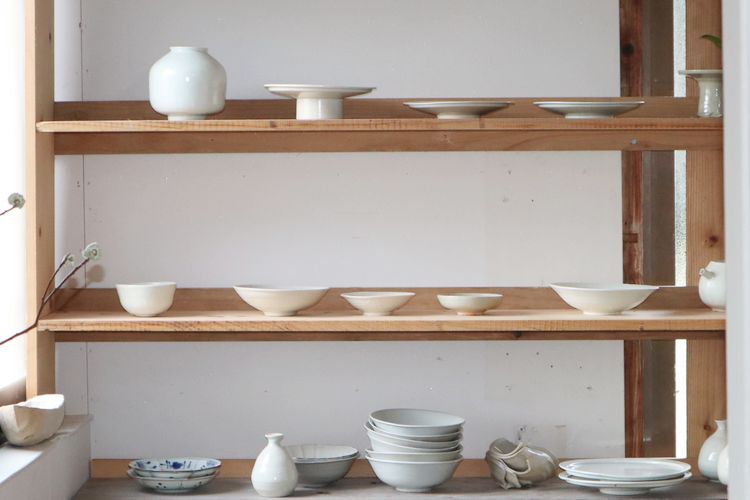
Ryohei Yamamoto : I studied oil painting at university, but I chose pottery because I wanted to be directly involved in the entire process, right from the raw materials to the finished piece. My admiration for white porcelain has never changed since then. It is the ultimate simplicity. I want to keep my creation as simple as possible.
Hanada: And then you chose Arita.
Ryohei Yamamoto : Arita is the birthplace of white porcelain in Japan. I was also drawn to the pottery wheel course at the Saga Prefectural Arita College of Ceramics. For a whole year, we did nothing but make covered rice bowls.
Hanada: So you focused entirely on mastering the wheel technique.
Learning in Arita
Ryohei Yamamoto : After graduating, I worked at a pottery studio in Arita as an overglaze painter for three years.
Hanada: Working in such an environment in Arita must be highly effective for developing your skills.
Ryohei Yamamoto : The artisans in Arita are incredibly skilled. Whether it is using the wheel or painting, their work perfectly embodies what you would call textbook quality.
Yuki Yamamoto : I also worked as a painter at a different studio, and it was truly beneficial. My husband makes all kinds of requests, so I am grateful that I was trained to handle a wide range of styles.
(Ryohei’s wife, Yuki, handles the painting.)
Hanada: What kind of requests does he make?
Yuki Yamamoto : He will say things like, “Make it softer,” or “Draw this line more sharply.” Then, looking at the finished piece, he might mutter, “Ah, I knew this part wasn’t quite right.” I always think, “If you knew, you should have told me earlier!” However, we usually do not have a perfectly clear ideal in mind from the start, so it is only natural that we discover things as we go along.
Hanada: Yuki, do you have any requests for Ryohei?
Ryohei Yamamoto : She speaks her mind quite a bit, saying things like, “That is not cute,” or “That is not beautiful.” She also has her own preferences for patterns. For instance, I really like this net pattern. It feels as though a vibration is created by this linear, simple back-and-forth movement. Even though it is a traditional pattern from long ago, it does not feel outdated at all.
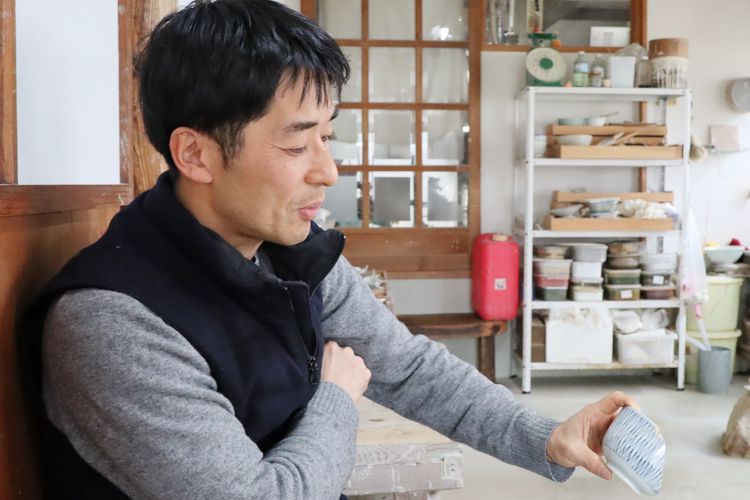
Yuki Yamamoto : I just thought it might not be very interesting to paint.
Ryohei Yamamoto : I think you will actually find it interesting once you try it. I would like you to try painting it, moving back and forth with a clear mind.
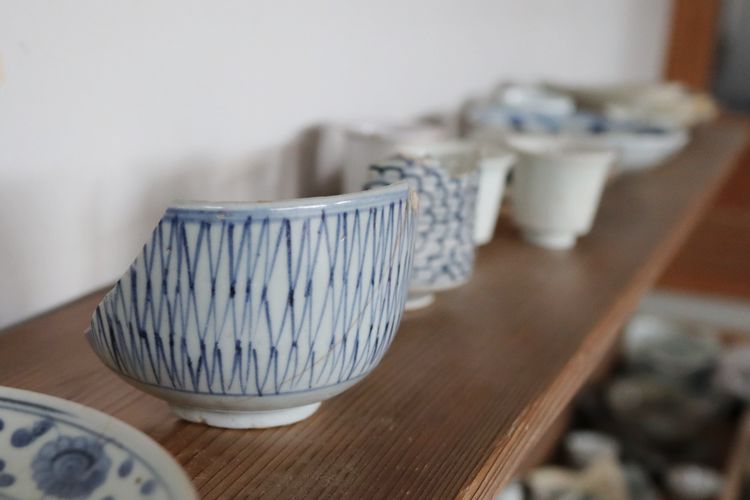
The Freshness of Early Imari
Hanada: What draws you to Shogen Imari and Early Imari, which you have been working on recently?
Ryohei Yamamoto : It is their freshness. Back then, the techniques brought by Korean potters were already well-established, but the raw materials were different. The climate and customs were also different. In other words, the process was not yet fully refined. I sense a similar unrefined atmosphere in the Ko-Kutani and early Kakiemon styles as well. It is the beauty of something before it becomes completely commercialized. The Ko-Kutani style did not last very long, so it ended before becoming fully standardized. That is why every piece remains so fascinating.
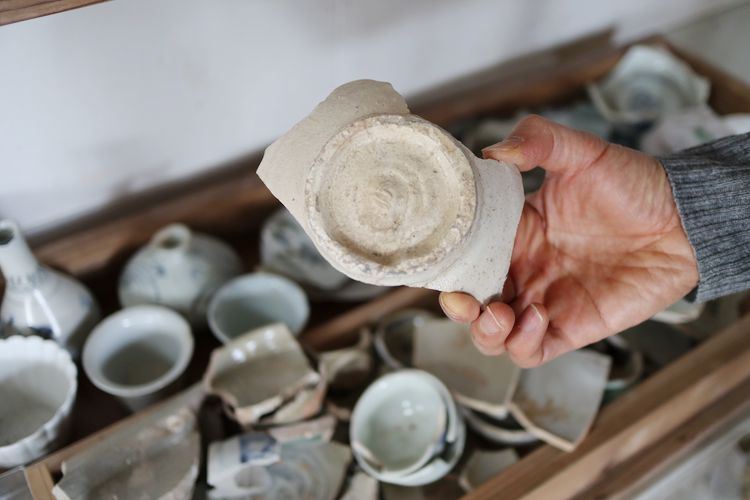
Hanada: We first met about ten years ago. Your work has changed since then, hasn’t it?
Ryohei Yamamoto : I used to do a lot of press-molding work. This piece is an original antique, but I used to make replicas of things like this. It is a traditional technique in Arita, and I liked it very much.
Hanada: This octagonal piece is beautiful.
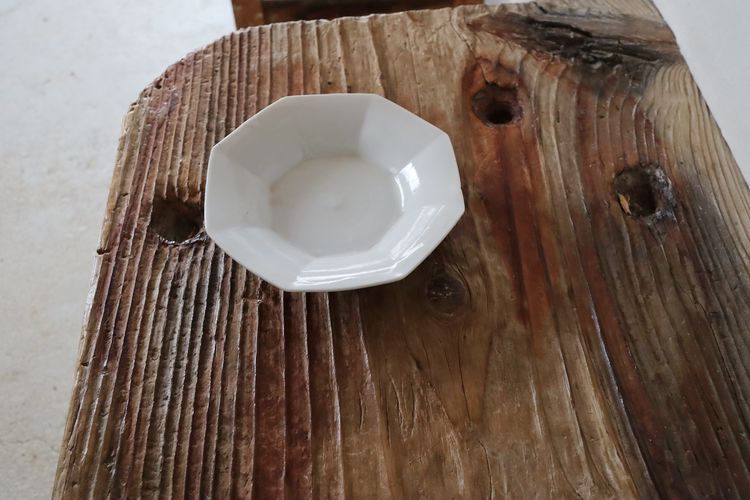
Ryohei Yamamoto : I love it. However, my days were spent constantly repeating the process of throwing on the wheel and press-molding, while always trying to think of the next shape. At some point, it became painful to force myself to create new things, as they kept growing more complex.
Hanada: Yet you originally chose white porcelain because you wanted your work to be simple.
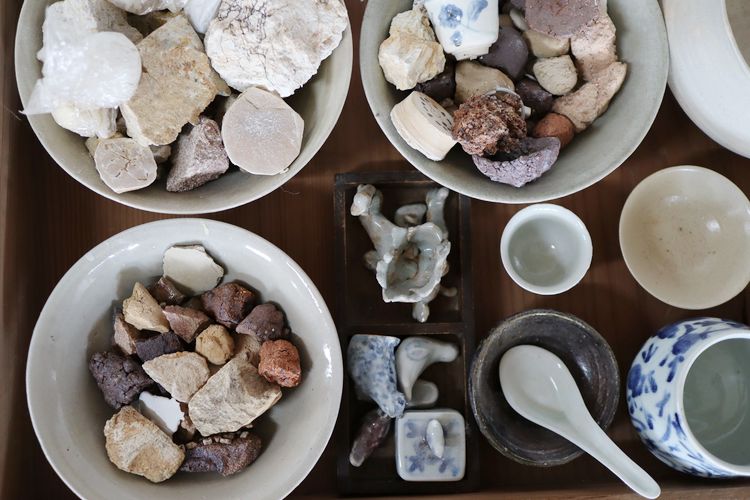
Ryohei Yamamoto : Exactly. So, I decided to return to the basics, starting right from crushing the stones.
Hanada: That truly is the absolute beginning.
Ryohei Yamamoto : Yes. Once you shift your mindset like that, the nearby kiln sites where I used to walk everyday start to look entirely different. Even the broken pottery shards on the ground begin to catch my eye, shining brightly.
When Your “Normal” Changes
Ryohei Yamamoto : Yasumoto Kajiwara in Karatsu traces the production methods and techniques from the past to revive Old Karatsu today. For a while, I went to his studio every week to help grind stones. It allowed me to observe his work, and he would answer any questions I had.
Yuki Yamamoto : Back then, whenever he came home from Mr. Kajiwara’s studio, he always looked so happy, saying, “I learned so much again today!”
Ryohei Yamamoto : Grinding stones by hand is incredibly tedious work, and just hearing about it makes it sound terribly troublesome. In fact, if you are used to clay that is ready to use right after purchase, the gap is huge at first. However, after doing it all day long, something changes. The task that felt unusual becomes your new normal. I believe this shift in what I consider normal brought a major change to my work.
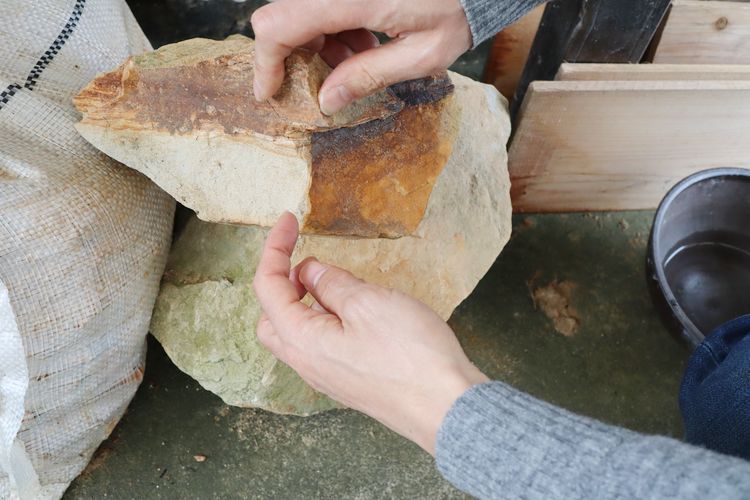
Hanada: The appeal of old pieces is certainly part of it, but wasn’t the process of finding challenges and seeking clues from various sources, both people and objects, also fascinating for you?
Ryohei Yamamoto : It is simply wonderful to discover things that you can only understand by trying them yourself.
An Unbelievable Speed
Hanada: You are currently building a new kiln. I heard that when another artist tried to build that type of kiln, many people warned them against it, saying it wouldn’t work out. It sounds like quite a challenge.
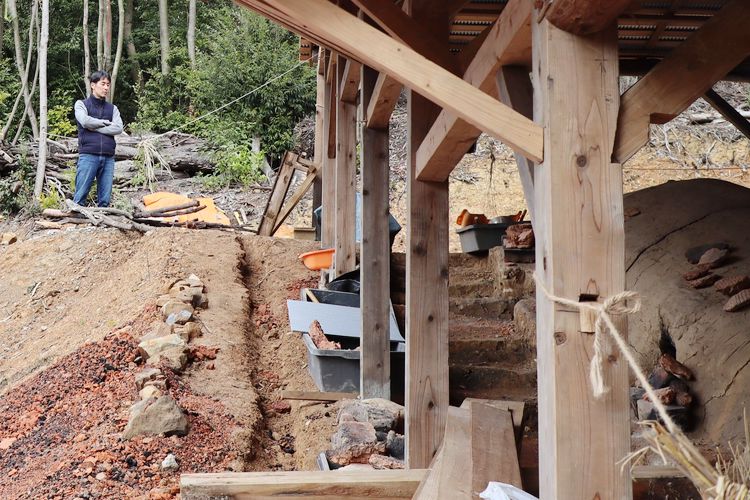
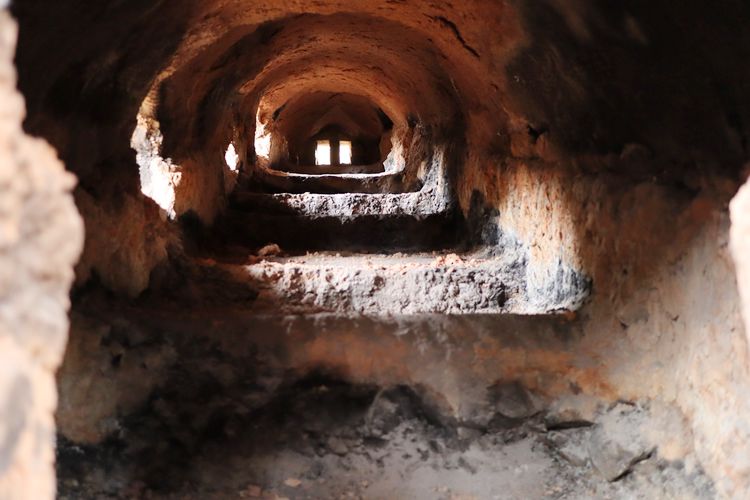
Ryohei Yamamoto : I have had many dreams where the kiln collapses during firing. However, it is also true that an earthen wood-firing kiln, built entirely of clay without bricks, has an outstanding advantage. When watching Mr. Kajiwara fire his kiln, the main firing finishes in just four to five hours.
Hanada: That is incredibly fast.
Ryohei Yamamoto : It defies conventional wisdom. Mr. Kajiwara says, “People in the past wouldn’t have used precious firewood so lavishly on a long firing.” Those words deeply impressed me. The earthen kiln is the result of pursuing rationality while working in harmony with nature.
Hanada: Does the temperature rise quickly?
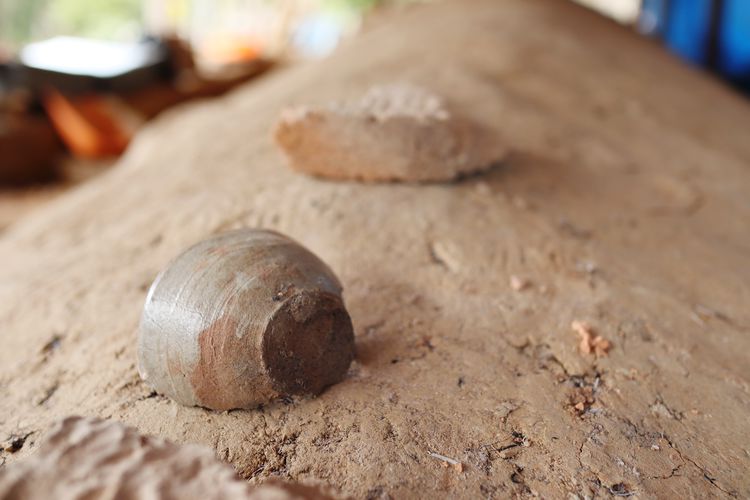
Ryohei Yamamoto : Since the kiln itself does not absorb the heat, the temperature rises immediately.
Working in a Pottery Region
Hanada: There are many historical kiln sites remaining nearby that can serve as references.
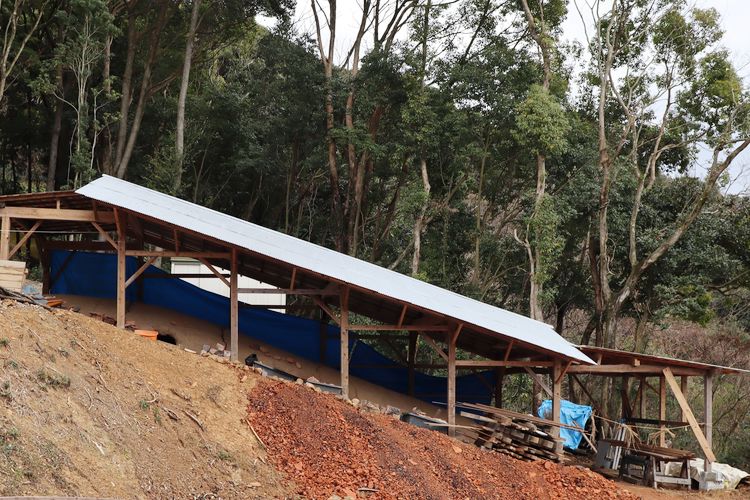
Ryohei Yamamoto : In Karatsu and Arita, there are many artifacts left that we can learn from. It truly shows the strength of an established pottery region. Moreover, I believe this area flourished not only for geographical reasons as a gateway for culture from the Korean Peninsula. The natural environment, including the geology and climate, is also perfectly suited for making pottery.
Hanada: By exploring the past yourself, these things began to make sense to you.
Ryohei Yamamoto : Things that did not quite register when I was just reading books became clear once I tried them myself, right down to the meaning behind the slope of a mountain.
Naturally
Hanada: What do you value most when making pottery?
Ryohei Yamamoto : Doing things naturally. When you try too hard to reproduce the great pieces of the past with your own hands, it inevitably becomes unnatural. I feel dissatisfied and uneasy with the final result. I do not want to leave unnecessary traces of my own intention. If there is an expression I want to achieve, instead of forcing it with my hands, I prefer to create an environment or a process where it occurs naturally. For example, raw glazing, where painting and glazing are done on the clay without bisque-firing. For our current work, it is best to throw on the wheel, trim and paint while it is still damp, and then glaze it right away.
Hanada: What makes that approach the best?
Ryohei Yamamoto : Variations in the blue wash of Early Imari are often attributed to a lack of technical skill, but I see them as something that arises naturally from the method itself. If the clay is damp, even if you apply the wash evenly, the moisture vibrates subtly, which naturally creates a waving unevenness. I do not want to create variations on purpose. When considering the conditions under which these variations naturally occur, it brings us back to raw glazing.
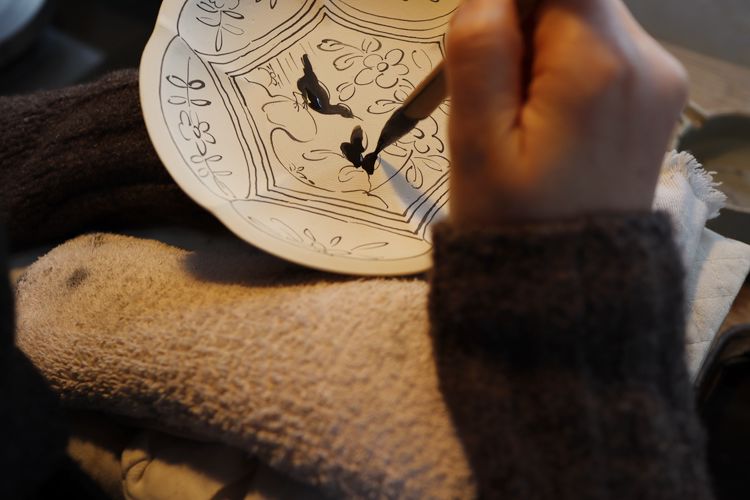
Hanada: Yuki, do you share a similar mindset when you paint?
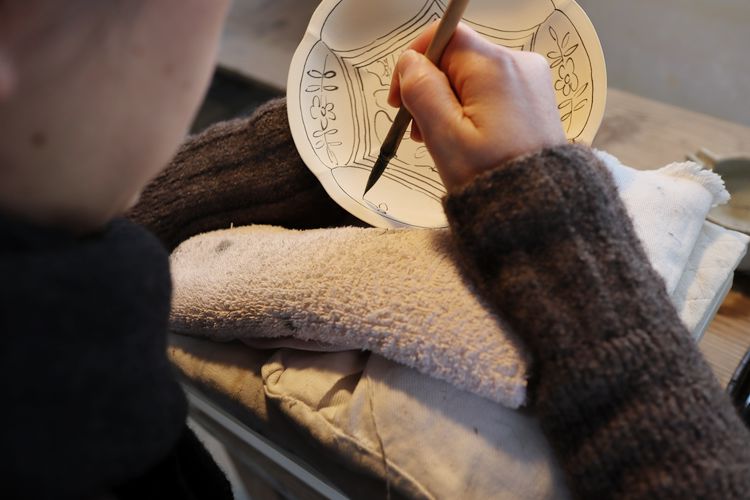
Yuki Yamamoto : I feel as though I am just painting. I try to think as little as possible.
Ryohei Yamamoto : This is the first time I am hearing this, but her painting really has no personal quirks. This absence of distinct habits is precious to us. Well, others might see some quirks in it, but I don’t think there are any.
What They Both Like
Hanada: You have a lot of reference pieces in your workshop.
Ryohei Yamamoto : This one is rather lovely, isn’t it?
Yuki Yamamoto : Yes, this one is beautiful.
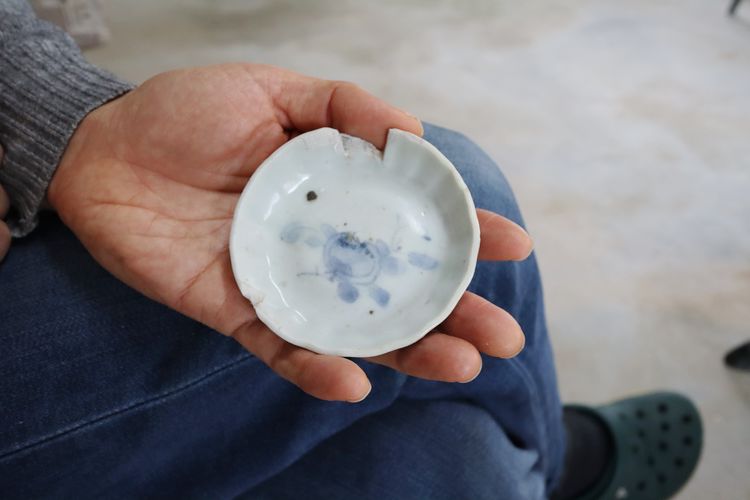
Hanada: So you both like this piece.
Ryohei Yamamoto : The painting, the quality of the glaze, and the shape all come together naturally. It feels perfectly integrated.
An Exciting Future
Hanada: I look forward to seeing what you do next.
Ryohei Yamamoto : I will continue to pursue rationality and efficiency, not for myself or my convenience, but in harmony with nature. It is not about creating unconsciously, or about intention versus unintentionality. I just find myself imagining what kind of work will emerge when every element aligns perfectly with that natural rationality.
Hanada: We look forward to your exhibition.
Ryohei Yamamoto : I hope the freshness of our new approach reaches people simply through our work. Also, since I attended Kudan High School, Kudan is a place that brings back fond memories.
Hanada: We are looking forward to it. Thank you very much.
≪ END ≫
白磁に対する憧れから
花田:山本さんが焼き物の仕事に至った経緯を教えてもらえますか。[以下花田-]
山本亮平:大学では油絵の勉強をしていましたが、原料の段階から最後まで自分が直接関われる焼き物を選びました。
そのころから持っている白磁に対する憧れは今でも変わりません。
究極のシンプルですよね。
もの作りはとにかくシンプルにやっていたいなと思います。
[以下山本亮平:山本(亮)]
-:そして、有田を選ばれます。
山本(亮):有田は日本における白磁発祥の地です。
なおかつ、有田の窯業大学校のロクロ科に惹かれました。
一年間、(蓋付)飯碗しか作らないという…。
-:集中してロクロの技術を習得されたのですね。
有田で学ぶこと
山本(亮):卒業後は、3年間絵付け師として、有田の窯元に就職しました。
-:技術を身に付けるという意味で、有田のそういう場所で仕事をすることは、非常に有効です。
山本(亮):有田の職人さん達って、本当に上手いです。
ロクロにしても絵付けにしても「教科書通り」とはこのことかと。
山本ゆき:私も、別の窯元で絵付け師をやっていましたが、本当にためになりました。
夫の要求は色々なので(笑)、一通りできるようにしていただいたこと、感謝しています。
(絵付けは、ゆきさんが担当されています)
[以下山本ゆき:山本(ゆ)]
-:どのような要求ですか。
山本(ゆ):「もっとフワっと」とか「ここシュっと」とか…。
あと、完成品を見て「やっぱり、ここが違ったな…」とか呟いているんですよ。
「『やっぱり』って、先に言ってくれればいいのにー」ってなる(笑)。
ただ、大抵、私たち自身も理想が何かはっきりしているわけでもないので、進めながら気づくのは当然と言えば当然です。
-:ゆきさんから亮平さんにリクエストはあるのですか。
山本(亮):結構、言ってきます。
「そこは可愛くない」とか「キレイじゃない」とか(笑)。
文様の好みもあります。
例えば、僕はこの網手、凄い好きなんですけどねぇ。
この直線的で単純な行ったり来たりに振動が起きている感じがして。
昔からの定番の文様なのに逆に古臭くないというか。
山本(ゆ):描くのには面白くないかなと思って…。
山本(亮):実際、描いてみたら面白いと思うよ。無心で行ったり来たりしてほしいな。
初期伊万里のフレッシュさ
-:山本さんにとって、最近取り組まれている初源伊万里や初期伊万里の魅力は何ですか。
山本(亮):「フレッシュさ」です。
当時、技術は朝鮮陶工が持ってきたもので既に確立していますが、原料が違います。
風土も、慣習も違う。
つまり、こなれていないんです。
古九谷様式や初期の柿右衛門様式にも同じようなこなれない雰囲気を感じるんですよね。
完全に商品化されきる前の良さ、というか。
古九谷様式もそんなに長くありませんから、こなれきる前に終わってしまう。
だからどれを見ても魅力的なのではないでしょうか。
-:山本さんと初めてお会いしたのは10年くらい前ですね。
その頃から仕事の内容は変わりました。
山本(亮):以前は型打ちの仕事が多かったです。
これは本歌ですけど、こういうものの模しをしていました。
有田の伝統的な技法ですし、とても好きでした。
花田 きれいですね、この八角。
山本(亮):大好きです。
ただ「ロクロして、型打ち」をひたすら繰り返しつつ、次の形を考える日々でした。
新しいものを無理に生み出そうとして、どんどん複雑になっていくのが、ある時からつらくなってきました。
-:元々シンプルに仕事をしていたくて選んだ白磁です。
山本(亮):で、もう一度原点に立ち返ろうと。石を砕くところから。
-:まさに原点ですね。
山本(亮):はい。
一度そういう意識になると、普段散歩していた近くの窯跡も違って見えてきます。
落ちている陶片もキラキラと目に入ってくる。
自分にとっての「当たり前」が変わる時
山本(亮):唐津の梶原靖元さんは当時の状況から製法や技術をたどりつつ、今に古唐津をよみがえらせています。
しばらく梶原さんのところへ毎週、石を削る作業をしに通っていました。
梶原さんのお仕事も見ることができるし、聞けば何でも教えてくれるので。
山本(ゆ):当時、梶原さんのところ行くと「今日も勉強になったー」っていつも楽しそうに帰ってきていたよね。
山本(亮):手で石を削るのって本当に地道な作業ですし、話だけだと、とんでもなく面倒くさく聞こえるでしょう。
実際、入手してすぐ使える状態の土に慣れていると、最初はギャップが大きいです。
ただ、一日中やっていると、変わってくる。
それまで当たり前でなかった作業が「当たり前」に感じられるようになるんです。
僕にとっての「当たり前」が変わったことは、仕事に大きな変化を与えてくれたと思っています。
-:古いものの魅力も勿論でしょうけど、課題を見つけて、人やものといった色々な情報源から手がかりを得ながら進んでいく過程も山本さんにとっては魅力的だったのではありませんか。
山本(亮):「自分でやってみなければ分からないこと」って楽しいです。
常識外れの早さ
-:現在新たな窯も作られています。
ある作家さんがあの窯をやろうとしたら「うまくいかないから、やめておいたほうがいい」と色々な人に止められたらしいです。
大変みたいですね。
山本(亮):焚いている時に窯が崩れる夢も何度も見ています。
ただ、土窯(レンガを使わず、土だけで築かれる薪窯)には抜群の強みがあるのも事実で、梶原さんの窯焚きを見ていると、本焼で4-5時間で終わるんです。
-:すごく早いですね。
山本(亮):常識外れの早さです。
梶原さんは「長々と焚いて、昔の人にとって貴重な薪をそんなにふんだんには使わないだろう」って。
その言葉は感銘を受けました。
自然に即した中で、合理性を追求した結果が土窯なんです。
-:温度上昇が早いんですか。
山本(亮):窯自体が熱を吸収しないので、すぐ温度が上がります。
産地で仕事をする
-:周辺には参考になる窯跡が数多く残っています。
山本(亮):唐津、有田には、参考にできる遺物がたくさん残っていて、さすが産地だなと思います。
それに、このあたりが産地として栄えたのは、朝鮮半島からの文化の入り口という地理的な理由だけではないと思います。
地質や気候といった風土も焼き物をやるのに非常に適しています。
-:ご自身で当時のことを追いかけていくうちに、そういうことに山本さんの中で説明がつくようになったのですね。
山本(亮):以前は本を読んでいてもピンと来なかったことが、自分でやってみて、良く理解でるようになりました。 山の傾斜一つとっても…。
自然に
-:山本さんが焼き物を作るうえで、大事にしていることはどのようなことですか。
山本(亮):「自然に」ということです。
過去の良いものを自分の手で再現しようとすると、どうしても自然ではなくなるというか…、仕上がった時に納得がいかないし、違和感を覚えます。自分で不必要な痕跡を付けたくないんです。
もし、したい表現があるなら、自らの手で表現行為は行わずに、それが自然に発生するような環境や製法を作り上げたいです。
例えば釉薬の生掛け(素焼きをしない状態で、絵付け、施釉をすること)。
我々の今の仕事にとって「轆轤ひいてまだ濡れている時に削って絵付けもして、すぐに釉掛けもする」のが一番いいです。
-:何がいいのでしょうか。
山本(亮):初期伊万里の濃のムラなど、技術の拙さなどで表現されることは良くありますが、僕は「技法から自然発生するもの」と捉えています。
素地が濡れていれば、均質に塗っても、水分が微妙に振動するのでユラユラとしたムラは出ざるを得ません。
僕自身、わざとムラにはしたくないんです。
「ムラが出てしまう」状況を考えると「生掛け」なんだということになります。
-:ゆきさんも絵を描いていて、同じような意識をお持ちですか。
山本(ゆ):「ただ描いているだけ」というか…。
出来るだけ何も考えないようにしています。
山本(亮):そんな話、今初めて聞きましたが、ゆきの絵付けには、とにかくクセが無いんです。
「クセのなさ」は、我々にとっては、貴重です。
まあ、他人から見ればクセはあるのかもしれないけど…(笑)。
いや、多分ないな。
二人が好きなもの
-:工房に沢山の参考品がありますね。
山本(亮):これは…、ちょっといいよね。
山本(ゆ):これは、いい。
-:これはお二人とも好きなんですね。
山本(亮):絵付も釉調も形も、すべてが自然に収まっていて、馴染んでいる…という感じです。
楽しみな今後
-:今後が楽しみですね。
山本(亮):自分や自分の仕事に対してではなく、自然に対して合理性や効率性を追求していきます。
「無意識で作る」とか「作為、無作為」とかいうことでもなくて、要素がその合理性に全て則った時にどんなものになるのか妄想が広がってしまいます。
-:展示会、よろしくお願いします。
山本(亮):新たな取り組みのフレッシュさが仕事を通じてシンプルに伝わればいいなと思います。
あと、九段高校に通っていたので、九段は懐かしい場所です。
-:楽しみにしています。よろしくお願いします。
≫山本亮平さんのうつわはこちらから≪
関連記事はこちら