








English version of the interview here.
It All Started with Manga
Hanada: How did you first become interested in the world of tableware?
Michiko Nakaarae : I’ve always liked drawing, and ever since elementary school I vaguely thought, “I’d like to have a job where I can draw.”
Hanada: What kind of drawings did you make?
Michiko Nakaarae : Manga. My favorite was Hunter × Hunter. I borrowed it from a friend’s older brother and became completely absorbed in it. I also read girls’ manga like Ribon and various gag manga.
Hanada: Gag manga? That sounds fun.
Michiko Nakaarae : I still draw it, actually…
Hanada: Really? Is there somewhere people can see it?
Michiko Nakaarae : It’s a little embarrassing, but I have a separate Instagram account called “Marukomerin.”
Around the time I needed to decide on my future path, I was thinking, “There are so many different kinds of jobs that involve drawing—what should I do?” Then I noticed a brochure for the Kyoto Traditional Arts Super College sitting in my high school’s staff room.
I saw photos of graduation projects by students in the ceramics painting course and thought, “Wow, you can learn to paint with this much detail.” That inspired me to pursue it.
Hanada: What was your experience at the Traditional Arts College like?
Michiko Nakaarae : It was refreshing to be surrounded by people who all loved the same things. Every class was about something I enjoyed, so every day was fun.
Gratitude to My Master
Hanada: What did you do after graduation?
Michiko Nakaarae : I spent about a year in Kyoto studying overglaze painting at Hozan Kiln (as it was known at the time). I remember realizing that I couldn’t do the work as well as I had expected. Of course, school and professional work are completely different things.
Hanada: And then you joined the Yamamoto Chosa Studio.
Michiko Nakaarae : Yes, I trained there for about four years. I had heard it was extremely demanding, but everyone who graduated from there became highly skilled, so I really wanted to learn in that environment.
Hanada: Were you accepted right away?
Michiko Nakaarae : At first, I was told, “We don’t have any openings this year.” But I kept faxing my drawings from Kyoto over and over for them to review. I often went to the Kyoto Botanical Gardens to work on my sketches as well. Those are fond memories now.
Hanada: That’s dedication.
Michiko Nakaarae : I think they accepted me almost by force of persistence. My master was a very compassionate person, and I’m still deeply grateful to him.
From Trial by Fire to the Spotlight
Hanada: How were those four years at the Yamamoto Chosa Studio?
Michiko Nakaarae : At first, I was scolded constantly and went home crying almost every day (laughs). I was incredibly slow at the beginning, and I was told, “You can’t make a living like that.” Someone would stand beside me with a stopwatch shouting, “Faster, faster, faster!”. My hands would shake, and I couldn’t even do things I was normally capable of doing. I learned that being “careful” is not an excuse for being slow. That experience completely shook me out of my student mindset.
Hanada: That must have been a valuable experience.
Michiko Nakaarae : I think I was probably a troublesome apprentice (laughs). I was even asked things like, “Do you really think you’re suited for this work?” and I remember answering through tears, “I don’t know,” or something along those lines.
Hanada: Sounds like quite an ordeal.
Michiko Nakaarae : It really was—I hardly knew what was going on anymore (laughs). But after about six months, there was an exhibition called “Yamamoto Chosa and His Apprentices,” where my master displayed works by his apprentices as well.
I wondered whether someone like me should really be exhibiting, but I made my own piece anyway. And it was incredibly enjoyable. What’s more, my master praised the work I exhibited.
It was the first time he had ever praised me, and I feel that things started to change after that.
Hanada: That was truly a turning point. You were able to rediscover the joy of creating your own work.
Michiko Nakaarae : Even though it was my own work, it was still based on what I had learned and adapted in my own way, so I think the influence of my master was clearly present in it.
Hanada: After six months of intense training, how did it feel to make something of your own again?
Michiko Nakaarae : I realized that, without noticing it, I had actually improved my painting skills somewhat. I still had a long way to go, though.
Hanada: What kind of piece did you exhibit?
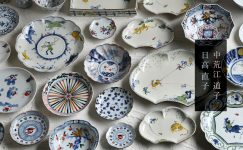
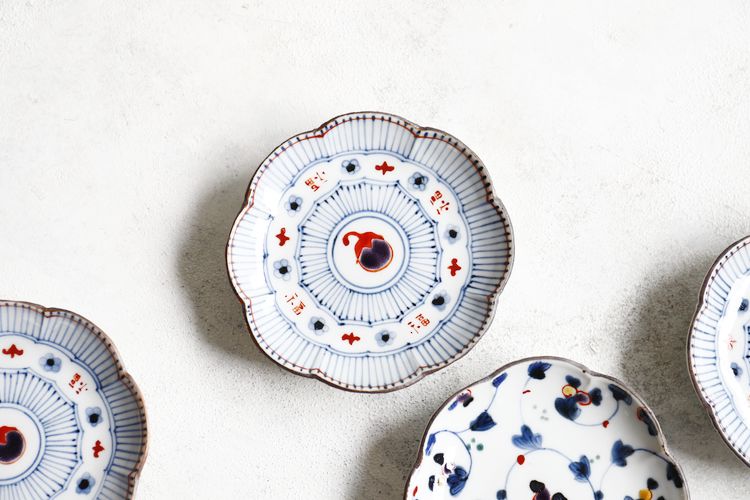
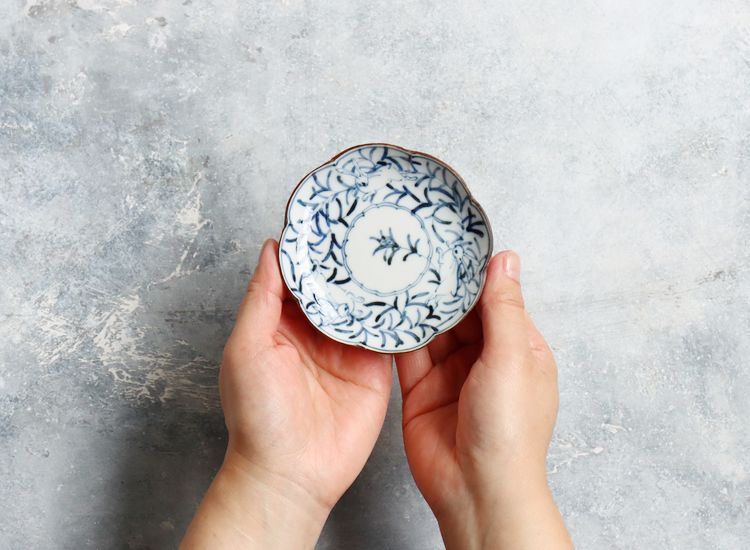
Michiko Nakaarae : It was the same fluted 9cm small dish with three rabbits that I still paint today. It featured arabesque patterns in underglaze blue.
Hanada: A lifelong companion, then.
Michiko Nakaarae : Yes (laughs).
Hanada: Eventually you became independent. What was it like when you left the studio?
Michiko Nakaarae : My master was actually the first one to say, “It’s about time.” That studio encourages apprentices to leave once they’ve grown enough, so hearing that made me feel I had finally earned some recognition. It made me genuinely happy. I became independent at the age of twenty-six.
Hanada: Once independent, you also had to source your own blanks.
Michiko Nakaarae : Sometimes I buy them from potters who specialize in making blanks, and sometimes I ask friends of former colleagues from my apprenticeship days.
One friend in particular really understands my tastes. The others do as well—they know exactly what I look for and make pieces with those points in mind, and I’m very grateful for that.
My name is on the finished work because I’m the one who does the final painting, but in reality it’s very much a collaborative effort.
What Brings Excitement
Hanada: What is most important to you when creating tableware?
Michiko Nakaarae : This is something my master often said as well: although I make pieces in batches, each one eventually goes to a different person. That’s why I never want the process to become an assembly line. I want to make every piece with care.
As for the actual design, I place great importance on how it looks when food is served on it. I want it to be something that lifts people’s spirits, whether they are using it or even washing it afterward.
Hanada: Customers often tell us, “Even washing a favorite piece is enjoyable.”
The Appeal of Dami Shading
Hanada: Your work includes both underglaze blue and overglaze enamels. The balance between playful and classical elements is excellent as well.
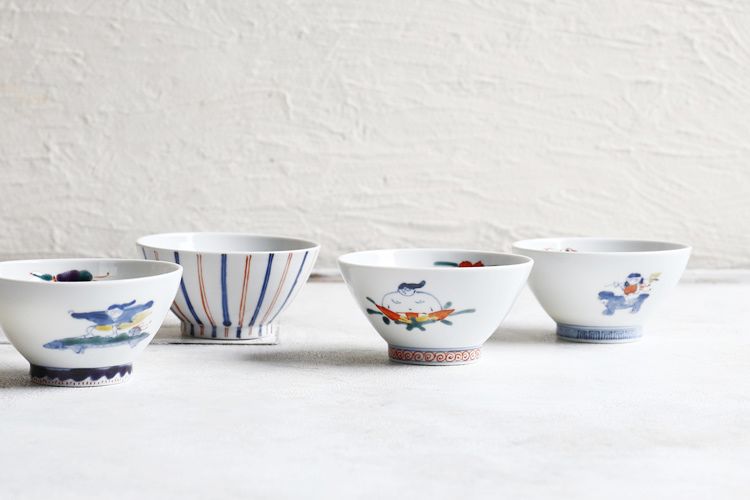
Michiko Nakaarae : Working in underglaze blue has a wonderful rhythm to it, and it’s enjoyable as a process. It allows me to express energy and movement. With overglaze enamels, I like to express a sense of playfulness. And since becoming a parent, I’ve found myself creating more whimsical and humorous motifs lately.
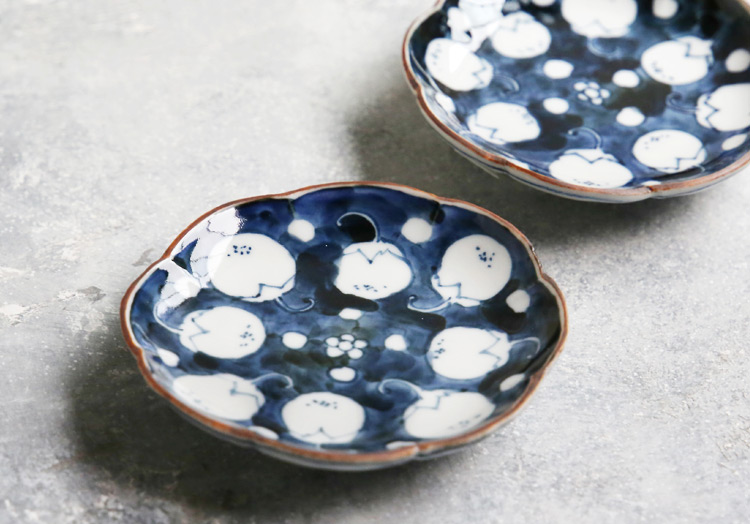
Hanada: Your dami shading is particularly appealing as well.
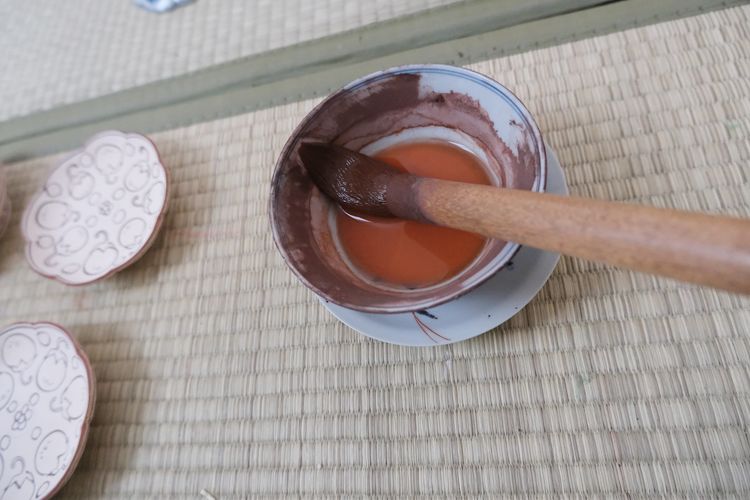
Michiko Nakaarae : During my apprenticeship, most of my time was spent doing line work. Dami was considered the most difficult technique, so I only had the opportunity to help with it occasionally.
I especially like jidami, where a broad wash is applied across the surface. Whenever I see it, I think, “Pieces with jidami really complement food beautifully.”
It’s actually quite difficult. If too much pigment pools, it turns black; if it’s too thin, that area becomes pale.
Even though there should be variations in tone, the overall effect still has to feel unified. In any case, you never truly know how it will turn out until it comes out of the kiln, so I try not to be afraid and load my brush generously with pigment.
Looking Ahead
Hanada: Is there anything you’d like to do in the future?
Michiko Nakaarae : Personally, I enjoy working by myself, but during the pandemic, being unable to meet people actually made me miss interacting with them.
I’ve started thinking that I’d like a place of my own where I can connect more directly with customers, and someday I’d love to open a small shop.
As for my work, I’d also like to try making larger pieces.
Hanada: What kind of pieces?
Michiko Nakaarae : Large jars or flower vessels, around 30 centimeters tall. I’d like to create them in underglaze blue with a contemporary feel.
Hanada: We look forward to your next exhibition.
Michiko Nakaarae : Of course I’ll continue making my standard pieces, but I’m also considering sake cups with an antique-inspired atmosphere made from different clay bodies, as well as starfish-shaped plates created from new molds.
Hanada: That sounds very exciting. Thank you very much.
≪ END ≫
始まりは漫画から
花田:中荒江さんは、どのようにしてうつわの世界に興味を持つようになったのですか。
(以下花田-)
中荒江:元々絵を描くのが好きで、ぼんやりとですが「絵を描く仕事をしたいな」と小学生の頃から思っていました。
-:どんな絵を描いていたのですか。
中荒江:漫画です。
一番好きなのは「ハンターハンター」。友達のお兄ちゃんに借りて夢中で読んでいました。
あとは、リボンなんかの少女漫画やギャグマンガ…。
-:ギャグマンガですか。楽しくていいですね。
中荒江:今でも描いています…。
-:本当ですか。それはどこかで見ることできるのでしょうか。
中荒江:ちょっと恥ずかしいのですが、インスタの「まるこめりん」という別アカウントです。
で、そろそろ進路を決なければならない頃「『絵を描く仕事』といっても色々あるからどうしよう」って思っていた時に、高校の職員室に置いてあった京都伝統工芸大学校のパンフレットが目に入ってきました。
そのパンフレットの陶芸科絵付コースの先輩の卒業作品写真を見て「こんなに細かく描けるようになるんだー」と思って目指したくなったのがきっかけです。
-:進学された伝統工芸大学校はいかがでしたか。
中荒江:同じものを好きな人が集まっているという状況が新鮮でした。
授業が全部好きなことだったので、毎日楽しかったです。
親方への感謝
-:卒業後はどうされたのですか?
中荒江:京都の抱山窯(当時)で1年ほど上絵を習いました。
予想していたより、仕事ができなかったのを覚えています。
当然ですが、学校と仕事では全く違いますね。
-:そして山本長左陶房へ。
中荒江:はい、4年ほど通っていました。
めちゃくちゃ厳しいというのは聞いていましたが、あそこを卒業された方々は皆さんとても上手くなっているので、ぜひそこで学びたいと思いました。
-:すんなり入門できたのですか。
中荒江:最初は「今年はもう枠無いよ」って言われていたのですが、京都から何度も何度も自分のデッサンをファックスして見てもらいました。
デッサンのために京都府立植物園にもよく行きました。
懐かしいですね。
-:熱意ですね。
中荒江:私は、ほとんど無理やり受け入れてもらえたんだと思います。
親方は情に厚い人で、今でも本当に感謝しています。
修羅場から表舞台へ
-:山本長左陶房での4年はいかがでしたか?
中荒江:最初は、よく叱られて、毎日泣きながら帰っていました(笑)。
私、最初は手がとても遅くて「そんなんじゃ仕事にならん」て。
横でストップウオッチ持って「はやくはやくはやく!」って…。
もう、手は震えるし、普段できることもできなくなってしまいます。
「丁寧に」は遅いことの言い訳にならないんですね。
あれがあって学生気分が完全に抜けました。
-:貴重な経験をされたのですね。
中荒江:私は問題児だったと思います(笑)。
「この仕事、自分に向いていると思うか」なんて迫られて、ほとんど泣きながら「分かりません」とかなんとか、取り敢えず答えた気がします。
-:修羅場ですね。
中荒江:もう何が何だか…(笑)。
でも半年くらい経ったら「山本長左と弟子たち展」というのがあって、親方は弟子たちの作品も出してくれるんです。
「私なんかが、出していいのかな」と思いながらも、自分のものを作りました。
そうしたら、すごく楽しいんです。
さらに、その展示会で出した作品を親方がほめてくれて…。
褒められたのはそれが初めてでしたが、それから変わってきた気がします。
-:まさに転換点ですね。
自分のものを作ることの楽しさも思い出すことができたわけです。
中荒江:自分のものといっても、学んだものを自分風にアレンジしたものなので、親方に学んだことは作品に出ていたと思います。
-:半年の鍛練を経て久しぶりに自分のものを作られた感触はどうでしたか。
中荒江:気づかないうちに多少は描けるようになっていたことに気が付きました。
まだまだではありましたけど。
-:出品したのはどのようなうつわだったのでしょうか。
中荒江:今でも描いている輪花の3寸豆皿でうさぎ3匹描いているものです。
染付で唐草が描いてあって。
-:もう一生の付き合いですね。
中荒江:はい(笑)。
-:いよいよ独立に向かうわけですが、辞めるときはどんな感じだったのですか?
中荒江:最初先生から「そろそろやな」って言われて。
あそこは成長したら出してくれるので、そう言われるということはちょっとは認めてもらえたようで、それは本当に嬉しかったです。
26歳の時に独立しました。
-:独立したら素地の調達もご自身でしなければなりません。
中荒江:素地師さんから買ったり、修行時代の同僚の友達に頼んだり…。
特にその友達は「私の趣味を分かってくれているな」って思います。
他の素地師さんもですけど、私のポイントを押さえて作ってくれているので、とてもありがたいです。
たまたま私が最後に絵付けをするので、私の名前の作品になってはいますが、実際はまさに共同作業です。
テンションが上がるもの
-:中荒江さんがうつわを作る上で大事にしていることは何ですか。
中荒江:親方も言っていたことですが、まとめて作りはしますが、一つ一つが違う人に渡るので、流れ作業にせず一つ一つを丁寧に作りたいと思っています。
実際のつくりに関しては「料理を盛って、どう見えるか」を大事にしています。
使う人が使っている時や洗っている時にテンションが上がるものです。
-:「好きな器は洗っていても楽しい」とよくお客様からも伺います。
濃の魅力
-:中荒江さんの仕事は染付と色絵です。
ポップなものとクラシックなもののバランスもとても良いですね。
中荒江:染付は作業としてもリズムよく楽しくて、勢いを表現できます。
色絵ではポップさを表現したいです。
あと、子供が生まれたこともあって、コミカルなのものが最近は増えました。
-:中荒江さんは濃(だみ)も魅力的です。
中荒江:修行時代はほとんど線描きで終わりました。
濃は一番難しいので、たまに手伝わせてもらっていた程度です。
地濃(じだみ)っていって全体的に濃を塗る感じが好きなんですけど「地濃のうつわってホントに料理に合うな」って思います。
あれ、結構難しくて、たまりすぎると黒くなるし、薄すぎるとそこだけ薄くなってしまう。
濃淡はあっても全体としてはまとまっていなくてはならないんです。
どちらにしても焼いてみないと出来は分からないので、恐れずたっぷり筆に絵具を含ませてやっています。
これからの話
-:これからしていきたいことはありますか。
中荒江:個人的には、一人で作業するのが好きなのですが、コロナ禍で、人に会えないと、逆に人恋しくなってきました。
自分でもお客さんと触れ合う場所が身近に欲しいなと思っていて、将来的には自分でちょっとした店でも出来ないかななんて思っています。
器に関しては、大きなものも作ってみたいなと思っていて。
-:どんなものですか。
中荒江:大きめの壺とか花器とかです、高さ30cmくらいの。現代風に染付で作りたいと思っています。
-:展示会、楽しみにしています。
中荒江:定番のものはもちろん、違う土を使って、アンティーク風の雰囲気を持ったぐい呑みや、新しい型で作るヒトデ型のお皿なんかも考えています。
-:それは楽しみです。よろしくお願いします。
関連記事はこちら