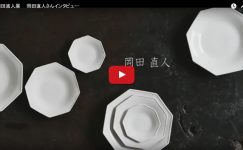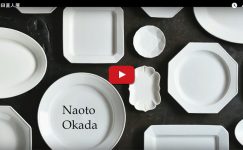




English version of the interview here.
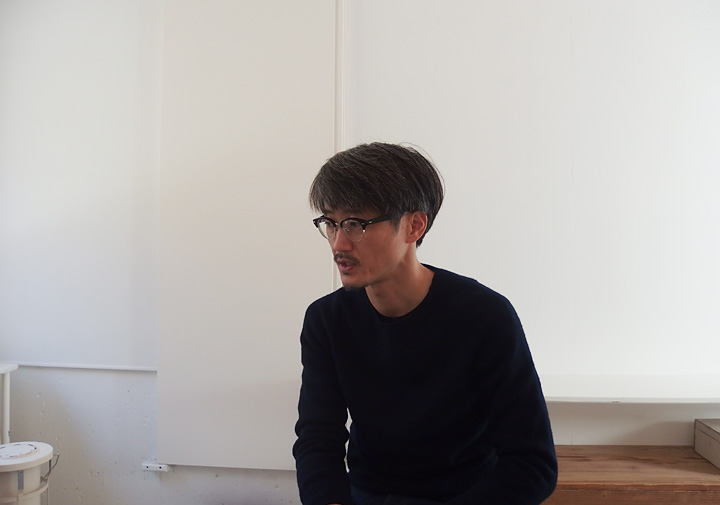
From Kutani Seiyo to His Own White.
Hanada: What led you to pursue ceramics, and specifically making tableware?
Naoto Okada : Ever since I was old enough to remember, I’ve been interested in making things of all kinds. My father worked in construction, and my mother was an expert with a sewing machine. I suppose that kind of home environment encouraged me as well. I wanted to go to art school, so throughout my teens I spent most of my time drawing, mainly practicing sketching for entrance exams.
Hanada: What kind of paintings did you like?
Naoto Okada : I liked Redon. He painted skies in pastel tones, using pale pinks and light blues. His paintings were beautiful, yet at times he would create extremely grotesque works as well. I was drawn to that contrast too, though personally I preferred the softer side of his work.
That’s why I initially studied illustration, but somehow it never quite felt right. Then I turned my attention to ceramics, and I felt a sense of history and tradition there.
And even on an individual level, it was something where technique and experience could steadily accumulate.
Hanada: Not long after that, you met Mr. Hata of Kutani Seiyo (founder of Kutani Seiyo).
Naoto Okada : Back then, I was pretty arrogant. I told him, “If I can’t start working on the wheel right away, I’m not interested.” And Mr. Hata just said, “Sure, go ahead.”
Honestly, he’s probably the only person who would have accepted me like that. Afterward, he took me to a sushi restaurant… and the firefly squid I had there was unbelievably good…
That became part of the deciding factor too (laughs). Fish from the Sea of Japan really is different.
I remember being struck by the thought that there was no way I could compete, through making tableware, with people who ate food this delicious as a matter of course.
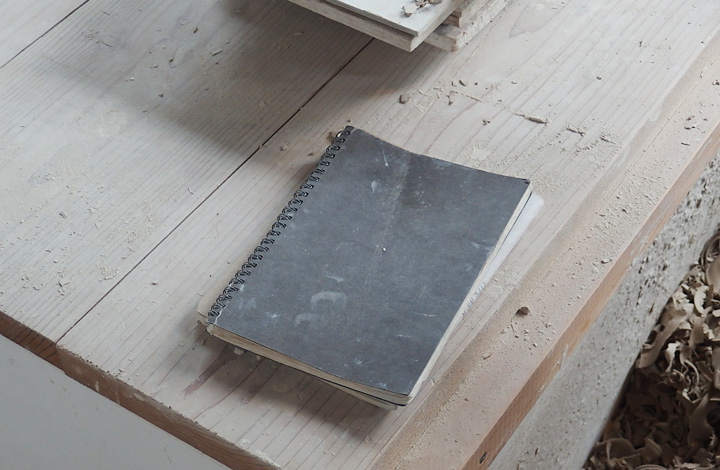
Hanada: And then you spent about ten years at Kutani Seiyo.
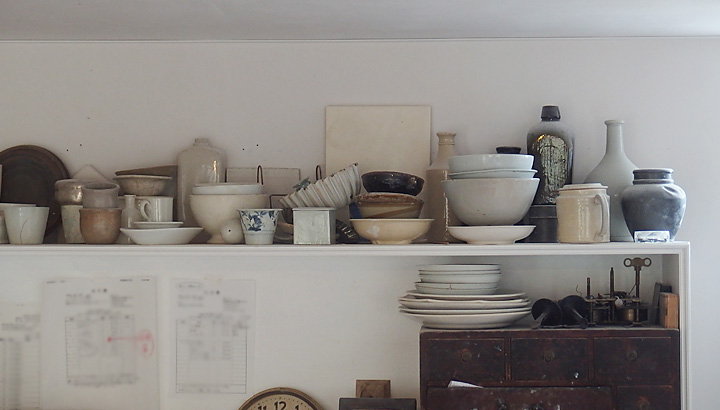
Naoto Okada : I truly learned an enormous amount there. Above all, I’m glad I was given work where I had to steadily produce large quantities. In the process of making so many pieces, I tried to erase as much self-expression as possible—it’s difficult to explain—but from that emerged what I’d call the “scent” of production work. I’m genuinely grateful that I was able to understand that.
Hanada: The “scent” of production work… do you mean something like the natural ease that develops the more you make? It feels as though the atmosphere of the workshop itself becomes part of it too.
Naoto Okada : Yes, exactly. The “scent” of production work is something you notice after making the same thing over and over—when you look closely, it begins to feel as though it carries a certain presence. Even when making something plain, that quality is still there. I really love that sensation.
Hanada: At Seiyo, there also wasn’t an excessive obsession with materials.
Naoto Okada : That’s true. And I don’t think bringing out atmosphere through materials themselves was what Mr. Hata aimed for. I think he believed that should come from the maker’s work, not the materials.
So things like mixing iron powder into the clay, changing the firing method, or giving the surface a slightly matte finish… I think Mr. Hata would probably dislike that sort of thing (laughs).
And honestly, he has a point. Once makers start embedding their own intentions into the materials, there’s no end to it. The aspect of the piece as a tool quietly disappears.
If you’re someone working on everyday tableware, the question becomes whether you should really go in that direction. Those elements are things you need to strip away.
When viewed that way, the work done at Kutani Seiyo is extremely interesting. Everything there—from the choice of materials to the methods used—is incredibly simple.
At the time, there were aspects of it that felt somewhat bland to me, but by placing myself in that environment, I feel I came to understand both the world without scent and the world with scent. Now, I feel as though I’m somewhere right in between the two.
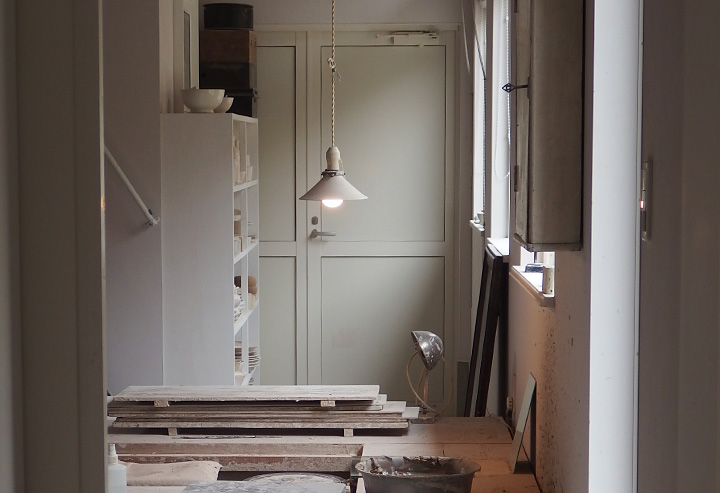
Hanada: With tableware, there’s the place where it’s made, the place where it’s chosen, and the place where it’s used. Both you and Mr. Hata place importance on the place where it’s used.
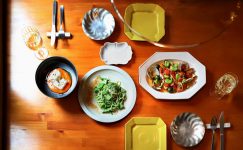
When creating tableware, I imagine the process begins with a vision—this lifestyle, this home, this dining table, this kind of food… and then thinking, “This kind of piece would create a nice atmosphere here,” while selecting from your own skills and knowledge as you work.
And another thing I notice when looking at your work is that you don’t seem overly attached to your past work. You keep moving forward.
Naoto Okada : I don’t really look back at the past very much. That’s thanks to Seiyo. I can only speak from my own experience there, but the people at Seiyo had enough technical skill that they didn’t need to cling to technique itself. They could discard things freely and create something new whenever they wanted.
I don’t think I’m quite at that level, but I became accustomed to that attitude. I was allowed to do an incredible amount of production work there. At the time, it didn’t fully resonate with me, but after becoming independent, I strongly felt the benefits of that experience.
The Scent of the Maker
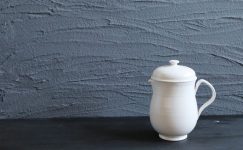
Hanada: Since becoming independent, your work has largely been based on European influences, hasn’t it? What is it about Delftware in particular that appeals to you?
Naoto Okada : Of course I love Delftware itself, but I’m also drawn to the background behind it. During the Delft period, Europe was first influenced by Chinese ceramics, and apparently it marked the very first stage in Europeans searching for their own tableware.
So in that sense, it feels close in spirit to the Japanese approach to making tableware.
It exists right at the threshold before becoming a full-fledged industrial product. And in terms of function, modern food culture has become increasingly Westernized, so it’s also a style that pairs easily with contemporary cuisine.
That said, I personally don’t think too much in terms of “Japanese” or “Western.” I like both. If something works well, I like it regardless.
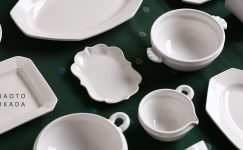
Hanada: You’ve also recreated pieces inspired not only by European works, but by old Imari incense burners and Seto pouring vessels as well. You really like old things, don’t you? Not just ceramics either—looking around your studio, you’ve collected all kinds of objects.
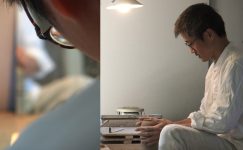
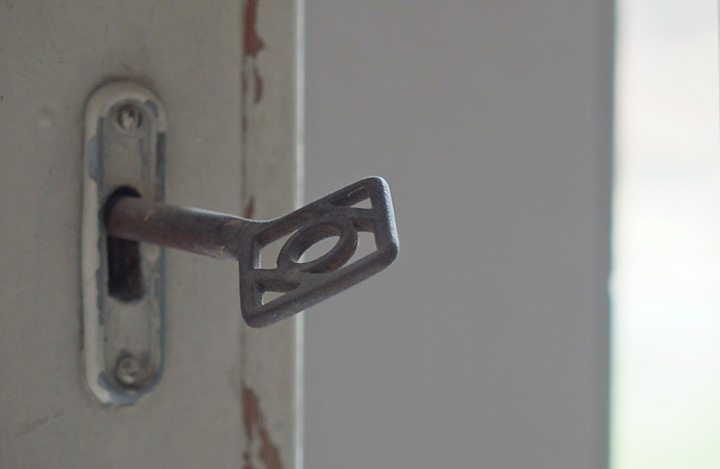
Naoto Okada : I’ve been like that since I was little. I’ve always liked rusted things, and I used to pick them up all the time. And stones too. I love stones like the ones here, and I still go to the beach to collect them. Stones are beautiful even though they haven’t been shaped by human hands. Even with things made by people, I’m drawn to objects where the “scent” of the maker has disappeared.
Maybe I have a stronger-than-average resistance to anything that feels overly self-conscious or artist-driven. After all, my own work involves artificially adding a certain “scent” to clay, so perhaps collecting stones is also a way of erasing that scent.
Hanada: Does that serve as a kind of support for your work?
Naoto Okada : I think it helps me look at my work more purely. Ishikawa Prefecture has a lot of beautiful stones, you know.
Creating with a Flat State of Mind
Hanada: Is there anything you consider especially important in your work?
Naoto Okada : Not becoming attached to things. And keeping both my mind and body in a flat state.
Hanada: What do you mean by “flat”?
Naoto Okada : When you become ill, both your mind and body become unbalanced, don’t they? So I make an effort, even forcefully at times, to return myself to a flat state. Only then can I properly engage in making things. While living in that balanced state—experiencing hardship, enjoyment, sadness, and everything else— I simply want to create from within that condition.
Hanada: It’s different from being neutral or emotionless. More like a balancing toy that sways in different directions but never loses its center point.
Naoto Okada : If you live an extreme lifestyle, then what you make will probably become extreme as well. I think things created while living in a flat, balanced way are naturally best suited for everyday use.
Hanada: Lately, I feel your work has become softer.
Naoto Okada : I think that, especially when I first became independent, I was probably quite unbalanced. At the beginning, I felt I had to work desperately hard, so unconsciously I was trying to sharpen things, to emphasize edges.
Hanada: At times like that, there’s also the reality that if you don’t sharpen those edges, people won’t notice your work.
Naoto Okada : Looking back on that period, as you says, I liked things with a certain sharp tension. Now, I try not to force too much onto the tableware itself.
Hanada: Do you have any thoughts about the future?
Naoto Okada : You can’t change your future through sheer force alone, so I’ll continue giving one hundred percent to what’s right in front of me. I want to keep improving the quality of what I’m making now.
Hanada: What does “quality” mean to you?
Naoto Okada : I think it’s about creating something and seeing how many people can genuinely accept it and use it with satisfaction. That’s the kind of world this is.
And for that reason, I want to raise the level of completion in each piece—its value as a functional object. For example, the overall body balance of a piece when you hold it in your hands. That’s something you sense in the work of skilled potters from the past as well. A certain flatness in the wheel work.
Hanada: That feeling where it’s not simply light, nor heavily weighted at the bottom, but somehow grounded and stable.
Naoto Okada : Exactly. That feeling between the wheel and the material itself. Japanese people use things while holding them in their hands, so how a piece feels to hold and its body balance are important.
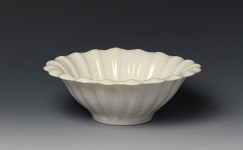
It’s a comprehensive balance involving how much clay is trimmed after throwing, how much thickness is left at the rim, and how much strength is necessary for it to function properly as a tool. Even with something like a café au lait bowl, the atmosphere changes dramatically depending on that body balance.
Hanada: Even if the appearance doesn’t change, it’s about what exists inside the object itself.
Naoto Okada : I think that’s the essential part of it.
Hanada: When creating something new, what is your process like?
Naoto Okada : I think comprehensively about whether it looks beautiful when food is served in it, whether it’s easy to plate with, and how versatile it is. Then I create from there.
Hanada: Well then, we’re looking forward to your upcoming two-person exhibition with Akinobu Ito.
Naoto Okada : Yes. I want to improve the quality of basic pieces, while also giving them a sense of playfulness. It’ll also be my first time exhibiting together with Mr. Ito, so I’m looking forward to it.
Hanada: I think your work pairs very well together. Thank you very much.
≪ END ≫
九谷青窯から自分の白へ。
花田: 岡田さんが陶芸、それもうつわ作りを志すことになったのは?(以下 花田-)
岡田: 物心ついたときから、作ることすべてに興味がありました。
父親は建築業であったし、母親はミシンの達人でした。
そういう家庭環境も後押ししてくれたのでしょう。
で、美大志望だったので、入試準備の為に、10代はデッサンを中心に絵ばかり描いていました。
-: どんな絵が好きだったのですか?
岡田: ルドンが好きでした。パステル調で空を描く人で、淡いピンクや水色で描くんです。
きれいな絵を描くんですけど、極端にグロテスクな絵を描いたりする。
そのコントラストにも惹かれるんですが、僕は淡いのが好きです。
そういうわけで、最初、イラストの勉強していたんですけど、どうもしっくりこなくて。
で、焼き物に目を向けてみると、歴史や伝統といったものを感じるし、
個人レベルでも技術や経験の積み重ねが出来る。
-: しばらくして、九谷青窯の秦さん(九谷青窯主宰)に出会う。
岡田: 当時の僕、生意気だったんです。
「最初からロクロさせてもらえなきゃ嫌です」って言ったんです。
そうしたら秦さん「いいよ、やれよ」って。
そんな風に受け入れてくれるの秦さんくらいですよ。
そのあと、寿司屋さんに連れて行ってくれて・・・その時食べたほたるいかが美味しすぎて・・・
それも決め手になりました(笑)。日本海の魚は違いますね。
こんな美味しいものを当たり前のように食べている人に、食器づくりで敵うわけないな、って
衝撃受けました。
-: そして九谷青窯におよそ10年。
岡田: 本当に沢山のことを学びました。
中でも、淡々と数をこなしていく仕事をさせてもらったのは良かった。
数作る中で自己表現をできるだけ消していって―うまく説明できないんですが―その中から
生まれてくる数仕事の匂いっていうんですかね。
これを知ることが出来たのは本当に感謝しています。
-: 数仕事の匂い・・・どんどん作っていくうちに出てくる、手馴れ感のようなものですか。
その作っている場の空気も含まれる気がします。
岡田: そうですね。数仕事の匂いって、ずっと同じもの作っていって、よくよく見ると匂いが
あるような感じ。プレーンなものを作っていても、それはあります。
あの感覚が僕は大好きで。
-: 青窯は材料にも過度にこだわることはしません。
岡田: そうですね。
あと、材料どうこうで趣を出すのは、秦さんの目指すところではないんだと思います。
それは材料ではなく作家の仕事である、と考えているんだと思います。
だから、土に鉄粉混ぜるとか、焼き方変えるとか、ちょっとマットにするとかっていうのは、
秦さん嫌がるだろうなあ(笑)。
確かに一理あって、作家が自分の意思を材料に詰め込み始めるときりがないんですよ。
道具の部分というのがスーッと消えていってしまう。
普段使いの食器に取り組む人間がそっち行っていいのかっていうと、
それらは外していかなければいけないんです。
九谷青窯の仕事っていうのは、そういう見方をしていくと非常に面白い。
あそこは素材選びにしても、やり方にしてもとにかくシンプル。
当時、僕には味気なく感じる部分でもあったのですが、そこに身を置いたことで、
無臭の世界と匂いのする世界をそれぞれ分かった気がして、よかったです。
今、ちょうど中間にいるような感じです。
-: うつわには、作る場所、選ぶ場所、使う場所があって、
岡田さんも秦さんも、使う場所を大切にしています。
うつわを作っていく手順も、この生活様式で、この住宅で、この食卓で、この料理で・・・
こういううつわなら・・・いい雰囲気が出そうだなっていうヴィジョンを持って、
自分の持っているスキルや知識を選択しながら、作業に入っていくのかなって思います。
あと、岡田さんの仕事見ていて思うのは、あまりご自身の過去の仕事にこだわりませんよね。
どんどん、前に進んでいく。
岡田: 僕、あまり過去は見ないです。それは青窯のおかげです。
自分がいた時の話しかできませんが、青窯のみなさんは、技術に執着しないだけの技術を持っ
ているんです。スコンスコン捨てて、新しいものを作ろうと思えば作れるんです。
僕はそこまでではないと思いますが、そういう姿勢に慣れてしまいました。
そこまで数の仕事をさせてもらえる。
いる時はしっくり来ていなかったんですが、独立後、その恩恵をヒシヒシと感じました。
作り手の匂い
-: 独立後、岡田さんの仕事は、通じて主にヨーロッパのものをベースにしていますよね。
特にデルフトの焼き物の魅力とは、岡田さんにとってどのようなものなのですか。
岡田: デルフトそのものを勿論好きですし、その背景にも僕は惹かれています。
このデルフトの時代って言うのは、まず中国の焼き物にヨーロッパが影響を受けて、
ヨーロッパ人がテーブルウエアを模索した洋食器の第一号だったらしいんです。
だから日本人の食器作りとニュアンスが近い。
プロダクトになる前のギリギリのポイントなんです。
また、用途で言えば、現在の食文化は欧米化していますし、料理が合いやすいスタイルである
ともいえる。ただ、僕自身、洋とか和とかっていうのはそんなに気にしていないんですよ。
和も好きだし、洋も好き。使えるものならなんでも好き。
-: ヨーロッパのものだけでなく、古伊万里の香炉や瀬戸の注器も模してもらいましたものね。岡田さん、古いものも、好きですよね。焼き物だけじゃなく、アトリエ見ていても、
色々なものを集められている。
岡田: 小さい頃からです。錆びたものが好きで、よく拾っていました。
あと、石。ここにあるようなこういう石が大好きで、いまだに海行って拾っています。
石って、人間の手が加わっていないけど、キレイですよね。
僕は人が作ったものでも、その人が作ったという匂いが消えているものが好きなんです。
作家臭みたいなものには人一倍抵抗があるのかもしれません。
自分は土に人口的に匂いをつける作業をしているわけで、
石を拾うのは、その匂いを消す作業でもあるのかなって言う風に考えています。
-: 仕事に対する支えになっているのでしょうか。
岡田: 自分の仕事を純粋に見られるようになる気がします。
石川県ってきれいな石が多いんですよ。
フラットな感覚でつくる
-: さて、岡田さんが仕事をする上で大切にされていること、ありますか?
岡田: モノに執着しないこと。そして、心も体もフラットでいることです。
-: フラットとは?
岡田: 病気になるとどちらも偏るじゃないですか。
無理にでもフラットな状態にもっていく努力をする。
その上で、ものづくりに取り組める。
フラットな状態で生活をする中で、苦しんだり楽しんだり、悲しんだりもしながら、
その状態でモノを作りたいだけなんです。
-: ニュートラルとも、無感情とも違います。色々ある中で、揺れながらも支点がずれない
ヤジロベイのように。
岡田: 極端な生活をしていると、多分極端なものになってしまう。
フラットに生活をしている中で出来あがるものが普通に使う分にはちょうどいいのではない
でしょうか。
-: 岡田さんの仕事、最近、柔らかくなってきているなって思うんです。
岡田: それこそ、独立した当時って、偏っていたんだと思います。
独立当初は一生懸命やらないといけないから、無意識のうちに角立てる、エッジ立てるって
ことをしていたんだと思います。
-: そういう時期には角立てないと、見てもらえないという部分もありますからね。
岡田: あの時代を思えば、松井さんが言うように、ピリッとしたものが好きでした。
今は、うつわに無理をさせないように、と考えています。
-: 今後について何か考えていらっしゃいますか。
岡田: 力ずくで自分の未来変えられるわけじゃないんで、目の前のことに100%努力して
いきます。目の前にあるもののクオリティーを上げ続けていきたいなって。
-: 岡田さんの言うクオリティーとは?
岡田: ひとつのものを作って、どれだけの方々がそれに対して納得して使ってくれるか、
そういう世界なのかなと思っています。そのためにも、ものの完成度といいますか、
道具としての価値を高めていく。
例えば、手に取ったときのうつわ全体のボディーバランスですかね。
昔のロクロの上手い人の焼き物ってみんなそんな感じなんですよね。ロクロのフラット感。
-: ただ軽いわけでもなく、重心が下に来ていてどっしりくるってわけでもないあの感じ。
岡田: えぇ、ろくろと素材のその感じ。
日本人は手にとって使うので、手取りやボディーバランスは大事です。
それは轆轤でひいてどれだけ削るかとか、縁にどれだけ厚みを持たせるか、
道具として成り立たせるために、どれ位強度を上げなきゃいけないのか、っていう
総合的なもので、バランス感みたいなもの。
例えばカフェオレボウルでもそのボディーバランスで大きくその雰囲気は変わってくる。
-: 見た目は変わらなくても、持っているものの中身ですよね。
岡田: 本質の部分なんだと思います。
-: 新たなものを作るとき、岡田さんの場合どんな風ですか。
岡田: 盛って美しいかどうか、そして盛りやすいか、あと多用性。それらを総合的に考えて、作ります。
-: さて、今度の伊藤聡信さんとの二人展、宜しくお願いします。
岡田: はい。ベーシックなもののクオリティーを上げていきたいし、
遊びも持たせたいとも思っています。
伊藤さんとも一緒になるのは初めてなので、楽しみです。
-: 相性、いいと思います。宜しくお願いします。
関連記事はこちら