




English version of the interview here.
Wanting to Make Things That Catch My Eye
Hanada: Did growing up with your family running a ceramics factory play a part in bringing you to this career?
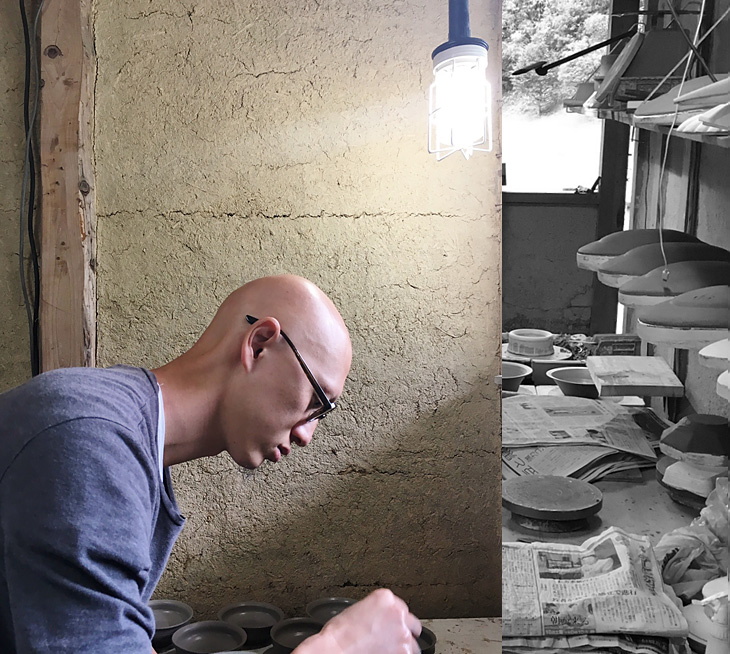
Takuji Hayashi : I am sure it is connected in some way. But for as long as I can remember, I have just loved making things. Whenever I look at everyday objects or see something and think, “That’s nice,” I instantly want to try making it myself.
Hanada: Is that so? (laughs) What kind of things did you make?
Takuji Hayashi : At one point, I used to make silver accessories. Also, during my university years, I loved fishing, so I would carve wood to make my own lures. I could make them in just about any shape.
Hanada: Did you just teach yourself by observing others?
Takuji Hayashi : I started by modifying existing lures. But you know… in the end, you never catch any fish with something you have messed around with yourself. (laughs)
Hanada: (laughs) That is a common story, isn’t it?
Takuji Hayashi : If you overthink and over-modify it, it just doesn’t work. Even so, it made me happy when I occasionally caught something, so I kept experimenting. Come to think of it, I also did glassblowing for a while.
Hanada: Did you study pottery at school?
Takuji Hayashi : My major at university was chemistry.
Hanada: That is surprising.
Takuji Hayashi : I actually wanted to study design. I was interested in product design and applied to schools for that, but my cram school counselor sent out an application for chemistry without telling me. Apparently, they made the decision based on my grades. Chemistry wasn’t what I wanted at all. (laughs)
Hanada: Your grades in chemistry must have been very good.
Takuji Hayashi : No, not at all, it was just that my other subjects were terrible. (laughs) Chemistry was the only thing I had going for me. (laughs)
Hanada: How did you find studying chemistry?
Takuji Hayashi : I didn’t mind it too much, but I was such an unpromising student back then. I had no real interest in it—it was more like, as long as I get the credits, that’s fine. I just wanted to avoid being a burden to my parents. I think that was pretty typical for university students in our generation.
Hanada: Yet, you still found your way into making tableware.
Takuji Hayashi : University ended like that, and after graduating, I sold clothes, worked at a fishing tackle shop… I just couldn’t make up my mind to take over the family business. Since I was a child, there was an unwritten expectation that I would take over as the fourth generation. Maybe I was rebelling against that a bit. But eventually, after some time, I started attending pottery classes while keeping the family business in mind. I had helped out at home, so I knew how to do slip casting, but that was the first time I ever touched a pottery wheel.
Hanada: So you were torn between the family company and living as a ceramic artist.
Takuji Hayashi : I was torn between mass-production ceramics and handcrafted pottery. I would think about these things while going to pottery classes and making a living at the fishing tackle shop. I used to ponder it while out fishing. The heritage passed down through generations, what had been given to me, the state of the world—all these things were spinning around in my head.
Hanada: That sounds like a difficult dilemma. You saw your grandfather and father working desperately to protect the family business, and you understood the appeal of that work. At the same time, you wanted to create things and live as an individual maker. And now, instead of working at a mass-production factory in Seto, you are living as an independent artist.
Takuji Hayashi : You could say that I am who I am today because of that period. It was an important time for me. I worked at Hayashi Ceramics for a year, and then spent a year each studying at the ceramics research institute and the Seto ceramics training school. Today, I feel like I am carrying on the family legacy, just in a different form. I believe both mass-production factories and studio pottery have their own place. However, Hayashi Ceramics was moving away from tableware towards making clay pots and water filtration equipment, whereas I really wanted to keep making tableware.
Hanada: So studio pottery was the choice that allowed you to keep making tableware. Even so, surely there are instincts you developed while helping with the family business as a child?
Takuji Hayashi : Yes, now I can understand what my father was doing back then, realizing, “Ah, so that’s why he did it that way.”
Hanada: Is there anything you particularly treasure when making tableware?
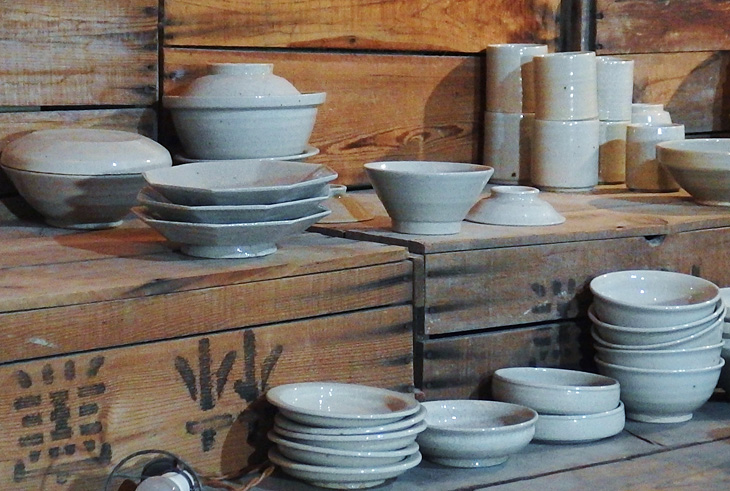
Takuji Hayashi : While usability is an absolute prerequisite, what I personally pay the closest attention to is the form.
Hanada: What kind of form do you strive for?
Takuji Hayashi : In a single word, a “crisp” form. People use various expressions like sharp or soft, but in my case, I want it to feel crisp.
Hanada: I felt a certain “refreshing clarity” from them. Is that a different sensation?
Takuji Hayashi : By “crisp,” I mean I want to give people a feeling of, “I haven’t really seen this kind of shape before,” through subtle variations. Something that leaves an instant impression… like, there is something delightfully unique about it. Something that feels traditional, yet somehow modern. That applies to the glazes too.
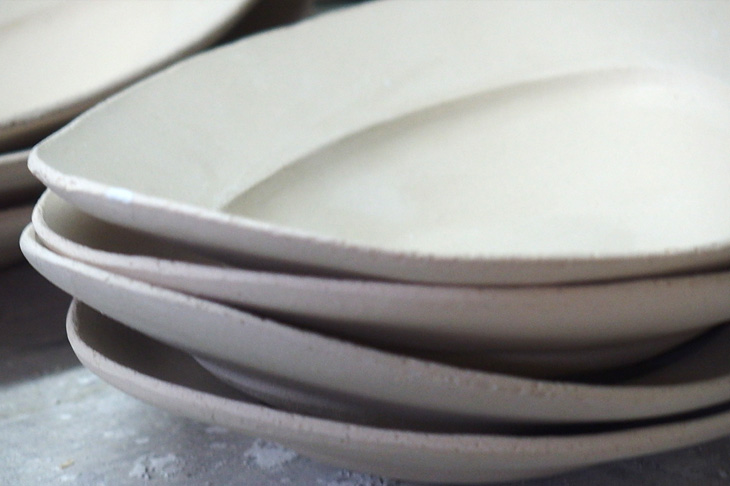
Hanada: Would you say your signature work is indeed that oval plate?
Takuji Hayashi : I was truly happy myself when the oval plate first came together.
Hanada: How long have you been making it?
Takuji Hayashi : This year marks its 10th anniversary.
Hanada: The 10th anniversary of the oval plate!
Takuji Hayashi : At first, it was a bit flatter. I made it with a glaze that had a metallic feel, but I wasn’t fully satisfied with it. When I placed it at the edge of my stall at the Seto Ceramic Festival, someone came by and told me, “This is wonderful.” I was so happy to hear that. From there, I kept refining it. Rather than pursuing a specific function, the oval plate came from a shape I created that just clicked with me.
Hanada: Are there any pieces by other makers that you like?
Takuji Hayashi : I am interested in historical work from Seto. I like Ishizara (traditional sturdy pottery plates) and Ofukei ware. I particularly love the unique form of Ishizara plates.
Hanada: What would be a dream piece for you to create?
Takuji Hayashi : I love the color of celadon from the Southern Song Dynasty. I simply think it is a beautiful color. However, how I will translate that into my own forms is something to explore in the future.
Hanada: You have finally finished moving. What kind of work do you want to focus on going forward?
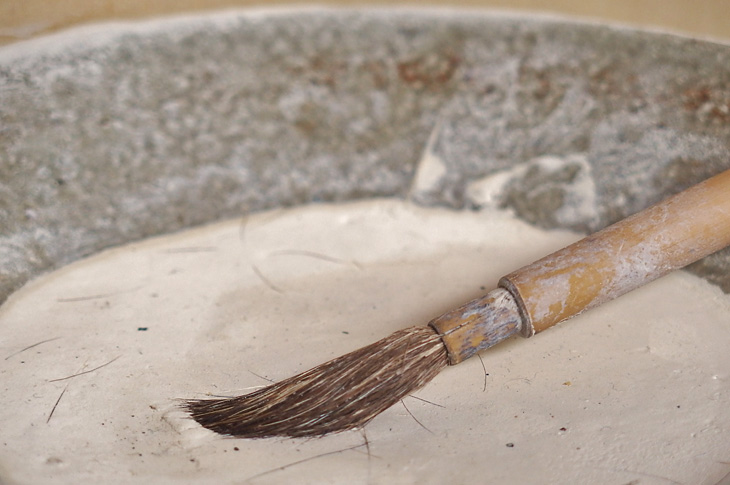
Takuji Hayashi : It is a place where hardly anyone comes, so I should be able to focus entirely on my work. Oh, right—while digging around the mountain behind my studio, I found clay. It is just a simple red clay with a lot of grit, but I am planning to test it out. Also, I am currently so overwhelmed with work that I don’t have time to think about new designs, so I want to carve out time for that as well.
Hanada: We look forward to your joint exhibition with Arata and Atsuko Anzai in October.
Takuji Hayashi : Thank you. It is my first time at Hanada, and also my first time exhibiting with Arata and Atsuko Anzai. I have known them for a while, and I really like their work; I even use their cup and saucer set at home. I am very much looking forward to it.
≪ END ≫
いいな、と思うものを自分で作りたくなる
花田: ご実家が元々窯業会社であったことも、現在の仕事に至った理由のひとつなのでしょうか。(以下 花田-)
林: 関係ないことはないと思います。ただ、気が付いた時にはモノを作ることが好きでした。
身の回りのものや、いいなって思うものを見ると、自分で作りたくなってしまうんですよ。
-: そうなんですね(笑)。何を作っていたのですか。
林: シルバーアクセサリーを作っていたこともあります。
あと、大学時代、釣りが好きだったので、釣りの道具、木を削って自分でルアーを作っていました。どんなかたちでも作れましたよ。
-: 見よう見まねで?
林: 最初はルアーの改造から始めました。
でもね・・・結局、自分でいじったものって魚釣れないんですよ(笑)。
-: (笑)ありがちな話ですね。
林: いじり過ぎちゃうとダメなんです。
それでもたまに釣れるのがうれしくて、色々いじっていました。吹きガラスも一時期やっていたな、そういえば。
-: 学校では焼き物の勉強をしていたのですか?
林: 大学の専攻は化学です。
-: 意外です。
林: 本当はデザインの勉強をしたかったんです。
プロダクトデザインにも興味があり、そういうところを受験していたのですが、予備校のカウンセラーの方が、僕に黙って願書を送っていたんですよ。
僕の成績を見て判断したらしいんです。化学は僕の希望ではないのに(笑)。
-: 化学の成績が良かったのでしょう。
林: いえいえ、他がひどすぎたんですよ(笑)。化学くらいしかとりえがなかった(笑)。
-: 化学の勉強はどうでしたか。
林: そんなに抵抗はありませんでしたが、とにかく僕はできない子どもだったので、なんの興味もないというか・・・単位とれればいいかなくらいの話しですよ。
親に迷惑をかけなければいいかなと。僕らの頃の大学生ってそんなものじゃないですかね。
-: それでもうつわ作りの道に進んでいく。
林: 大学はそんな感じで終わりまして、卒業後は服の販売をしたり、釣具屋さんで働いたり・・・家業を継ぐ覚悟も決まらないままいました。
小さい頃から4代目の僕が継いでいくというのはなんとなく決まっているような雰囲気だったんです。
それに対する反発心もあったのかなあ・・・でも、結局しばらくして、家業を継ぐことも考えながら陶芸教室に通うようになるんです。
家の手伝いをしていたので鋳込みの仕事は出来たんですが、ロクロを触ったのはその時が初めてでした。
-: 家業の会社なのか、陶芸家として生きていくのか、ですね。
林: 僕の中では大量生産窯業と手作り陶芸の間で、揺れていました。釣具屋の仕事で生活しながら、陶芸教室に通っている中でね。
その頃、釣りなんかをしながら、そういうこと考えるんですよ。
代々引き継いできたもの、自分に与えられているもの、社会の情勢、いろいろな事がグルグルと頭を巡る。
-: 悩ましいですね。
おじいさんやお父様が家業を必死に守っている姿も見ていて、またその仕事の魅力も分かっている。
でも自分個人で物を作って生きたい気持ちもある。
そして、今は瀬戸の窯業工場ではなく、一人の作家として生きているわけですね。
林: あの時期があったから、今があるとも言えるんです。僕にとっては大事な時間でした。
林窯業としても一年間は働いて、そのあと窯業試験場と瀬戸窯業訓練校で1年づつ勉強しました。現在は、かたちを変えて引き継いでいる気持ちでいます。
窯業、陶芸の両方にそれぞれの在り方があるんだと思います。
ただ、林窯業は土鍋であったり、水をろ過するものを作っていたり、食器ではない方向に移っていたのですが、僕は食器を作っていたかったということもある。
-: 食器を作り続けられる上での選択肢が陶芸だったと。
それでも、小さい頃家業を手伝う中で身に付けられた感覚もあるのではないでしょうか。
林: あの時こうしていたのはこういうことだったのか、と親父がやっていたことにも説明がつくようになりました。
-: うつわ作りで大切にしていることはなにかありますか。
林: 使えることが大前提ですが、自分が気を使っているのはかたちです。
-: 林さんが目指す形とは、どのようなものなのでしょうか。
林: 一言で言うと、パキッとしたかたちです。
シャープにとか、柔らかくとか色々な表現があると思うんですが、僕の場合は「パキッ」としたいんです。
-: 僕は「カラッ」としたものを感じました。これまた違う感覚ですかね。
林: パキッていうのは、少しの変化で「あまりこういう形見たことないぞ」っていう気持ちを与えたいんです。
一瞬で印象に残るような・・・なんかちょっと違うぞ、みたいな。
昔っぽいけど、なんか今っぽいな、みたいな。釉薬も含めて。
-: 林さんの仕事を象徴するものは、やはりあの楕円皿でしょうか。
林: 楕円皿は、最初できたとき、自分でもうれしかったです。
-: いつごろから作っていますか。
林: 今年で10年目になります。
-: 楕円皿10周年ですね!
林: 初めは、もう少し平たかったんです。
それも金属的なイメージの釉薬で作ったんですが満足いかずに、瀬戸物祭りで端のほうに置いておいたら、ある方が「すごくいい」って言ってくれて。
うれしかったです、いわれた時は。それを改良していったんです。楕円皿は用途を追求していったというよりは、作り上げたカタチにピンと来ました。
-: 自分以外のもので林さんの好きなうつわはなにかありますか。
林: 瀬戸の昔の仕事は興味があります。石皿、御深井が好きです。
特に石皿のあのカタチが、なんか好きなんですよね。
-: 林さんにとっての夢のうつわって?
林: 南宋の青磁のあの色が好きなんです。、いい色だなー、って単純に思います。
ただ、自分ならどのような形にしていくだろう、というのはこれからですね。
-: ついに引越しも完了。これからしていきたい仕事はどのようなことなのでしょうか。
林: 人がほとんど来ない場所なので、仕事に集中できそうです。
そうそう、裏山を掘っていたら、粘土が出てきたんです。砂利分の多い、単純な赤土なんですが、試してみようと思っています。
あと、今は仕事に追われすぎていて、新作を考える時間も無いので、そういう時間も作っていきたいと思います。
-: さて、10月の安齋さんとの展示会、宜しくお願いします。
林: はい。花田では初めてだし、安齋さんとも初めてなんですが、もともと知っていたし、安齋さんのうつわを好きで、カップ&ソーサーも使わせてもらっています。それなので楽しみです。
関連記事はこちら