



English version of the interview here.
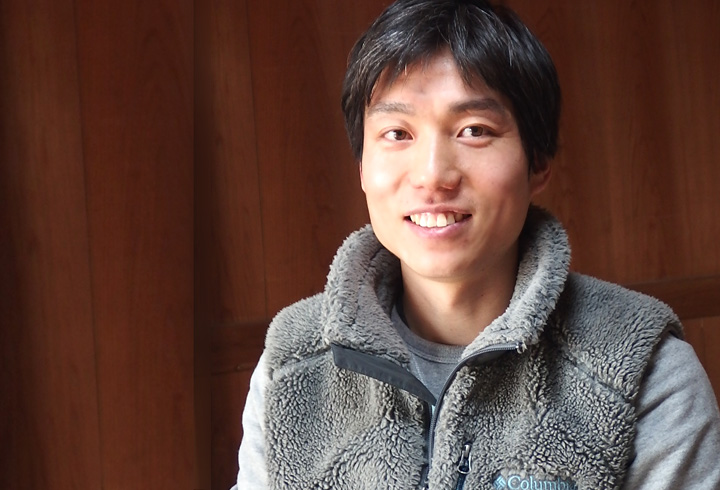
Born and Raised in a Potter’s Family
Hanada: Your father also works in ceramics. When you were small, you must have had many chances to watch him work.
Haruya Abe: I often helped out from elementary school.
Well, “helped” might not be the right word—it was more like I was made to help (laughs). Mostly chores.
Ceramics involves a lot of small tasks in between the actual work. It didn’t feel like “creating things!” so I didn’t find it fun at all. Back then, Saturdays were half-days, right?
Just as I was about to go out and play, they’d say “help out” (laughs).
Hanada: Were your older brothers involved too?
Haruya Abe: We were in it together—fatefully (laughs). All four of us brothers disliked it.
The eldest seemed willing to inherit the family business when he was young, so maybe it wasn’t as bad for him.
Hanada: Now, you’re the only one in the family working in ceramics, right?
Haruya Abe: The eldest tried it at first, but when I was in my second or third year of high school, he said he wanted to do something else… I thought, if no one is going to do it, maybe I’ll give it a try. That’s how it started.
Hanada: So the reason is that no one else would do it (laughs).
Even so, I imagine you also considered that if no one took over your father’s work, it would be a problem.
Haruya Abe: At first, I wanted to go to culinary school, but things turned out differently…
I ended up going to the Seto training school.
I could leave home if I went to Seto, so I lightly decided to give it a try.
Once school started, as the son of a potter, I had hardly touched clay, so I couldn’t knead it, couldn’t use the wheel, basically couldn’t do anything (laughs).
Well, I could do packing, maybe (laughs).
Has It Really Ended?
Hanada: After school, you went to work with Izuru Yamamoto in Bizen.
Haruya Abe: I wanted to become an apprentice.
Then someone suggested Bizen, and I thought, “Okay, let’s go with that.”
Hanada:(laughs)
Haruya Abe: I also wanted to learn about unglazed firing different from my father’s style, and wood-fired kilns.
I stayed three years, and the teacher was friendly and explained things while working.
He would say, “When making this shape, imagine it like this,” and show me as he worked.
Hanada: Of course, there were strict moments as well.
Haruya Abe: One time, the teacher asked me to prepare clay for a vase. I prepared it too soft. For vases, it shouldn’t be that soft.
He scolded me, saying, “Just because you think you’re done, doesn’t mean it’s really done.”
I often do things without thinking, but that phrase stayed with me.
To create something properly, you must follow the necessary steps; otherwise, it won’t turn out well. I learned this lesson, which seems obvious now.
Hanada: I feel like there are many things I think are done but aren’t really finished…
Haruya Abe: Even now, at work, I feel like I’m asked, “Is this really finished?”
Whether it’s done or not is often just about whether I want it to be done.
Hanada: “Are you really satisfied with this? Did you do it properly?”
Haruya Abe: Looking back, I think that’s what the teacher meant. That’s why, even though he was usually calm, he was so strict.
It might not have been just about the clay problem.
Hanada: Do you remember something that made you happy?
Haruya Abe: When I was leaving, he said, “You worked hard without ever taking a day off.”
That was the only thing I was praised for (laughs).
Hanada: Three years, no tardiness or absences!
Haruya Abe: Well, yes. I remember feeling happy that he had noticed.
What Flows Naturally Within Me
Hanada: After Bizen, you initially worked with your father.
Compared to your childhood, your father’s work must have looked different, and you probably learned a lot.
Haruya Abe: I think I learn a lot unconsciously. What I inherited from my father is definitely incorporated into the flow of my own work.
Hanada: One year later, you were truly on your own.
Haruya Abe: It was tough. I was just over 20 at the time. I couldn’t even wake up on time or start work on time properly.
Hanada: After a while, you came to Hanada.
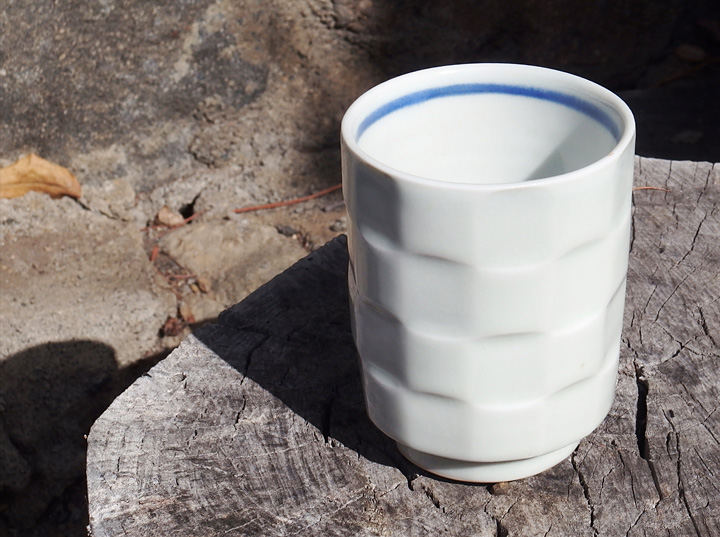
Haruya Abe: I was 23. At first, I was told, “Come back after a year,” and at my next visit, I got an order. The first order was a katakuchi pouring vessel and a shinogi-ichimatsu teacup.
I never imagined my current situation back then (laughs).
Hanada: You just went with the natural flow to get here, it seems.
Haruya Abe: I don’t think much. It’s not as glamorous as saying “I was guided,” but I think, “If it doesn’t work, I can go back.”
Hanada: In a good way, you always seem to have an easygoing attitude, not fixated on narrow ideas.
Haruya Abe: For example, when asked “Which piece in this exhibition do you like the most?” I struggle to answer.
Hanada: What do you answer?
Haruya Abe: “None.” It may be a disappointing answer, but I don’t work in a way that focuses on one favorite item.
Nowadays I use my name, Haruya Abe, but before that, my family’s kiln would, for example, mass-produce Minpei Kashu’s tableware.
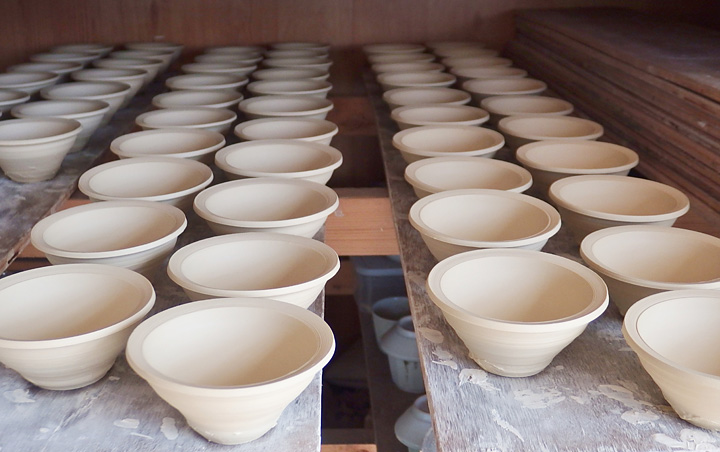
Hanada: People like you support the foundation of the Japanese ceramics world. Your pieces are functional, not overly assertive, and respect the purpose of tableware.
Of course, at reasonable prices. You make a moderate amount—neither too few nor too many. It’s reassuring to have your perspective.
Haruya Abe: Of course, each piece is made with care, but I don’t aim to sell it based on the intensity of my feelings.
Hanada: Indeed, you aren’t consciously putting your feelings into it. But it seems that, naturally, you’re completely present in the work.
Being born in a potter’s family and facing the maker of the tableware you use, everything blends naturally. You don’t feel like you’re making something special.
Haruya Abe: I don’t treat ceramics as work. I just enjoy making them.
Hanada: That suits you well.
Haruya Abe: Being praised or seeing people enjoy my work motivates me. Even if I’m not praised directly, people are using my pieces. That allows me to continue making more.Being able to keep creating is a happiness.
Sometimes I talk with my family, “Why do we make so much? Is it really okay?” (laughs) But somewhere, someone is using them. Even if I rarely see it, it makes me happy and sometimes nervous (laughs).
C’mon, me, get it together!
Hanada: Are there tasks you want to do or don’t feel like doing?
Haruya Abe: Honestly, yes. But often it’s just a self-imposed limitation.
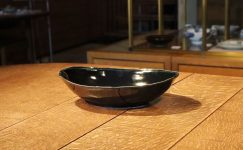
Like with this oval plate—I thought I wasn’t good at slab work. But this time, I found it surprisingly enjoyable.
Hanada: “Hey, I have talent for slab work too!” (laughs)
Haruya Abe: No, not like that (laughs). I just thought I didn’t like it, and that’s why. Once I committed to it, it became really fun.
Hanada: You do it out of necessity. When someone like me brings reference materials. This is typical of how you go with the flow.
And your amazing quality is that you never say “NO” to any request. You always accept. I must have asked some rather selfish things before.
Haruya Abe: Yes (laughs). But including those experiences, I can grow.
Hanada: I must grow too.
Haruya Abe: “C’mon, me, get it together!” (laughs) Most potters work alone. You could slack off if you wanted. You could pick only the work you like, but stepping forward is important, isn’t it?
Hanada: It certainly is.
A Little Consideration
Hanada: When working, what do you consider important?
Haruya Abe: I don’t have a grand policy, but I always think about how people will use the pieces.
For example, I make sure patterns don’t interfere with food presentation. Choosing in a shop is just the start for the tableware. I want to make it with that in mind.
Even when I make new works, I have almost no truly original pieces.I just want to offer traditional and existing designs subtly for modern living.
Looking Forward to May
Hanada: Are there any memorable new works for this exhibition?
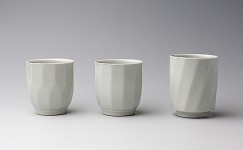
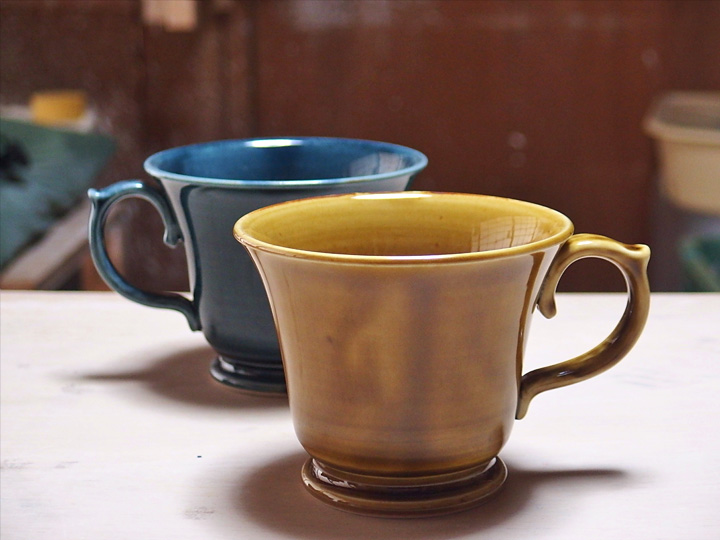
Haruya Abe: Slab work. And I was able to finish the handle of that mug beautifully and cutely.
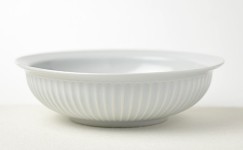
Hanada: You’ve also started light blue glaze.
Haruya Abe: I like this soft, deep feeling. It makes the engraved and relief designs stand out clearly.
Hanada: The atmosphere is similar to the old Imari six-inch blue plate you saw before.
Compared to thickly glazed dark pieces, you can see beyond the glaze, like looking at a lake.
Technically, it also makes the decoration stand out.
Haruya Abe: This light blue glaze feels soft and nice.
Recently, I’ve been keeping my work from becoming too refined. I try to leave a little imperfection. For daily use, this is just right, thought.
Hanada: It brings out your strengths.I look forward to the exhibition. See you in May.
Haruya Abe: Yes, I’ll make it with full energy!
≪ END ≫
陶芸家の家に生まれ育って
花田:
阿部さんはお父様も焼き物の仕事をされています。
小さい頃から、お父様の仕事を見る機会も多かったのではないでしょうか?(以下 花田-)
阿部: 小学生の頃から、よく手伝いをしていました。
いや、していたというか、させられていた(笑)。雑用がほとんど。
焼き物って合間、合間の雑用が多いじゃないですか。
モノ作り!みたいな感じではなかったので、全然楽しくなかったです。
昔、土曜って半ドンでしたよね。
帰宅してから、遊びに行こうって時に「手伝え」って(笑)。
-: お兄さんたちも一緒ですか?
阿部: 運命共同体―みんな一緒です(笑)。
4人兄弟、みんな嫌がっていた。
長男は小さい頃は継ぐ気でいたようなので、そこまで嫌ではなかったかもしれませんが。
-: 今、焼き物の仕事しているのは末っ子の阿部さんだけですね。
阿部: 長男は最初やっていたのですが、僕が高校2年か3年の時に、やめて違うことやりたいと言い出して・・・誰もやらないなら、やってみようかなと思ったのがきっかけです。
-: 誰もやらないのが理由ですか(笑)。
そうは言いつつも、自分の父親がしていた家業が誰にも引き継がれていかないとすれば、考えるところもあったのだと思います。
阿部: 最初は、料理学校を志望していたのですが、そういうことになり・・・
瀬戸の訓練校に行くことになりました。
瀬戸なら家から出られるし、これはいいなと軽い気持ちで足を突っ込んだのが始まりです。
で、学校が始まると、焼き物屋の息子のくせに、土を触ったことがほとんど無いので、土は練れない、ロクロはできない、何にもできない・・・(笑)。
まあ、梱包ならできますよ、くらいな(笑)。
それは本当に終わったのか
-: 学校の後は、備前の山本出さんのところへ。
阿部: 僕の進路希望は「弟子入りしたい」でした。
そうしたら「備前があるぞ」という話になって「じゃあ、それで」って。
-: (笑)
阿部: 父親の仕事とは違う焼締、そして薪窯を学んでみたいという気持ちもありました。
3年いましたが、先生は気さくな方で、色々話してくださいました。
仕事中も「ここの造形はこういうのをイメージして作るんじゃ」とか説明しながら作ってくれるんですよ。
-: 厳しい部分も勿論ありますよね。
阿部: いつだったか、先生が壷を作るので、土を用意しておくように言われました。
僕は土を柔らかく用意してしまったんです。
壷の時は柔らかすぎてはいけないのです。
「俺が壷をひくって分かっているのに、こういうやり方をして『終わりました』っていうのは、終わったことにならない」って叱られました。
僕、色々考えないでやってしまうことが多いのですが、その時の「終わったことにはならない」という一言が耳に残っています。
何かを作りあげるためにはそのために必要なことがあって、そういうことをきちっと踏んでいかないと、出来上がらないんだという、今思えば当然至極のことを学びました。
-: 終わったつもりになっているけど、本当は終わってないこと・・・僕にもたくさんある気が・・・。
阿部: 仕事をしていても「それは本当にちゃんと終わったのか」と今でも聞かれる気がします。
終わったかどうかなんて、自分が終わらせたいだけのことが多いので。
-: 「本当にお前はそれで満足なのか?やりきったのか?」ってことですよね。
阿部: 今思えば、先生はそういうことを言っていたような気がします。
だからこそ、普段穏やかな先生が、あれだけ厳しくおっしゃった。
土の問題ではなかったのかもしれませんね。
-: 嬉しかったことはなにか覚えていますか。
阿部: 辞めるときに「阿部は、一度も休まずよく頑張ったな」って。
それが唯一褒められたことかな(笑)。
-: 3年間、無遅刻無欠勤!
阿部: えぇまぁ一応。
「見てくれていたんだな」と思うと、うれしかったのを覚えています。
自然と自分の中に流れるもの
-: 阿部さんは備前のあと最初はお父様と一緒に仕事をされていました。
小さい頃とは、お父様の仕事も違って見えたでしょうし、学ぶことも多かったのでは。
阿部: 無意識のうちに学んでいることが多いのでしょう。
自身の仕事の流れの中に、父から伝わったことは確実に組み込まれていると思います。
-: その1年後、本当に1人になるのですね。
阿部: 大変でした。
当時まだ20歳そこそこでしょう。
まずちゃんと定時に起きて、定時に仕事を始めることすら出来なかったです。
-: しばらくして、花田に来てくださいますね。
阿部: 23の時です。
最初は「1年したらまた来て」って言われて、1年後の訪問で、注文をもらったのを覚えています。
最初の注文は面取の片口と、しのぎ市松の湯呑でした。
懐かしいですねえ(笑)。
その頃、今の状況なんて、全く想像していませんでした。
-: 自然の流れに身をまかせてここまで来た感じですね。
阿部: 考えないんですよ。
「導かれる」なんていうほど格好のいいものではありませんが「やってみてダメなら戻ればいいじゃん」としか思えないんです。
-: いい意味で、阿部さん「どうとでもなるだろう」という雰囲気は常に持っていますよね、以前から。
偏った拘りのようなものも感じません。
阿部: 例えば「今回の展示会で一番気に入っているものはなんですか」と聞かれると、僕はすごく答えに困るんです。
-: 何と答えるんですか。
阿部: 「無いです」って答えます。
すごく期待はずれな答えで申し訳ないのですが、一つのものにこれっていう気持ちを込める仕事の仕方ではないのだと思います。
今は時代の流れで、阿部春弥という個人名でやってはいますが、ちょっと前ならうちは例えば珉平の食器を量産している窯、みたいな。
-: 僕は、阿部さんみたいな人こそが、日本のうつわの世界をベースの部分で支えていると思います。
使いやすいし、押しも強くなく、うつわとしての本分をわきまえている。
勿論、良心的な価格も含めて。
作る量も、少量ではないし、かといって大量でもない。
中量と言えばいいのでしょうか。
阿部さんのような考えは支えになります。
阿部: 勿論、一つ一つはとても大切に作りますが、それに対する思い入れの強さを売りにしたいわけではありません。
-: 確かに、阿部さんは意識的に思いを込めてはいないと思います。
でも、かえって実はすっぽり自分がそのまま入ってしまっているという気もするんです。
焼き物屋さんの家に生まれて、使っているうつわを作った人が目の前にいるという環境もあってか、色々なことが自然と馴染んでしまっているのでしょう。
特別なものを作っているという感覚は全くない。
阿部: 僕は、焼き物を仕事だと思ってやっていないと思います。
ただ単に作っていて楽しいんですよ。
-: 阿部さんらしくて、いいですね。
阿部: そして、使ってくれた人に褒められたり、喜んでもらったり、そういうことの一つ一つの積み重ねが今のモチベーションになっている気がします。
直接褒めてくれなくても使ってくれている人はたくさんいますし、それがあるからまた次作ることができるわけです。
作り続けられるということは、幸せなことです。
家族でもたまに話すんです「こんなに沢山作ってどうするんだろうね。
本当に大丈夫かなあ」って(笑)。
でも、どこかで誰かが使ってくれている。
そういう場面はほとんど知らなくても、そう思うと嬉しいし、たまにビビリもします(笑)。
ちゃんとしろよ、俺!
-: 阿部さんに、やりたい仕事、気が進まない仕事というのはあるのでしょうか。
阿部: 正直、あります。
でも、そういうことって、自分で勝手に決め付けているだけだったりするんです。
今回のこの楕円皿もそうです。
これまで、タタラの仕事は苦手だと思い込んでいました。
でも今回、タタラも意外と面白いなって。
-: 「俺、タタラの才能もあるじゃん」みたいな?(笑)
阿部: いやいや、そういう意味ではないですよ(笑)。
嫌だなって思っていたから、そうなっていただけで。
やらなきゃいけないと思って腹くくってやったら、とても楽しかった。
-: 不可抗力ですものね。
僕みたいな他人に参考資料を持ってこられることで。
流れに身を任せる阿部さんならではではありませんか。
それに、阿部さんの凄いところは、どんなリクエストにも決して「NO」と言わないことです。
必ず、受け入れる。
僕、今までも結構勝手なお願いをしてきたはずです。
阿部: ですね(笑)。
でも、そういうものも含めて成長していけるんです。
-: 俺も成長しなければなと。
阿部: 「ちゃんとしろよ、俺!」っていう(笑)。
焼き物やっている人の多くは個人でやっていますよね。
そこに甘えようと思えば、いくらでも甘えられるわけです。
自分の好きな仕事だけ選んでやっていればいいのかもしれませんが、そこをどう一歩踏み込めるかどうかっていうのが、大きくないですか。
-: 大きいとは思います。
少しの思い
-: 仕事をしていて、阿部さんが大事にしていることはありますか。
阿部: 人に語れるような立派なポリシーはありませんが、使ってもらう時のことは、いつも考えます。
例えば、文様は盛った時に料理の邪魔にならないように気をつけます。
お店で選んでもらって終わりなのではなく、うつわにとってはそこがスタートです。
そこを意識して作りたいとは思います。
そして、新作を作ったといっても、僕なんかは自分の本当のオリジナルはほとんどありません。
いや、皆無でしょう。
昔ながらの伝統や、元々あるものを今の暮らしの中に無理なくそっと提供できたらなという思いだけです。
5月を楽しみに
-: 今回の企画展ための新作で、印象に残っているものはありますか。
阿部: タタラの仕事。
あのマグの取っ手も、可愛くキレイに仕上げることができました。
-: 淡ルリも始められました。
阿部: この淡い感じ、懐の深い感じが好きなんです。
そして、刻文や陽刻のようなものがはっきりとしたかたちで活きる気がします。
-: 雰囲気は、以前見てもらった古伊万里のルリの6寸皿に近いですね。
がっちり釉が掛かっている濃いものに比べると、釉の向こうが見える、というか湖を見ているような奥行を感じます。
技術的には装飾がよく見えるとか、そういうこともあるんでしょうけど。
阿部: この淡ルリは柔らかい感じがして、いいなと思っています。
それと最近は、仕事が、洗練されすぎないようにしています。
というか、ちょっと抜け感があるような。
普段使いだとこれくらいのほうが、ちょうどいいのかなって。
-: 阿部さんの良さがでそうですね。
企画展が楽しみになります。
5月、宜しくお願いします。
阿部: はい、張り切って作りたいと思います!
≫阿部春弥さんのうつわはこちらから≪
関連記事はこちら