





English version of the interview here.
Encountering Ceramics
Hanada: What led you to pursue a career in making tableware?
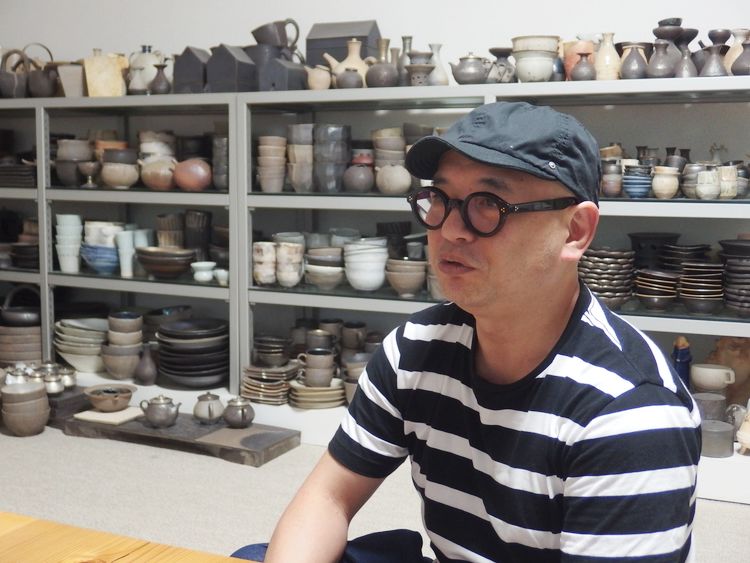
Tetsuya Yamamoto : I was born and raised very close to the Kiyomizu ware district in Yamashina, Kyoto. When I was a child, relatives would take me to places like that, and I’d get scolded with “Don’t touch that!” (laughs). To be honest, it was so familiar to me that I couldn’t really take an interest in it. If anything, I almost disliked it (laughs).
Then later, when I was attending prep school in the late 1980s, clay work—ceramic objects and sculptural pieces—was becoming fairly popular. Seeing those works made me realize, “Ceramics can be like this too…” and it felt very fresh to me.
At first, I wanted to study product design, but partly because of that experience, and also under the influence of one of my prep school instructors, I decided to enter the ceramics department. The university I attended also had a very free and open atmosphere, so I was able to enter the world of ceramics naturally and without resistance.
Hanada: So the feelings you had as a child gradually disappeared.
Tetsuya Yamamoto : That school had excellent facilities. At the time, I believe it had the largest kiln among universities in Japan. I made quite a lot of large-scale works there.
Learning Through Conversations with Many People
Hanada: Was that when you began making tableware?
Tetsuya Yamamoto : It was after graduation, when I was working in a shared studio in the Kiyomizu ware district. Because of the environment I was in, it naturally led me toward making tableware. That said, during my student years I had hardly made any functional dishes, so I copied other people’s work, asked senior artists, teachers, and local craftsmen for advice… I would ask things like, “I want to make something like this—how should I go about it?”
From all the different answers I received, I chose the methods that suited me best. I’ve truly been helped by many different people. And not only by people in Kyoto, so I don’t think even my wheel-throwing style is particularly Kyoto-style.
Hanada: It sounds like you solved each challenge as new themes emerged.
Tetsuya Yamamoto : That hasn’t changed even now. I’ve been doing that for about twenty-five years already (laughs).
From Beginning to End
Hanada: And that brings you to where you are today.
Tetsuya Yamamoto : Looking back, I think making tableware really suits me. Even in product design, you’re rarely involved from beginning to end, right? Many different people become involved, and gradually the original concept starts to fade. But with ceramics, everything—from start to finish—is done by myself.
Hanada: That’s true.
Tetsuya Yamamoto : Also, when I was in my twenties, I participated in an event where chefs used my work in restaurants, and I had to prepare pieces for an entire ten-course meal.
I had to think about the flow of the meal, create a kind of story, and coordinate the sizes, colors, and overall feel of the pieces, which I found incredibly interesting. Experiences like that became opportunities for me to immerse myself more deeply in making tableware.
Nothing More Than the Basics
Hanada: What do you value most in your work and craftsmanship?
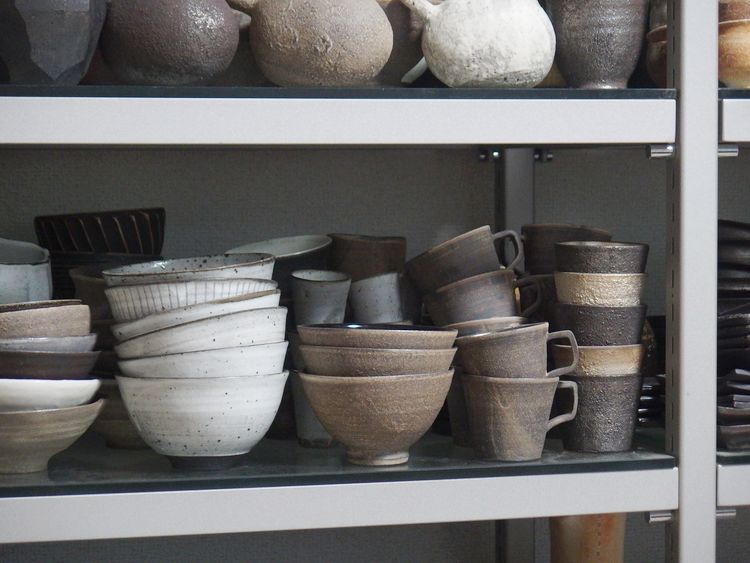
Tetsuya Yamamoto : It’s connected to what I just mentioned about that event—the overall balance and flow. And on an individual level: size, weight, stacking, and so on. For me, it’s really only those very basic things.
Hanada: Those aspects also affect the visual impression, so it’s not just about functionality.
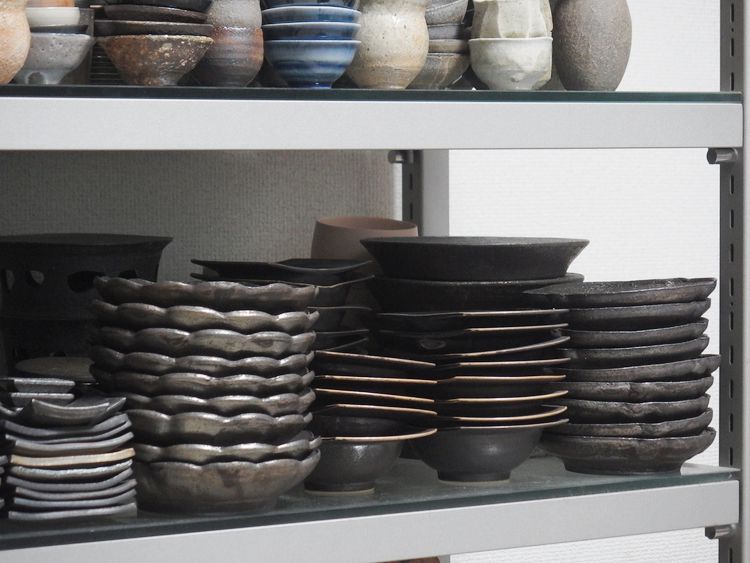
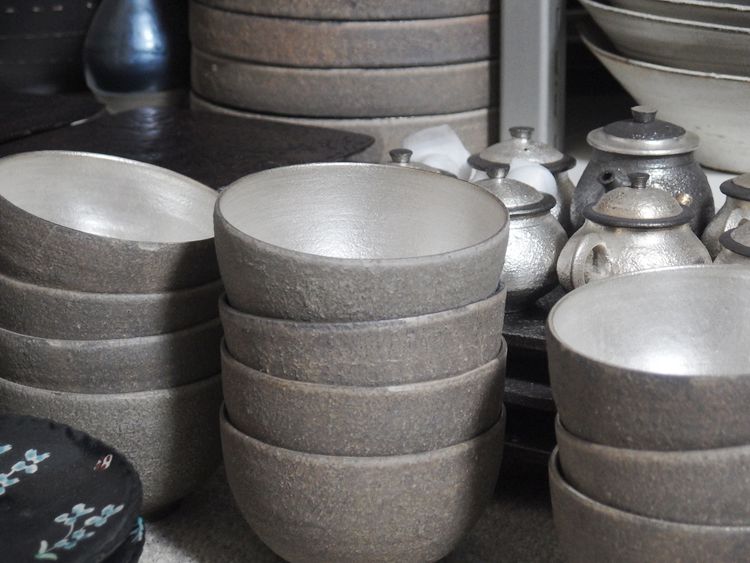
Tetsuya Yamamoto : Exactly. With stacking, it’s not enough that pieces simply stack well—the appearance when stacked also matters. In restaurants, tableware is often placed where customers can see it, after all.
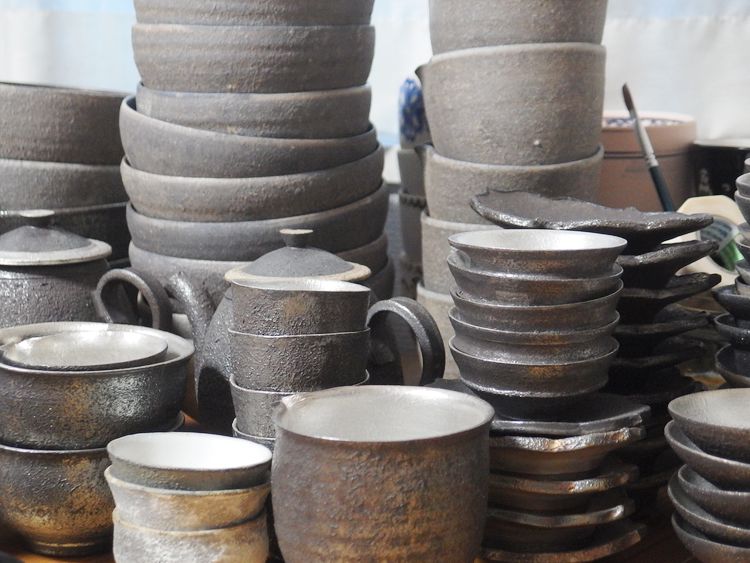
Hanada: Right now, you work with techniques such as carbonized firing, iron glaze, kohiki, yakishime, and silver decoration.
There’s a wide variety, but none of them are overly assertive in tone, and they really enhance the food. The forms are sharp, with very little ornamentation, and they almost feel close to porcelain.
Tetsuya Yamamoto : I prefer that kind of aesthetic over something overly heavy or imposing.
Developing Sensibility Through Dialogue
Hanada: You’ve worked closely with many chefs over the years, especially Kyoto chefs.
Tetsuya Yamamoto : Especially in the beginning, I remember receiving many requests like, “Could you make a rectangular plate in this pattern and this exact size?”
Hanada: How precise were those specifications?
Tetsuya Yamamoto : Down to the millimeter. And also things like depth, angle, and the feeling against the lips. Even the balance between tension and comfort…Through that process, I think I naturally developed a sense for what makes something easy to use.
White Porcelain
Hanada: Is there anything you would like to pursue in the future?
Tetsuya Yamamoto : For example, white porcelain…
Hanada: That sounds wonderful. It feels like it would suit you perfectly.
Tetsuya Yamamoto : White porcelain isn’t simply “white-colored porcelain,” after all. It’s something refined down to its essence, something with a kind of dignity that quietly emerges from within… It’s not something you can create just by trying to force it.
I hope that by continuing to gain experience, I’ll eventually be able to create that kind of quality when I make white porcelain.
Hanada: Finally, a few words for the upcoming exhibition.
Tetsuya Yamamoto : I often make black tableware. At first glance, people sometimes hesitate to use it, but it’s actually very versatile and easy to use.
Hanada: You understand once you actually try it.
Tetsuya Yamamoto : Exactly.
Hanada: Thank you very much.
≪ END ≫
焼き物との出会い
花田:うつわ作りの仕事に至った経緯はどのような感じだったのでしょうか。
山本:僕は京都山科の清水焼団地すぐ近くで生まれ育ちました。
子供の頃は、親戚なんかにそういう所に連れていかれて「触ったらアカン!」って叱られていました(笑)。
正直なところ、身近すぎて興味を持てなかったです。寧ろ嫌なくらい(笑)。
で、大きくなって、予備校に通っていた頃、―80年代後半ですが―クレイワークというか「焼き物でオブジェ」というのが、割と盛んでした。
それらが「焼き物ってこんなのもあるんだ・・・」って新鮮に見えたんです。
最初はプロダクトデザインを志していましたが、それがきっかけになりつつ、予備校の講師の方の影響なんかもあって、陶芸科に進むことになりました。
入った大学も、自由な校風で、抵抗なく焼き物の世界に入っていくことができました。
-:子供の頃、抱いていた感覚が払しょくされましたね。
山本:その学校は設備が恵まれていました。
当時、日本の大学では一番窯も大きかったはずです。
大きいものも随分作りました。
色々な人々に聞きながら…
-:うつわ作りを始めるのは…?
山本:卒業後、清水焼団地の貸し工房で活動をしていた時です。
環境もあって、自然にうつわを作るような流れになっていました。
ただ、学生時代は食器をほとんど作っていなかったので、人の真似したり、先輩や先生、近所の親方に聞きに行ったり…
「こういうの作りたいんですけど、どうしたらいいんですか」って。
色々な答えの中から自分に合うやり方を選んできました。
本当、色々な人のお世話になっています。
京都の人たちだけでもありませんでしたので、多分ロクロも、京都の引き方ではないと思います。
-:テーマが発生するごとに解決していった感じですね。
山本:今も変わりません。
そういうことを、かれこれ25年続けています(笑)。
最初から最後まで
-:そうやって現在に至るわけです。
山本:考えてみれば、うつわ作りは自分に合っているんだと思います。
プロダクトデザインにしても、最初から最後まで関わることはないですよね。
色々な人々が関わって、だんだん最初のものが薄れてくるというか。
焼き物は最初から最後まで自分ですから。
-:そうですね。
山本:それと、20代の頃、料理屋さんに使ってもらうイベントがあって、コース丸ごと、10品分のうつわを用意することになりました。
流れを考えて、ストーリーを作って、うつわのサイズや色味、テイストを構成していかなければならないことがあって、とても面白かったんです。
そういうものもうつわに没頭するチャンスになっていったと思います。
極々当たり前のことばかり
-:山本さんがモノ作りをする上で、大事にされていることはどのようなことですか。
山本:いまのイベントの話と一緒ですが、全体のバランスや流れです。
個々には、サイズ、重さ、それとスタッキング等々。
極々当たり前のことだけです、僕の場合。
-:これらは見た目にも影響してくることにもなるので、機能だけの話でもないですね。
山本:スタッキングも、重ねられればそれでいいわけではなく、重ねたときの景色も大事ですよね。
料理屋さんなんかでも、お客さんから見えるところに食器が置いてあることも多いので。
-:山本さん、今は炭化、鉄釉、粉引、焼締、銀彩などに取り組まれています。
色々ありますが、どれも表に出過ぎない色調で、料理が引き立ちます。
つくりはシャープで、装飾をあまり加えず、磁器に近いような気がします。
山本:どしっとしているものよりは、そういうもののほうが好きです。
やり取りの中から感覚を
-:山本さんは、料理屋さん、特に京都の料理人の方々とのやり取りを多く重ねて仕事を進めてこられました。
山本:特に最初の頃は「このパターンで、このサイズの板皿を作ってくれないか」という類の話を沢山受けていた覚えがあります。
-:どれくらいの単位なのでしょうか。
山本:ミリ単位です。
あとは深さ、角度、口当たりあたり。
緊張感と安心感のバランスなんかも…。
そうやっているうちに、自然と使いやすいものの感覚は身についてきたのかなとは思います。
白磁
-:今後やっていきたいことはありますか。
山本:例えば、白磁…。
-:いいですね!しっくりきそうです。
山本:白磁って、単に「色が白い磁器」なわけではないじゃないですか。
そぎ落とされた末のもの、染み出てくるような品格のようなもの…というか。
出そうと思って出せるものでもないし。
これからも経験を積んで、白磁を作った時にそういうものができてくればいいなと思います。
-:展示会に向けて、お願いします。
山本:僕は、黒いうつわをよく作ります。
一見敬遠されることもあるのですが、実はとても使いやすいです。
-:一回使ってみると分かりますね。
山本:そういう感じです。
-:有難うございました。
≫山本哲也さんのうつわはこちらから≪
関連記事はこちら