




English version of the interview here.
Glass, Glass, Carpentry, Glass
Hanada: Could you tell us about your journey leading up to your work with glass?
Kohei Wada : I graduated with a humanities degree from a regular university and took a typical job. After a while, though, I started thinking about turning my lifelong love for making things into a career. That said, it was just a vague idea, so the only things that really came to mind were ceramics or glass (laughs).
Hanada: And so you chose glass.
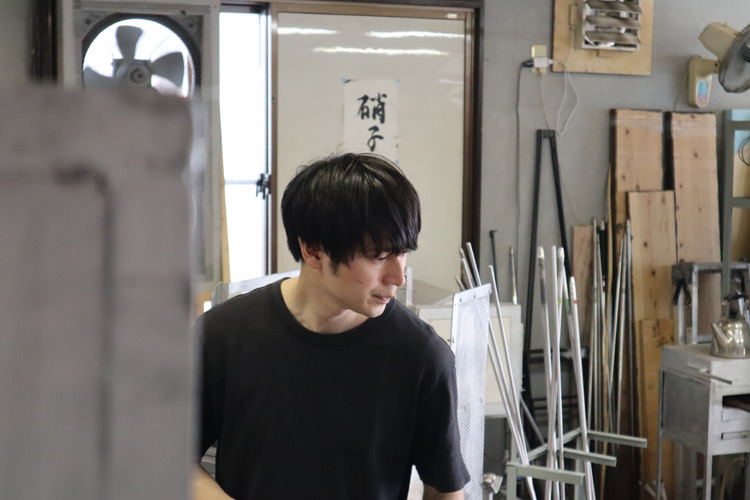
Kohei Wada : I decided to attend the Toyama Institute of Glass Art. The school leaned more toward an artistic focus, so my work there centered mostly on creating sculptural objects. I did things like casting—pouring molten glass into plaster molds—to make glass toy pistols and the like. I was doing that sort of thing all the time.
Hanada: You must have learned a great deal about glass there.
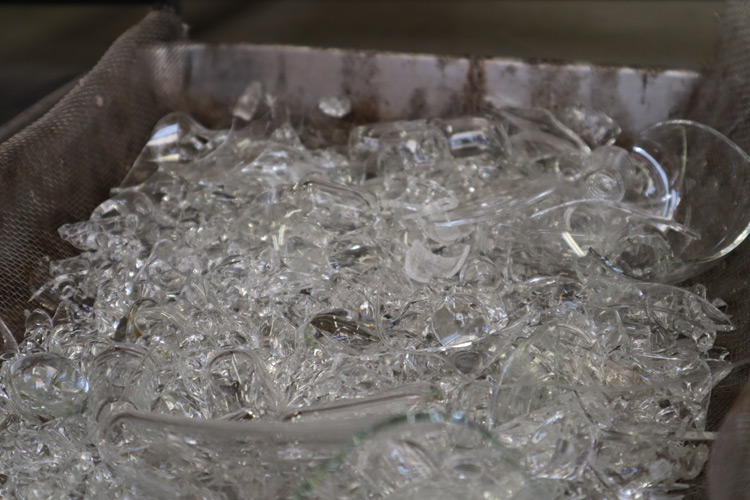
Kohei Wada : Glasswork is generally divided into three main categories: hot work, cold work, and kiln work, and Toyama is a place that teaches you all of them comprehensively. After Toyama, I spent time in the glass department at the Seto New Century Craft Center. Seto is a pottery town, but it is also a place where you can source silica sand, which is the raw material for glass.
Hanada: What did you do after that?
Kohei Wada : Actually, I stopped working with glass for a time. I ended up starting a sort of apprenticeship with a carpenter. Well, I certainly got scolded a lot there (laughs). My main memory is just running around all day long.
Hanada: That is an unexpected turn. Your current work might not have existed in the world today. We are glad you returned to glass.
Kohei Wada : However, about three months in, I had an accident and suffered a serious injury. Since I was working deep in the mountains at the time, I had to be evacuated from there by an emergency helicopter. When I regained consciousness at the hospital, the master carpenter told me, “You can still come back whenever you are ready,” but…
Hanada: Even if the master felt you were welcome back, whether you actually wanted to return is a different story (laughs).
Kohei Wada : Exactly (laughs). Still, that experience was truly invaluable. Even though it was a short period, I learned just how wide my emotional range could be—experiencing both deep frustration and moments of joy. It was incredibly rigorous and pushed me to my absolute limits. I suppose it was my initiation into the real world.
Hanada: That is a rather extreme initiation.
Three Elements
Kohei Wada : A bit later, I joined the Sai Glass Studio in Kawasaki, where I was able to properly relearn glassblowing from the ground up. Looking back now, even though I had watched highly skilled people work in Toyama and Seto, I did not yet have the eye to truly see what they were doing, so I had not fully understood it.
Hanada: What was it that finally became clear to you there?
Kohei Wada : The essential factors for shaping glass crystallized in my mind. To put them into words, they are three elements: temperature, rotation, and center axis.
Hanada: First, what do you mean by temperature?
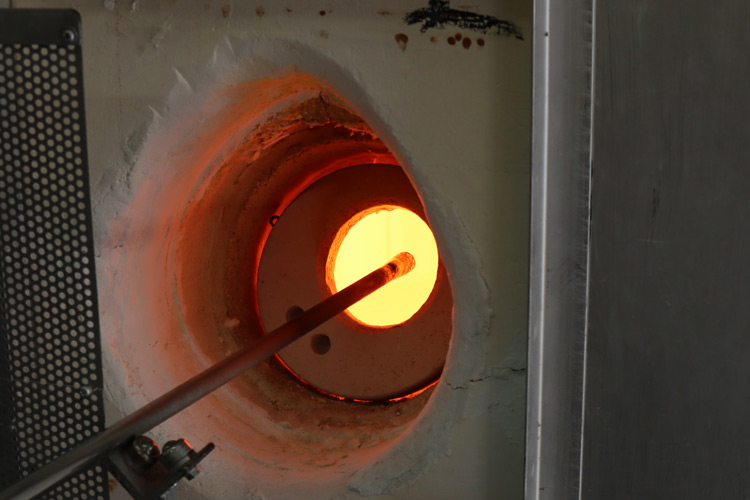
Kohei Wada : It means managing the heat so the glass expands beautifully and remains easy to work with. If the temperature drops too low, it expands unevenly. However, there are areas where you want the glass to stay firm, so simply heating everything uniformly is not the goal. It is about knowing exactly how much to heat the specific part you want to shape.
Hanada: What about rotation?
Kohei Wada : In glassblowing, you are constantly turning the pipe as you work. You speed up or slow down that rotation depending on the task. For instance, when I want to set a specific shape, I might suddenly increase the speed significantly.
Hanada: What happens if your speed is insufficient?
Kohei Wada : Take the stem of a goblet, for example. You attach a gather of glass to the bottom and shape it outward using tools. If the rotation is too slow and does not match the pressure you are applying, you end up flattening the glass rather than shaping it outward. By aligning the rotational force with the applied pressure, it expands into a beautiful, clean circle.
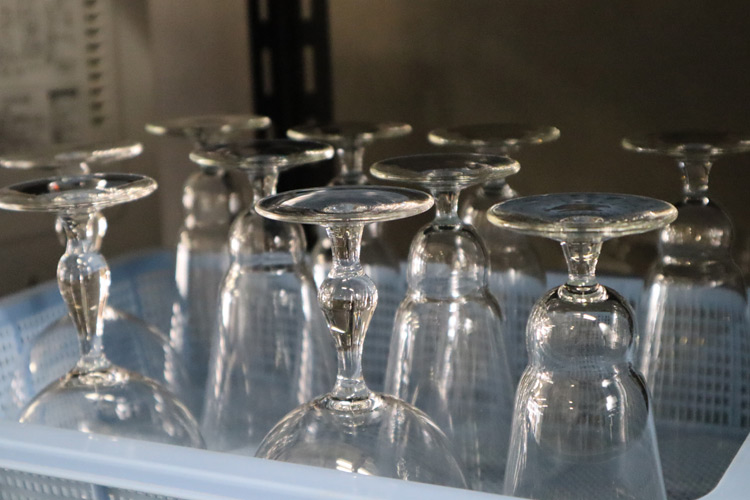
Hanada: And the third element, the center axis?
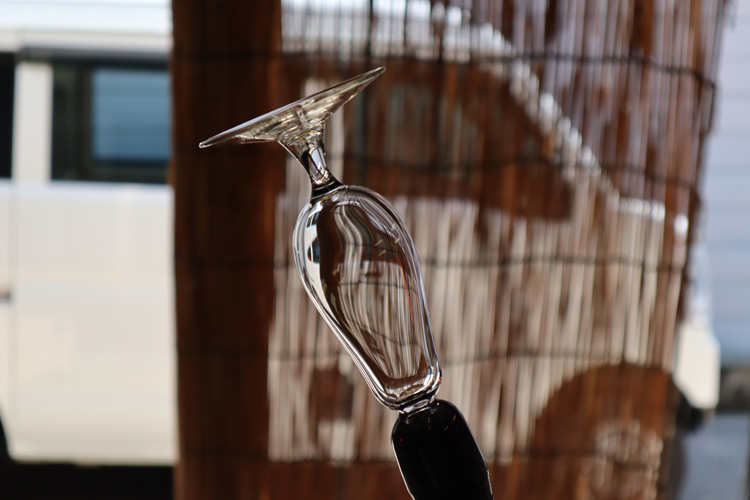
Kohei Wada : Since glassblowing involves shaping while rotating, the forms are basically axisymmetric. The axis refers to that central line of symmetry, and you must maintain that center perfectly. If it wavers, the finished piece will lose its balance and stability.
Crafting My Own Approach to Glass
Hanada: What kind of glass tableware do you aim to create?
Kohei Wada : Glass techniques themselves have changed very little since ancient Roman times, so when looking for inspiration, I naturally turn to antique objects. Pieces that have survived for a long time are often visually and technically natural, without any forced elements. I am particularly fond of Venetian glass, and while learning from those traditions, I want to bring a contemporary impression to my own work.
Hanada: While the glass you make is simple, there is always a unique twist to the forms.
Kohei Wada : There are plenty of inexpensive, durable, mass-produced glasses out there. I use them myself and fully appreciate their reliability and ease of use. That is precisely why, when creating as an artist, I want to add something that those commercial products simply do not have.
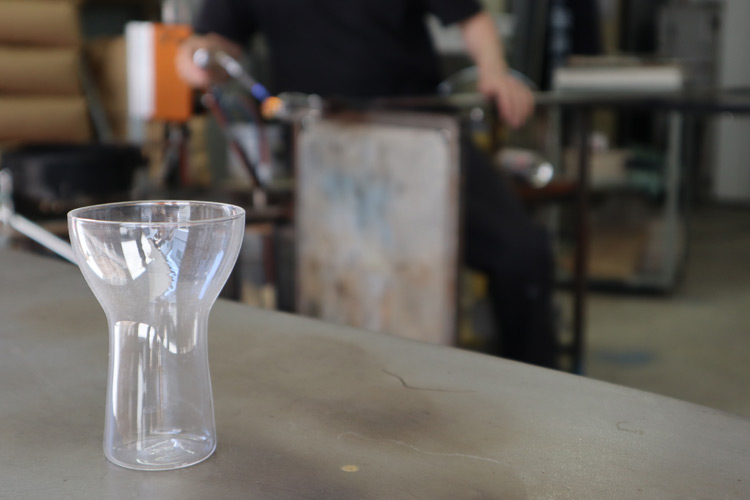
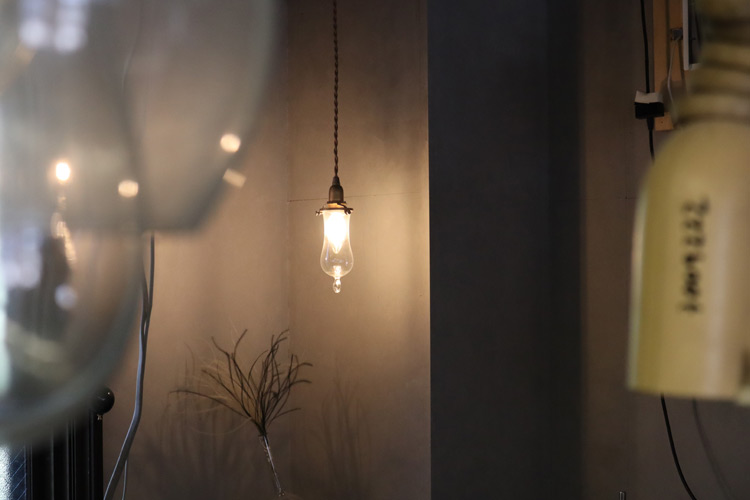
Hanada: Currently, you are also focusing a lot of energy on lamps.
Kohei Wada : When making tableware like drinking glasses, you hold an ideal shape in mind from the very start and systematically build toward it. With lamps, however, I can explore ideas more freely, and they are incredibly fun to make.
Looking Around
Hanada: I look forward to seeing your distinctive style develop further.
Kohei Wada : Lately, it has really struck me that you can only ever do what you are capable of doing. It sounds obvious, but you cannot create beyond your current level of skill. The only option is to steadily expand that boundaries.
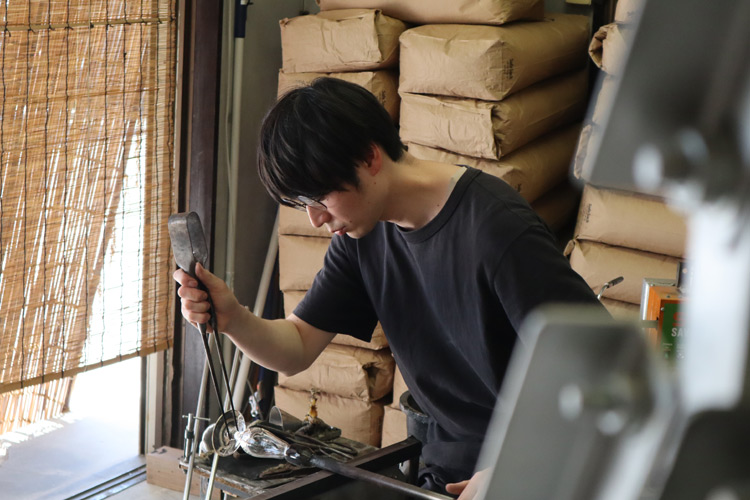
Hanada: And along with that, your concepts and ideas expand as well.
Kohei Wada : In terms of ideas, I find myself constantly looking around without even realizing it—always wondering if there is something out there that could be reinterpreted in glass. I am looking around when I visit a shopping mall, and I am looking around just walking down the street (laughs).
Hanada: The everyday town scenery I see must look entirely different through your eyes.
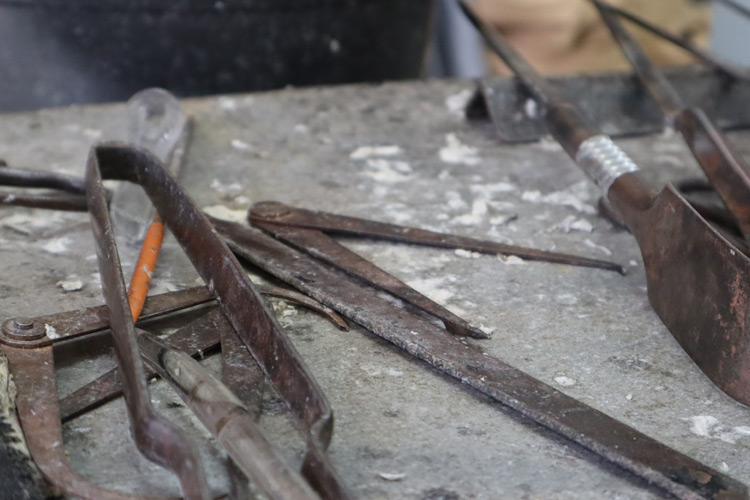
Future Vision
Hanada: Is there anything specific you would like to undertake moving forward?
Kohei Wada : Having recently gone independent, I currently work entirely on my own. I frequently find myself thinking, “If only I had one more hand,” or “If only I had two more.” Glassblowing is fundamentally designed around teamwork, so trying to do it alone often sets limits on what is possible. If I can increase the number of people in the studio—for example, with my glasses—I could incorporate many more intricate details into the stems. It would also expand the variety of forms I can produce.
With that in mind, I want to build my own production team in the future. I am not sure how many years down the road that will be, though.
Hanada: Thank you very much. Is there anything else you would like to add before we finish?
Kohei Wada : I hope this sort of conversation is alright. I have never been particularly good at talking about myself or explaining things to people…
Hanada: No, not at all. It was a very meaningful conversation. Thank you so much.
≪ END ≫
ガラス、ガラス、大工、ガラス
花田: ワダさんがガラスの仕事をするようになるまでのお話をお聞かせください。(以下花田-)
ワダ: 普通の大学の文系学部を出て、普通に就職しましたが、しばらくして、元々好きだったモノ作りを仕事にしたいなと思い始めました。と言っても、漠然と考えていただけなので、陶芸かガラスくらいしか思いつかないんですよ(笑)
-: それでガラスを選ばれたのですね。
ワダ: 富山ガラス造形研究所に行くことにしました。
そこはどちらかというと、アーティスト志向でしたので、オブジェ中心の制作をしていました。
鋳造で(石膏型にガラスを流し込んで成形)、おもちゃのピストルをガラスで作ってみたり・・・。そういうことばかりやっていました。
-: ガラスについて色々学ばれたのではないですか。
ワダ: ガラスは基本的にはホットワーク、コールドワーク、キルンワークの3つに大きく分かれるのですが、富山はそれらを満遍なく教えてくれる場所です。
富山の後は、瀬戸の新世紀工芸館のガラス科にいました。瀬戸は焼き物の町ですけど、珪砂というガラスの原料も取れる場所です。
-: その後はどうされたのですか。
ワダ: 実は、一旦ガラスをやめているんです。大工さんのところで、修行のようなことを始めてしまいました。まあ、そこではよく怒られましたねえ(笑)。一日中走り回っていた印象です。
-: 意外な流れです。ワダさんの今の仕事が世の中に存在しなかったかもしれないのですね。よくガラスに戻ってきてくださいました。
ワダ: ただ、3カ月くらい経った時に事故にあって、大けがをしてしまいました。その時は、山に入っての仕事だったので、そこから救急ヘリで搬送されて・・・。
病院で意識が戻った時に親方が「まだ戻ってきていいからな」って言ってくれたんですけど・・・。
-: 親方が「戻ってきていい」と思っていても、和田さんが「戻りたいかどうか」は別の話ですよね(笑)。
ワダ: そういうことです(笑)。でも、あの経験は本当に貴重でした。短い期間でしたけど、悔しさやら嬉しさやら、自分の感情の振れ幅の大きさを知ったので。まあ、とにかく厳しくて、限界まで追い込まれていましたから。社会の洗礼・・・ですかね。
-: 相当極端な洗礼ですけど。
3つのこと
ワダ: しばらくして、川崎の彩グラススタジオに入ったのですが、あらためて、吹きガラスを学び直すことが出来ました。今考えると、富山や瀬戸でも上手い人の技術を見てはいたのですが、自分にそれを見る目がまだそなわっていなくて、ちゃんと理解できていませんでした。
-: そこで見えてきたものとはどのようなものだったのですか。
ワダ: 成形する上で大事なことが頭の中でまとまりました。言葉にすれば「温度」「回転」「軸」の3つです。
-: まず「温度」とはどういうことでしょうか。
ワダ: ガラスが気持ちよく膨らんでくれる温度、作業しやすい温度の管理です。温度が低いと、ムラになって膨らんでしまいます。
ただ、とどまってほしいところもありますので、全部焼けていればいいというわけではありません。「動かしたいところをどれくらい焼いたらいいのか」ということです。
-: 「回転」とは何でしょうか。
ワダ: 吹きガラスは竿を使って常に回しながら作りますが、その回転のことで、作業によってそのスピードを早くしたり遅くしたりしています。
例えば、形を決めたいと思ったところで、一気にスピードを上げることもあります。
-: スピードが十分でないと、どうなってしまうのですか。
ワダ: 例えば、足付グラスなどの足は、ガラスの塊を下につけて、道具で広げて作るのですが、その時に回転が遅くて、押す力に合っていないと「広げる」というより「潰す」感じになってしまいます。「回転する力」と「押す力」を合わせることで、キレイに丸く広がっていきます。
-: 三つ目の「軸」とは?
ワダ: 吹きガラスは、回しながら作るので、基本的には線対称です。軸というのはその対称軸のことで、そのセンターをちゃんと取る必要があります。そこがブレてくると安定感の無い作品になってしまします。
自分ならではのガラスの仕事
-: ワダさんの目指すガラスのうつわはどのようなものですか。
ワダ: ガラスの技法自体は古代ローマからあまり変わっていないので、ヒントを探そうとすると、どうしても古いモノになります。
特に古くから残っているものって、見た目にも技術的にも無理のないものが多いんですよね。
僕はベネチアングラスが好きなのですが、そういうものに学びながら、自分の作品には、現代的な印象を加えていきたいと思っています。
-: ワダさんの作るガラスはシンプルですけど、かたちにひとひねりあります。
ワダ: 手作り以外で安価で丈夫なグラスって、世の中には沢山あります。僕自身も使っていますし、その安心感や使いやすさは理解しているつもりです。その上で、作家として作るのであれば、それらには無いものを加えていきたいと思っています。
-: 今はランプにも力を入れられています。
ワダ: グラスなどのうつわを作る時は、最初から理想とする形をもって、作業を積み上げていくのですが、ランプは、自由に発想できるし、作っていて楽しいです。

キョロキョロ
-: これからワダさんの世界が出来上がっていくのが楽しみです。
ワダ: 最近つくづく感じるのが「できることしかできないな」ということです。当たり前の話ですけど、自分の技術以内の事しか出来ませんよね。その範囲を広げていくしかないなと。
-: それと共に、発想やアイデアも広がっていくわけですね。
ワダ: 発想で言うと、無意識にいつもキョロキョロしていると思います。「なにかガラスに置き換えられるもの、ないかな」って。ショッピングモール行ってもキョロキョロ、道を歩いていてもキョロキョロ(笑)
-: 僕が普通に見ている町の風景も、ワダさんには別様に映っているのでしょうね。
展望
-: これからやっていきたいことはありますか。
ワダ: 今は独立したてで、自分一人での作業です。「腕がもう1本あればいいのにな」「もう2本あればいいのにな」としょっちゅう思います。
吹きガラスはチーム作業が前提なので、一人でやっていると、成立しないことも多いです。人数が増えていけば―例えば、僕のグラスで言うと、ステムの部分にもっと色々な工夫もできます。作れるもののパターンも増えると思いますし。
そういうこともあって、これから自分の制作チームを作っていきたいなと思っています。何年先になるか分かりませんけど。
-: 有難うございました。何か言い残したことありますか。
ワダ: こんな話で大丈夫なのでしょうか。あまり人に話したり説明したりするのは得意ではないので・・・。
-: いえいえ、そんなことないです。有意義なお話でした。有難うございました。
関連記事はこちら