







English version of the interview here.
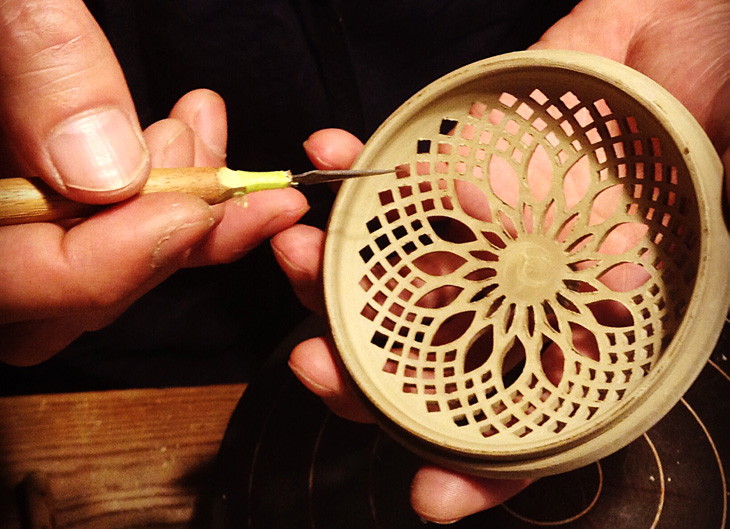
To Be Honest…
Hanada: What first led you to start working in the field of craft-making?
Tokuhiro Masubuchi: I think it had a lot to do with the fact that my family was a pottery household.
My grandfather also worked in crafts. To be honest, I wasn’t very interested at first.
My father was the first-generation head of the kiln, and he was always busy, so I barely remember ever hearing him talk calmly about his work.
But it’s true that I grew up surrounded by those things.
Also, our family home was near Shumpu Banri-so, and it was part of my playground.
Back then, Rōsanjin’s works were just lying around where even children could touch them.
Hanada: So you grew up with those things around you.
Tokuhiro Masubuchi: After graduating from high school, I came to Tokyo to study design.
In my first year, I studied industrial design. But I hated the rush hour trains in Tokyo, so I often skipped school.
To tell the truth, the real reason I came to Tokyo was because I wanted to play in a band…
In my second year, I studied crafts.
After that, I went to Seto, graduated from the ceramics school, and then worked for five years at a Seto kiln.
I was assigned to a department that made Oribe and Shino pieces by hand.
Hanada: You must have learned many things there.
Tokuhiro Masubuchi: …(long silence).
Sorry, but I hardly remember because we were drinking all the time (laughs).
Seto… you see, the people there are strangely passionate.
They talk endlessly—ceramics theory, material theory—always heated discussions.
And once people start drinking, it turns into fistfights.
Hanada: Did you get into fights as well? (laughs)
Tokuhiro Masubuchi: No, I was always the one stopping them.
Saying things like, “I understand what you’re saying.”
Though honestly, I had no idea what they were talking about—completely incoherent (laughs).
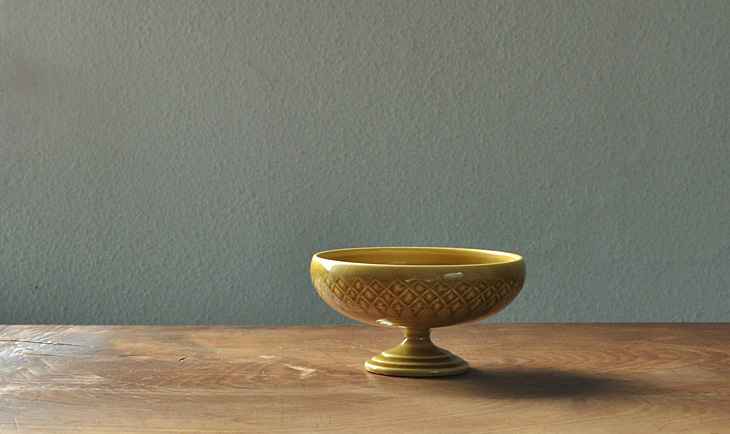
What Gets Chosen, What We Admire
Hanada: Your work has a world uniquely its own.
Tokuhiro Masubuchi: I left Kasama without any preparation and just went independent.
The only confidence I had was in producing quickly. I used to throw about 1,000 teacups in eight hours.
But… no matter how many you make, it means nothing if people don’t choose them.
Looking around, everyone else was making each piece with great care.
So I gradually began spending more time on each piece.
My techniques are a mix of various methods I’ve adapted in my own way.
Hanada: And now you spend more time and effort than anyone, crafting each piece carefully.
Your carved work in particular is extremely precise, yet it also has warmth—that’s the appeal.
The black-and-white Tokusa pattern is something you’ve been making since the early days, right?
Tokuhiro Masubuchi: Originally, I started because I wanted to make a material resembling oniita, but I failed miserably (laughs).
But even though the “fake oniita” failed, it felt like it might be usable somehow, so I kept refining it—and that’s how it was born. Then I thought, maybe I could use it to draw patterns.
Back in Seto, I spent a whole year drawing Tokusa patterns on donburi bowls, so I got to the point where I could draw them even lying down. When I tried drawing with this material, it fit perfectly.
Hanada: So that’s how your style developed.
Tokuhiro Masubuchi: Also, purely classical Japanese tableware felt hard to use in my own home.
Architecture and cuisine have changed so much—something just didn’t feel right anymore.
And I realized that many of my friends’ homes had similar kinds of dining spaces.
But at the same time, there’s also a part of me that admires Shino, Oribe, and Kizeto.
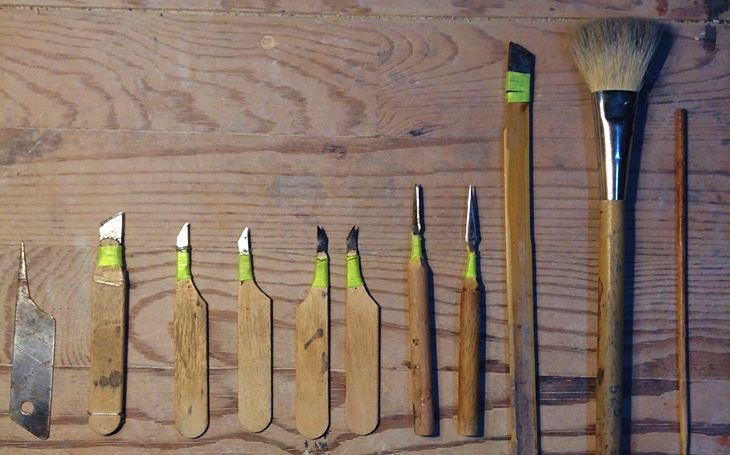
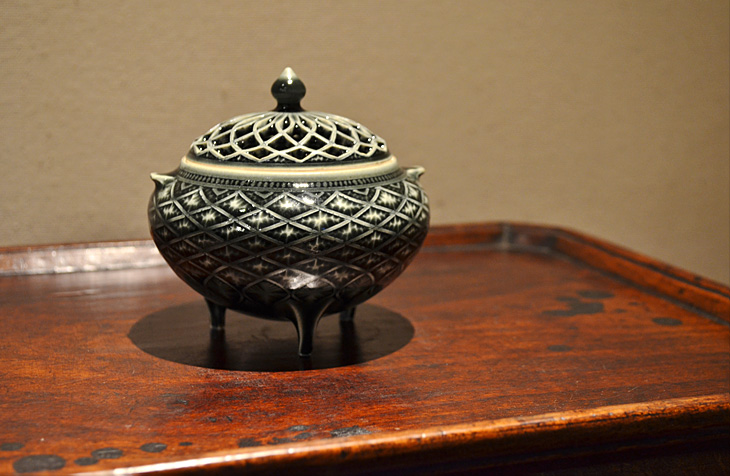
Not Rushing, Not Forcing—Forgetting Time
Hanada: I understand that feeling. What is important to you when you work?
Tokuhiro Masubuchi: Not rushing. Not hurrying.
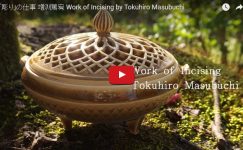
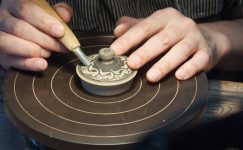
Carving in particular never goes well if you’re in a hurry.
Especially when making incense burners, I remove clocks from my sight.
I don’t look at anything that reminds me of time, like calendars.
I think it’s important to forget about efficiency.
With that kind of intricate work, if you don’t make that mental separation, you can’t keep going.
Hanada: What is “a good tableware” to you?
Tokuhiro Masubuchi: I think it’s simply one that suits the table it’s used on. It’s not that simple things or ornate things are good *because* of that. Even if something could be called a “good tableware,” it won’t match everyone’s life equally.
Japanese dining tables are wonderful because so many different things coexist. And the fact that they all come together as a whole—that might be the answer.
If one of those pieces happens to be mine, then that makes me happy.
Hanada: Homes and food vary so much nowadays.
Tokuhiro Masubuchi: It’s important to use different things depending on the occasion.
I mean, even if you love swim trunks, you wouldn’t wear them to climb a mountain (laughs).

The Joy of Matching Tableware
Hanada: That’s a very “Masubuchi-like” way to wrap things up—convincing and not convincing at the same time. Before our conversation drifts too far from tableware (laughs), please share a message for the upcoming exhibition.
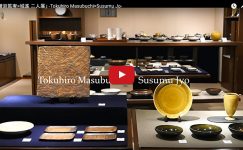
Tokuhiro Masubuchi: Since it’s a two-person exhibition with Mr. Shimura, I hope people enjoy the combinations. The joy of pairing our pieces, even though at first glance they seem different.
Hanada: Last time, many visitors enjoyed choosing pieces from both of you together.
Any final words?
Tokuhiro Masubuchi: Nothing comes to mind (laughs).
Hanada: You were honest till the very end. Thank you very much.
≪ END ≫
正直言うと・・・
花田: もの作りの仕事をするようになったきっかけは何ですか。(以下 花田-)
増渕: 実家が焼き物屋だったので、その影響はあると思います。
祖父も工芸の仕事をしていました。正直言うと、最初はあまり興味なかったんです。
父親も窯元の初代で、忙しくていて、ゆっくりと仕事の話を聞いた記憶もほとんど無い。
まあまわりにそういうものがあふれていたのは事実です。
あと、実家が春風萬里荘の近所で、遊び場にしていました。
当時は、魯山人のものが子どもが触れる場所に無造作に置いてあったりして。
-: そういうものが身の回りにあったのですね。
増渕: そして、高校卒業後、東京にデザインの勉強をしに来ました。
1年目に工業デザインを勉強。でも、東京の電車のラッシュが嫌で、学校はさぼりがち。
実は東京に出てきてバンドやりたいっていうのが本当の理由だったので・・・
2年目は工芸を勉強しました。
その後、瀬戸に行き、窯業学校卒業後、瀬戸の窯元に5年。
配属先は手作りで織部や志野を作る部署でした。
-: 色々と学ぶことが出来たのではないでしょうか。
増渕: ・・・(しばらく沈黙)。
すみません、ほとんど飲み明かしていたので、よく覚えていません(笑)。
瀬戸ってね・・・周りの人がなんか、やたらと熱いんですよ。
陶芸論、材料論・・・ずっとそういう話を熱くしている。
そして、飲んでいると殴り合いになるんです。
-: 増渕さんも殴りあいましたか(笑)。
増渕: いや、僕は止めるほう。
「お前の言っていることも分かるから」って。
ほんとは何言っているんだか、さっぱり分かりませんでしたけどね、支離滅裂で(笑)。
選ばれるもの、憧れるもの
-: 増渕さんの仕事は独自の世界を持っています。
増渕: 何の準備もしないで笠間出て、独立しちゃったんです。
当時あったのは数を早く作る自信だけ。8時間で1,000個くらい湯呑ひいていましたから。
でもね・・・数作ったって選んでもらえなきゃ、意味が無い・・・
周りを見るとみんな一個一個を丁寧に作っているんです。
で、一つひとつのものに時間をかけるようになっていきました。
技法は色々なものを自分なりにミックスしています。
-: 結局今は、誰よりも手間、時間を掛けて、丁寧に作るようになった。
特に彫りの仕事は精緻だけど、やはり同時にあたたかみも感じるのが魅力です。
白黒の木賊なんかは最初の頃から作られているものですよね。
増渕: もともとは、鬼板もどきの材料作ろうと思って始めたんですけど、それに失敗しましてね(笑)。
ただ、鬼板もどきは失敗したけど、なんか使えそうだな、と思って改良を続けた結果生まれたんです。で、それで模様描いてみようと思って、始めました。
瀬戸で丼ぶりに木賊引く仕事を1年間ずっとやっていたことがあって、寝ながらでも描けるくらいになっていたんです。それを描いたら上手くはまりました。
-: そうやって増渕さんの作風は築き上げられていったのですね。
増渕: それと、ただ単にクラシックな和食器だと自分の家では使いづらかったんです。
建築やら料理やら、今は色々変わってきているので、なんかしっくり来ない。
で、結構どこの友達の家行ってもそういう食卓だっていうことに気が付いた。
ただ一方で、志野、織部、黄瀬戸あたりに憧れている自分もいるんです。
焦らない、急がない、時間を忘れる
-: なんか、その気分、分かります。
増渕さんが仕事をする上で大切にしていること、どんなことなのですか。
増渕: 焦らない。急がない。
特に彫る仕事は気持ちが焦ると全く良いものができません。
特に香炉を作るときなんかは時計も視界から外します。
カレンダーのように時間を思い出させるものも見ない。
効率を忘れることが大切だと思っています。
あの手の細工物はそれくらい割り切らないと、続かないんです。
-: 増渕さんにとって、よいうつわとは?
増渕: それぞれの食卓に合えばそれで良いんだと思います。
シンプルなもの、或いは華美なものがそれを理由に良いわけじゃないし、仮に「よいうつわ」のようなものがあったとしても、すべての人々にとってそれが当てはまるわけじゃないですよね。
日本の食卓って色々なものが混在しているのがいいんです。
そしてそれらが食卓の上で全体として成立していることこそが答えなんじゃないかなって。
そして、そのうちの一つが僕のうつわだとすれば、それで僕は幸せです。
-: 住宅も料理も様々ですものね。
増渕: その時どきにあわせて使い分けることも必要。
だって、海パンが好きだからって、海パンで山へは行かないでしょ(笑)。
うつわをあわせる楽しみ
-: 増渕さんらしい、説得力のあるような無いようなしめ方ですね。
このまま話していると、うつわと関係ない話になっていきそうなので(笑)、そろそろ展示会に向けて一言お願いします。
増渕: 志村さんとの二人展なので、その組み合わせを楽しんで欲しい。
一見違うタイプの我々のうつわをあわせる楽しみ。
-: 前回は一緒に選んで下さる方々も多かったです。
最後になにか言い残したことはありますか?
増渕: 思いつきません(笑)。
-: 最後まで正直な増渕さんでした。有難うございました。
≫増渕篤宥さんのうつわはこちらから≪
関連記事はこちら