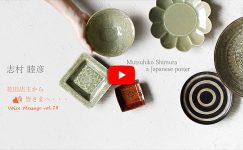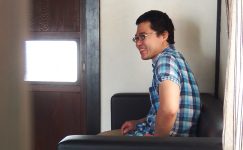



English version of the interview here.
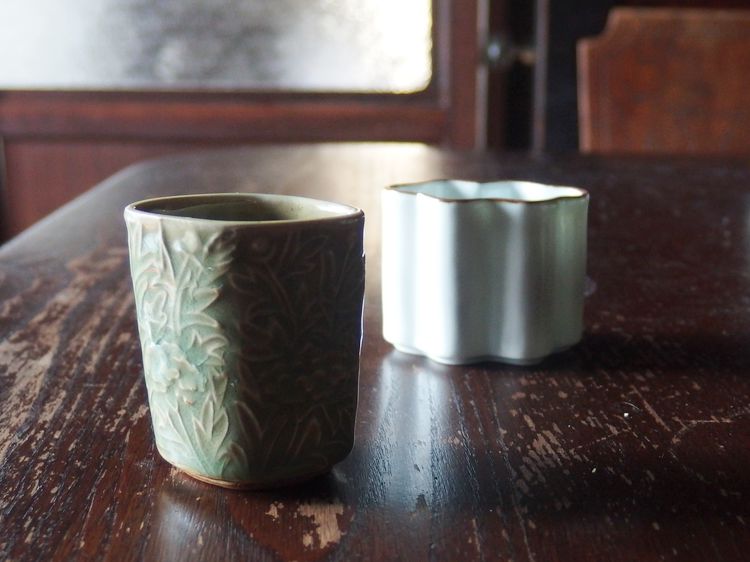
Beautifully Arranged
Hanada: I would like to ask Mr. Shimura and Ms. Miyaoka about the works they are exhibiting in this exhibition.First, Mr. Shimura, let’s start with the Celadon Incised Peony Guinomi.
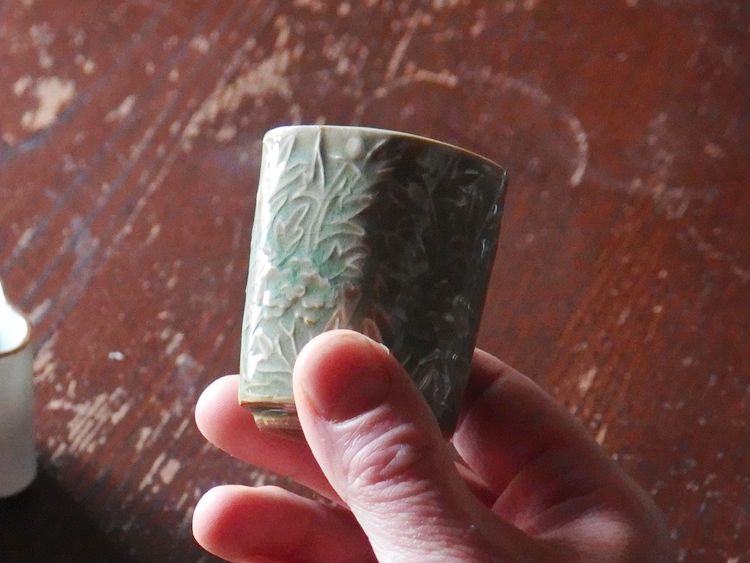
Mutsuhiko Shimura: This style is often seen in Ko-Imari, particularly around the Ko-Kutani period, in celadon or white porcelain.
I wanted to make a guinomi for drinking sake, so I made it a bit smaller.
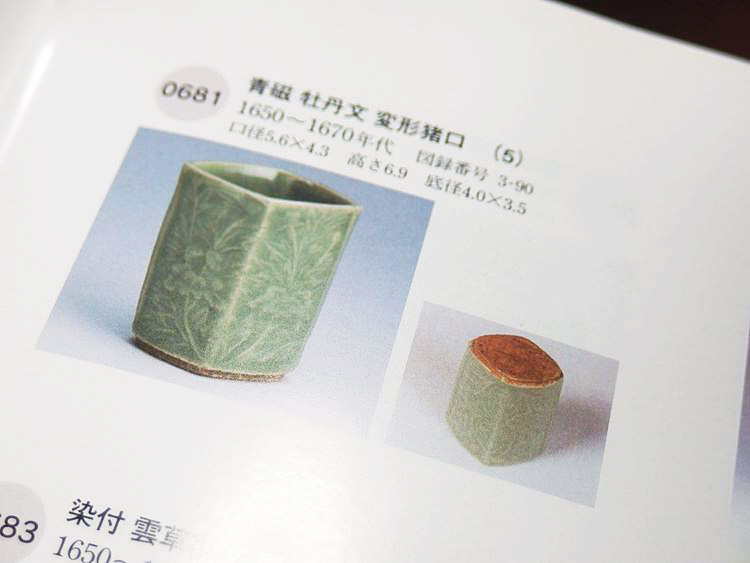
Hanada: The entire side surface is incised.
Mutsuhiko Shimura: Until now, I often did the incising inside the bowl, but I wanted to try it on the outside. I thought it would look beautiful when several are lined up.
Hanada: The shape is also striking.
Mutsuhiko Shimura: Besides the diamond shape, there are various interesting forms like gourd shapes and mokko shapes. Earlier, Miyaoka worked on a gourd-shaped one, which also gave me a hint. Here it is.
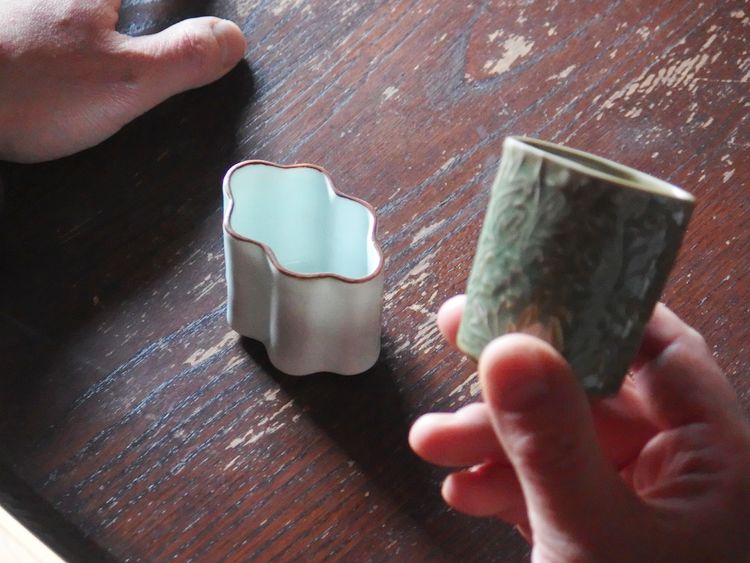
Hanada: It’s cute. The diamond shape creates four distinct surfaces on the sides.
Mutsuhiko Shimura: I slightly varied the peony design on each of the four sides.
Hanada: Is it meant for use as a sake cup?
Mutsuhiko Shimura: Sake or small delicacies, yes. It might also work well for small steamed rice dishes served between courses. Imagine something like karasumi on top.
Lotus
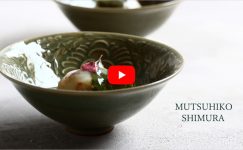
Hanada: This Celadon Lotus Petal Bowl also features incising on the outer surface.
The glaze pools create a beautiful gradation.
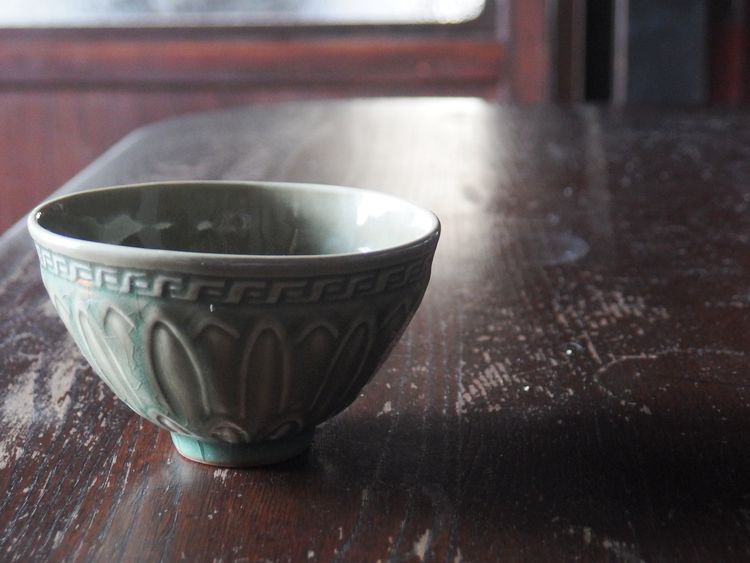
Mutsuhiko Shimura: The deeper the incising, the more the glaze pools.
I pay careful attention to the depth of the incisions.
Hanada: Lotus is often seen in your incised designs.
Mutsuhiko Shimura: I like peonies, lotuses, and chrysanthemums, so I tend to include them.
When you look at the moat from Kudan-zaka on your way here, the lotus flowers are amazing.
I keep that image in mind while creating.
My Favorite Blue
Hanada: Next, the Celadon Incised Peony & Shippo Oval Plate.
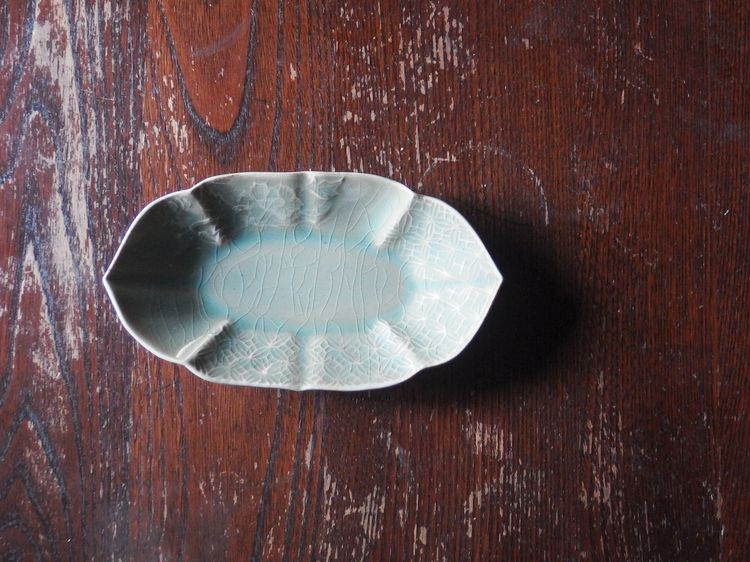
Mutsuhiko Shimura: I wanted to create a ruffled edge on an oval plate, so I made this one.
Hanada: The incising is stylish, combining peony and shippo patterns.
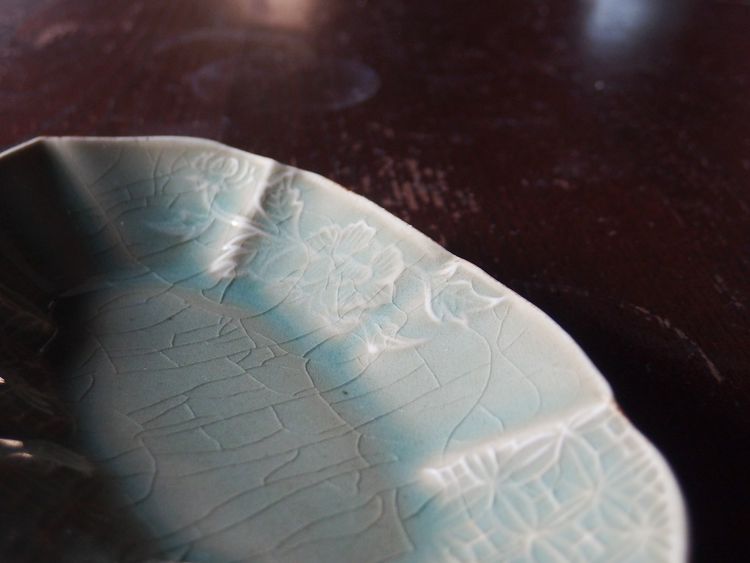
Mutsuhiko Shimura: This combination existed in old pieces. It’s often seen even in early Imari ware.
Maiko Miyaoka: The one we borrowed from Hanada was like that too.
Hanada: That’s right. So, what would we use this for?
Mutsuhiko Shimura: Sashimi, grilled shirako, or even tomatoes.
Hanada: Arranging sliced tomatoes would fit perfectly. The red of the tomatoes goes well with this celadon color.
Mutsuhiko Shimura: The glaze pooling in the center turned out beautifully.
Hanada: There are many shades of celadon blue and green. What colors do you prefer?
Mutsuhiko Shimura: I prefer shades that aren’t too green, more of a green with a hint of blue. I lean toward Yaozhou ware rather than Ru ware. Ru ware is a deeper blue.
Maiko Miyaoka: Yaozhou ware, definitely.
Mutsuhiko Shimura: I like the Northern Song period. By the Southern Song, the blue becomes too strong.
Beautiful from Above and the Side
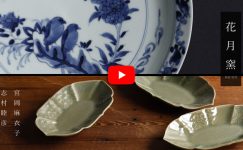
Hanada: Next is the Celadon Flower-Shaped Small Bowl.
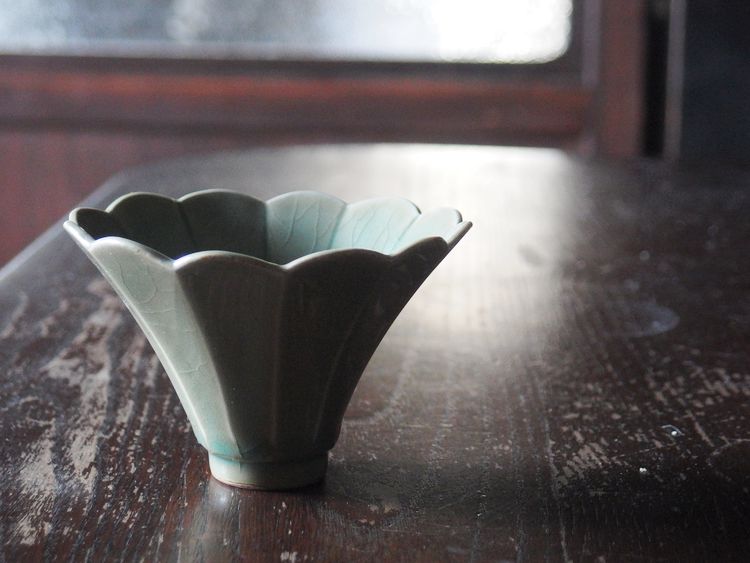
Mutsuhiko Shimura: I referenced the bellflower shape of early Imari ware. Although the shape is different.
Hanada: The bellflower shape has pointed tips, doesn’t it?
Mutsuhiko Shimura: Yes, and I adapted it into a morning glory shape. I also changed the number of petals.
Hanada: It’s beautiful from both above and the side.
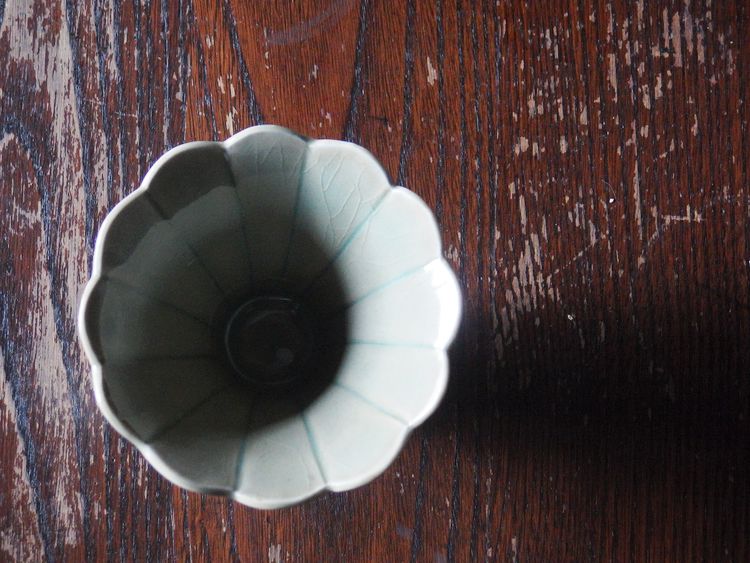
Mutsuhiko Shimura: I think it looks nice even after finishing a meal.
Hanada: It would be perfect for crab with roe.
Mutsuhiko Shimura: Now I feel like eating crab. I need to go to Omicho Market (laughs).
Playful Humor
Hanada: Next, Ms.Miyaoka, please. Let’s start with this Bird motif Plate.
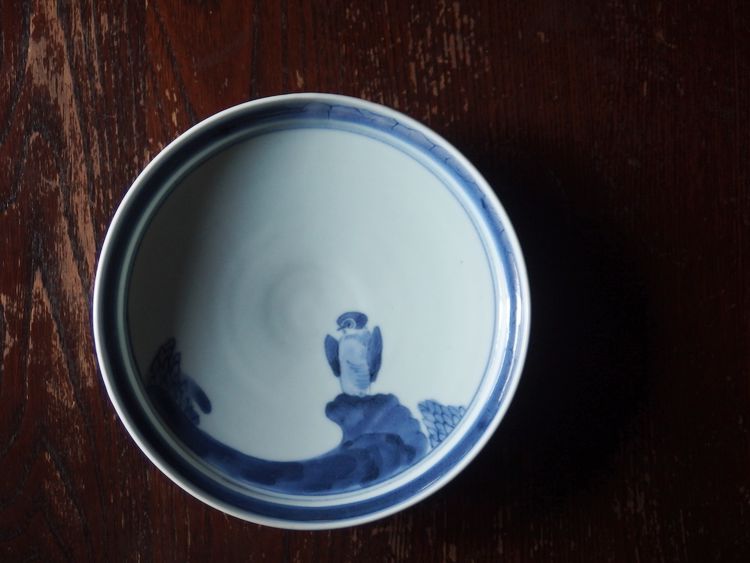
Mutsuhiko Shimura: Is this an owl?
Maiko Miyaoka: Not an owl. I’m not sure what kind of bird it is, but it’s modeled after early Imari ware. Sometimes early Imari has birds that look like penguins. They are often labeled as cormorants, but not specifically identified.
Hanada: Cormorants, perhaps. Since the painter didn’t specify, we can’t be certain.
Maiko Miyaoka: I don’t think it’s a penguin (laughs). I like this whimsical pose. I also like the background—grass, rocks, and so on.
Hanada: Overall, it’s quite humorous.
Maiko Miyaoka: The playful design, the overall composition, and the spacing… It’s simple but stylish.
Not a Person, But Resembles Me (Laughs)
Hanada: Ms. Miyaoka, how do you approach reproducing old pieces?
Maiko Miyaoka: First, I prepare the clay body and start painting a few pieces, which helps me get used to it.
Hanada: You paint directly on the clay body from the start?
Maiko Miyaoka: Yes, though I sometimes make light guidelines.
Hanada: No trial practice, then…
Maiko Miyaoka: That’s right.
Hanada: You handle this style very well.
Maiko Miyaoka: Maybe it’s easy for me because the whimsical quality resembles myself (laughs).
Hanada: (laughs)
Maiko Miyaoka: By the way, not for this plate, but a friend from high school once said, “This plate somehow reminds me of Maiko, it really does—exactly like you” (laughs).
Hanada: (laughs)
Maiko Miyaoka: It was odd because it wasn’t a human motif. Even though I was painting something that wasn’t a person, they said “exactly like you!” How does that make sense?
Hanada: What was the motif? (laughs)
Maiko Miyaoka: I don’t remember, but it definitely wasn’t a person (laughs). They kept saying, “I don’t know why, but it looks like Maiko!” and were delighted (laughs).
Classic: Mount Fuji
Hanada: Next, the Mount Fuji-shaped Heron Plate.
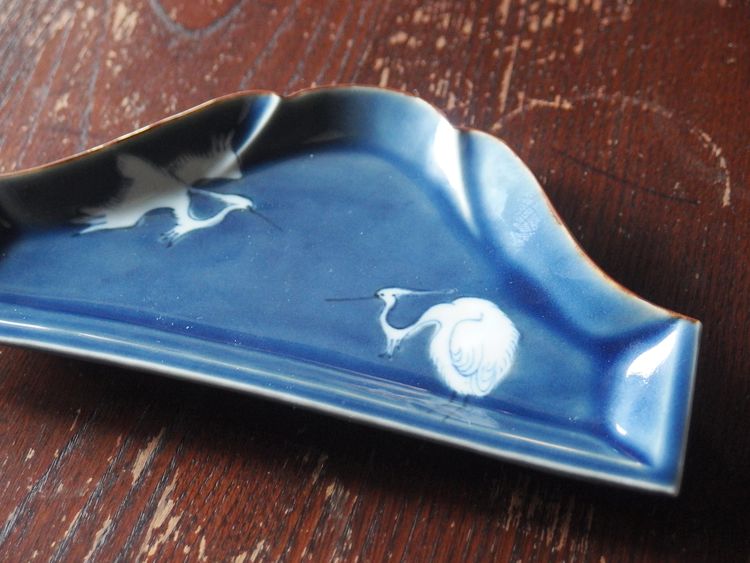
Maiko Miyaoka: Mount Fuji is too classic, so I haven’t made many in the past, but I decided to try this time. I like the pattern on the clay body and the overall composition.
Maiko Miyaoka: In the trial stage, I made versions with one and two herons. I liked the simplicity of the one heron, but when placing wagashi, the two herons on either side looked better, so I chose the two-heron version.
Mutsuhiko Shimura: In Ome, there are many herons flying around, so you can draw while watching them.
Maiko Miyaoka: Well, they’re there, but…
Hanada: You speak as if it’s someone else’s problem. Just watch and draw (laughs).
Maiko Miyaoka: They’re too far away to see them flying (laughs).
Hanada: It seems useful for more than just wagashi.
Maiko Miyaoka: Sashimi, fruits, pickles… I think it can be used for various things.
Rust-colored Glaze
Hanada: Next is the Rust Glaze Plum Plate. The iron painting on top of the rust glaze looks great.
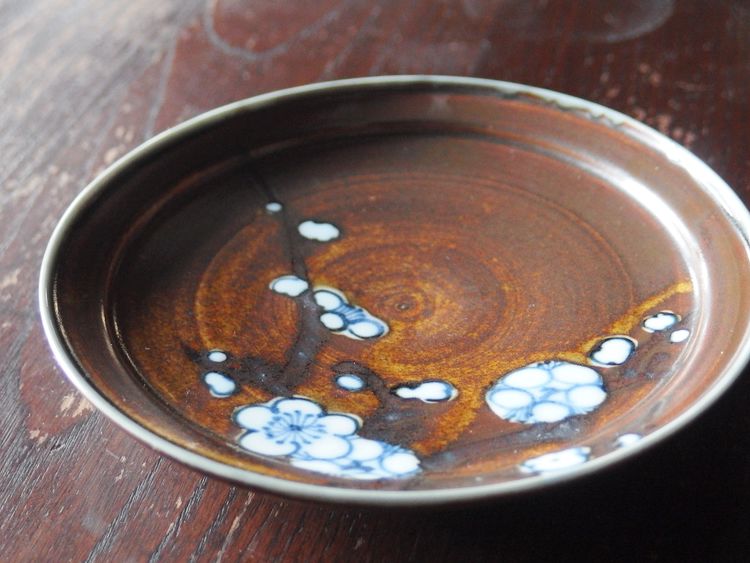
Maiko Miyaoka: I tried a cobalt edge, but it ran. Next time it should come out clearer. I saw this a long time ago and thought it was cute, so I’ve had my eye on it. The cobalt is stylish, and the piece also incorporates the rust-removal technique. Some parts of the rust glaze are slightly yellowish… It contains many elements I love—glaze colors and techniques—so I decided to make it for this exhibition.
The Exhibition
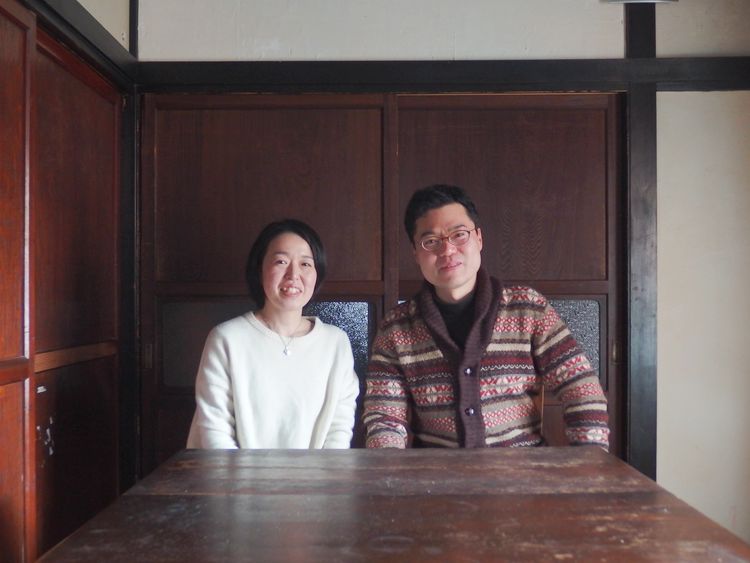
Hanada: Mr. Shimura, MS. Miyaoka, we’re looking forward to the exhibition, so thank you in advance.
Mutsuhiko Shimura: Thank you.
Maiko Miyaoka: We’re looking forward to it.
≪ END ≫
並べてキレイに
花田:志村さん、宮岡さんに今回の展示会への出品作についてお話を伺いたいと思います。
まず志村さん、青磁陽刻牡丹文猪口からお願いします。(以下花田-)
志村:古伊万里、特に古九谷あたりの時代に、青磁や白磁でよく見るものです。
お酒を飲むような猪口を作りたかったので、一回り小さくしました。
-:側面全面に陽刻が施してあります。
志村:今までは、見込みに陽刻をすることが多かったのですが、
外側に陽刻をしてみたいなと思っていました。
複数が並んだ時に、キレイだなと思って。
-:形も印象的です。
志村:ひし形以外にもひょうたん型やモッコ型など色々あって面白いです。
以前、宮岡がひょうたんのものをやっていて、それもヒントになりました。
これです。
-:可愛いですね。 菱形は、角があるので側面に4つの世界ができます。
志村:4面、少しずつ牡丹の形を変えました。
-:用途としては酒器でしょうか。
志村:お酒か珍味ですね。
コースの間に出てくる小さな飯蒸なんかにも、いいかもしれません。
上にカラスミなんかがのっている感じで。
蓮
-:こちらの青磁蓮弁鉢も外型で陽刻が外側に施されています。
釉のたまり方も濃淡があってきれいですね。
志村:陽刻を深く入れたところは、釉が濃くたまります。
陽刻の深さには気を使っています。
-:蓮は、志村さんの陽刻にはよく登場します。
志村:牡丹や蓮、菊は好きなので、ついついやってしまいます。
花田さん行く途中の九段坂からお濠を見ると、蓮の花凄いですよね。
あれを、イメージしつつ。
私の好きなブルー
-:続いて、青磁陽刻牡丹七宝文楕円皿です。
志村:楕円のものに輪花をしたくて、作りました。
-:陽刻の入れ方も洒落ています。 牡丹と七宝の組み合わせ。
志村:古いものにありました。
こういう組み合わせ、初期伊万里にも多いですよね。
宮岡:花田さんに借りたのもそうだったよね。
-:そうでした。
さて、これは何に使いましょうか。
志村:刺身、白子焼・・・トマトでも。
-:切ったトマトを並べるとうまくはまりそうですね。
この青磁の色にトマトの赤、相性いいです。
志村:見込みのここに釉がたまったところがキレイにいきました。
-:青磁の青や緑にも色々ありますが、志村さんはどのような色が好きですか。
志村:そこまで緑が強くないほうが好きです。
ちょっとブルーを感じさせる緑。
耀州窯や汝窯・・・どっちかというと耀州窯かな。
汝窯はもっと青いですね。
宮岡:耀州窯だね。
志村:時代で言うと北宋が好きです。
南宋までくるとブルーすぎます。
上から見ても、横から見ても。
-:続いて青磁花形小鉢です。
志村:初期伊万里の桔梗型を参考にしました。
形は違いますが。
-:桔梗型は先が尖がっていますものね。
志村:はい、それを朝顔のかたちにしました。
弁の数も変えています。
-:上から見ても横から見てもきれいですね。
志村:食べ終わった時きれいだなと思います。
-:蟹のとも和えなんかよさそうです。
志村:蟹、食べたくなってきますね。
近江町市場、行かなきゃ(笑)。
とぼけた面白さ
-:続いて宮岡さん、お願いします。
まずこちらの鳥文皿です。
志村:これ、ふくろう?
宮岡:ふくろうじゃないよ。
何の鳥か分からないけど、初期伊万里の模しです。
なんか、こういうペンギンみたいな鳥、初期伊万里って時々出てきませんか。
鵜ってなっていたり、特定していなかったり。
-:鵜、なんですかね。
描いた人が言っているわけじゃないから、何とも言えませんが。
宮岡:まあ、ペンギンではないと思いますけど(笑)、
このとぼけた姿が気に入っています。
背景も好きです。草とか岩とか・・・。
-:全体的にユーモラスですね。
宮岡:絵柄のとぼけた面白さと、全体の構図・・・
間の取り方も、シンプルだけど洒落ているなって思います。
人じゃないのに、私に似てる(笑)
-:宮岡さんは、古いものを模すとき、どのように進めていかれるのですか。
宮岡:まず、素地を用意して、何枚か描いていくと慣れてきます。
-:いきなり素地に描くのですね。
宮岡:そうですね。多少アタリをつけたりはしますが。
-:試しの練習もなく・・・。
宮岡:はい。
-:宮岡さん、この手はうまくこなされますよね。
宮岡:とぼけたところが、自分に似ていてやりやすいのでしょうか(笑)。
-:(笑)。
宮岡:そういえば、このお皿ではないのですが、高校からの友人に
「このお皿、なんか麻衣子に似てるよね、似てる似てるー。そっくりー」
と言われたことがあります。
-:(笑)。
宮岡:それがひどくて、人物の文様じゃないんですよ。
人じゃないもの描いているのに「そっくり!」って、どういうことなんでしょうね。
-:モチーフは何でしたか(笑)。
宮岡:何だったか全く覚えていませんが、人じゃなかったことは確かです(笑)。
で「よく分からないけど、麻衣子に似てるー」ってずっと喜んでいるんです(笑)。
王道、富士山
-:続いて、富士山型鷺文皿です。
宮岡:富士山は王道過ぎるので、今まではあまりやりませんでしたが、
今回作ってみました。
素地の形にこの文様。
全体の構成が好きです。
宮岡:試昨段階で、一羽と二羽、両方のバージョンを作ってみました。
一羽のほうも、それはそれで、シンプルで好きでしたが、和菓子などを置いた場合に二羽の鷺が両サイドに出て見栄えが良かったので、二羽の方に決めました。
志村:青梅(志村さん、宮岡さんの所在地)には鷺が沢山飛んでいるから見ながら描けるね。
宮岡:まあ、いるけど・・・。
-:他人事ですねえ。見て描けばいいって(笑)。
宮岡:遠すぎるよ、飛んでいるところなんて(笑)。
-:和菓子以外にも使えそうですね。
宮岡:お刺身にも果物にも、あとお漬物なんかにも・・・。
割と色々使えそうな気がします。
錆の色
-:次は錆釉梅文皿です。
錆釉の上に、鉄絵がのっているのが、良い感じですね。
宮岡:これ、縁を瑠璃にしたのですが、流れてしまいました。
次回はもっとはっきり出てくるはずです。
ずいぶん前に見て、可愛いなと思ってずっと目をつけていました。
ルリの感じが洒落ているし、錆抜きしているし、錆の色合いも部分的に黄色がかっているし・・・、好きな要素がたくさん含まれています。
展示会では、この錆釉の系統は何種類か作ろうと思っています。
展示会
-:志村さん、宮岡さん、展示会楽しみにしていますので、よろしくお願いします。
志村:よろしくお願いします。
宮岡:楽しみにしています。
≫志村睦彦さんのうつわはこちらから≪
≫宮岡麻衣子さんのうつわはこちらから≪
関連記事はこちら