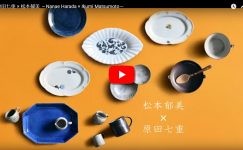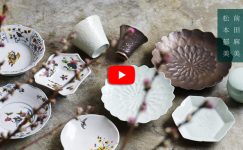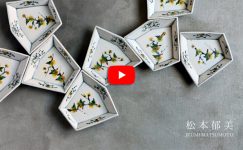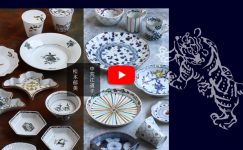




English version of the interview here.
The Beginnings of Making Tableware
Hanada: How did you come to start making tableware as your profession?
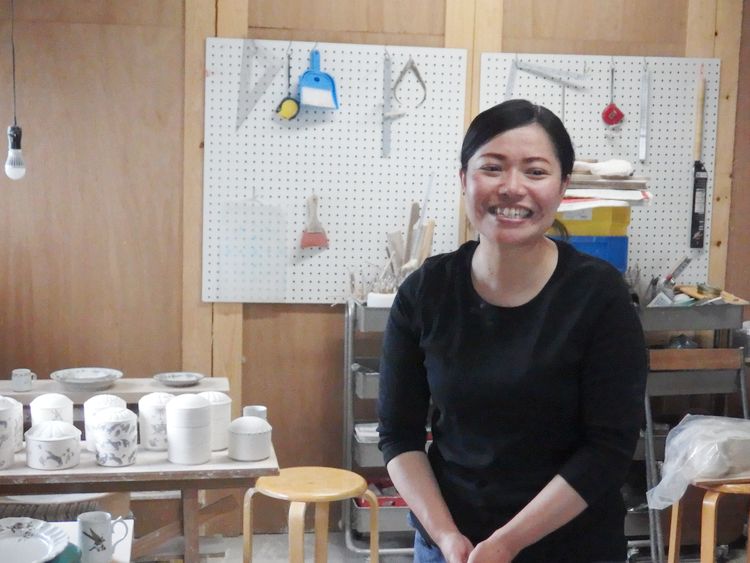
Ikumi Matsumoto : Initially, I was aiming to become a sculptural artist and spent seven years under Asuka Tsuboi. One day, I happened to make some tableware and showed it to her. I realized that people would actually use these items, and it made me feel a close connection to the users. It was a kind of joy I couldn’t get from making sculpture. For a while, I worked on both sculpture and tableware side by side, but now I focus solely on tableware.
Hanada: How did you end up apprenticing under Asuka Tsuboi?
Ikumi Matsumoto : When I was attending a training school in Kyoto, there was an opportunity to work part-time at her studio.
Hanada: Did she accept you right away?
Ikumi Matsumoto : She is in her 80s now, but when I first visited her, we spoke for three hours. As we talked, I felt a strong sense of compatibility. We spoke about ordinary topics—daily life, family structure, ceramics—but with every conversation, the doubts and uncertainties I was facing back then became remarkably clear. I was amazed. After three hours, she simply said, “All right.”
Hanada: That was wonderful. Weren’t those seven years highly enjoyable?
Ikumi Matsumoto : She was a strict teacher, so there were difficult times, but it was incredibly educational. Throughout those seven years, she kept telling me, “Whatever you do, don’t limit yourself to a small scope.” I tend to overthink things and stop in my tracks over a single worry. She would say, “It is most important to have a much broader perspective and do various things—both in human relationships and in making things—just the way you like, so do it while having fun.” Her words still resonate with me today.
Continuing to Make Tableware
Hanada: For you, what is the difference between tableware and sculpture?
Ikumi Matsumoto : Tableware heavily involves the aspect of “use.” For me, sculpture was for myself. I had daily thoughts and ideas that I wanted to preserve throughout my life, and I think I chose sculpture as a means of expression to shape them.
Hanada: Do you feel you are achieving that through tableware now?
Ikumi Matsumoto : Yes, I do now. With sculpture, if the artist asserts, “This is what it looks like,” the viewers largely look at it within that setting. Tableware is different. You cannot make it without standing from the perspective of the person receiving it. The more I make tableware, the more difficult it becomes, but I feel an even greater sense of enjoyment from it.
Bringing a “Joyful Feeling” to the Dining Table
Hanada: What do you value most right now when making tableware?
Ikumi Matsumoto : There are items from many different artists out there, but among all those various pieces on a dining table, I hope my tableware can add a “joyful feeling.”
Hanada: Your tableware production seems to have really gotten on track and appears to be going smoothly.
Ikumi Matsumoto : In terms of “making things that people use,” the past few years have truly been a great learning experience for me.
Fascinated by Cizhou Ware
Hanada: Can you see your path forward now?
Ikumi Matsumoto : I have always liked ancient Chinese ceramics, so I want to continue making that kind of work.
Hanada: You mentioned before that you like pieces from the Song dynasty.
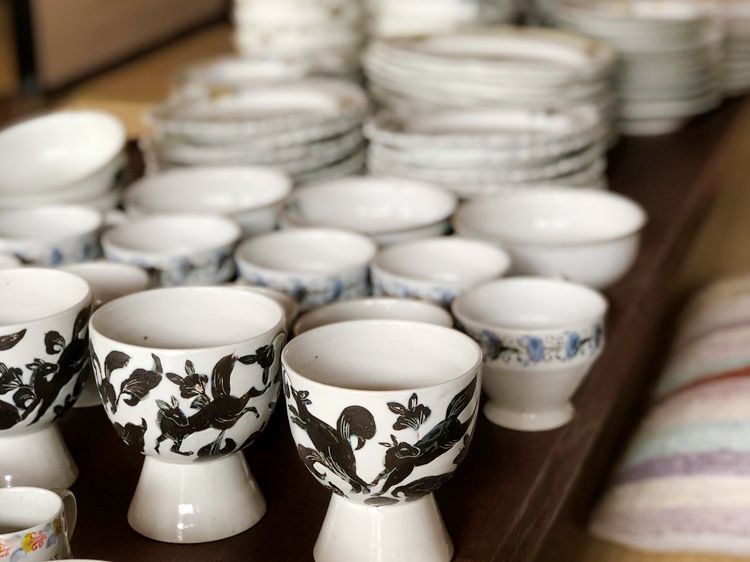
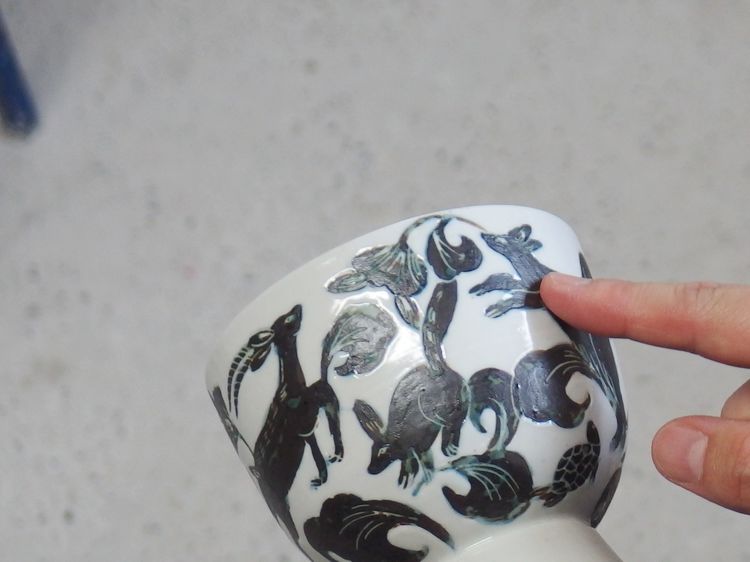
Ikumi Matsumoto : I have loved Cizhou ware ever since I saw it at The Museum of Oriental Ceramics about ten years ago. I am drawn to that clear, sharp contrast of black and white, and the exoticism of the patterns. I would like to express those charms in my own modern style. The strength of that sgraffito touch is wonderful.
Hanada: What kind of arrangements go into the “Ikumi Matsumoto Version of Cizhou Ware”?
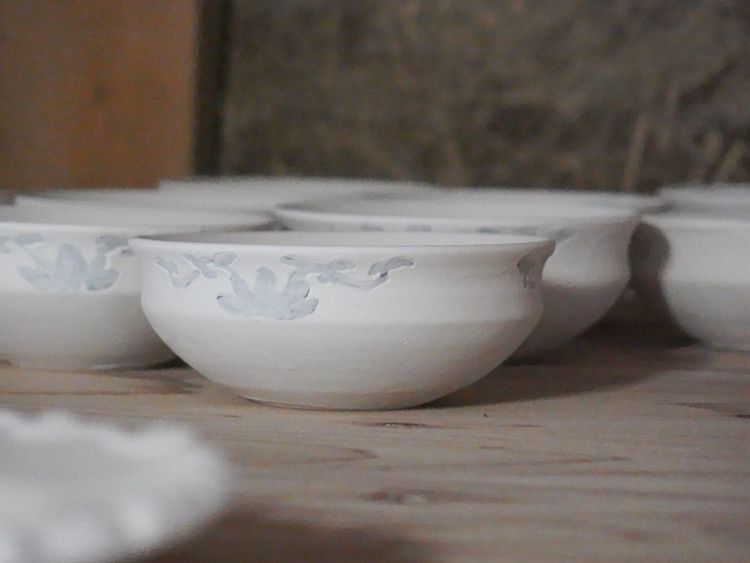
Ikumi Matsumoto : While choosing motifs that I like, I want to incorporate other colors rather than just black and white. Also, look right here. Can you see how it is slightly bluish? I researched this on my own and created a slip that creates yo-hen (kiln transformations) effects. I want to bring out irregularities to make it look like shadows.
Hanada: Is there anything you are thinking about for the future?
Ikumi Matsumoto : I easily find myself wanting to try all sorts of things. No matter what I make, I want to keep a firm core within myself so that my own worldview always comes through.
Hand-Painted Plates
Hanada: Let’s talk about the pieces you made for the exhibition. These were modeled after antique pieces.
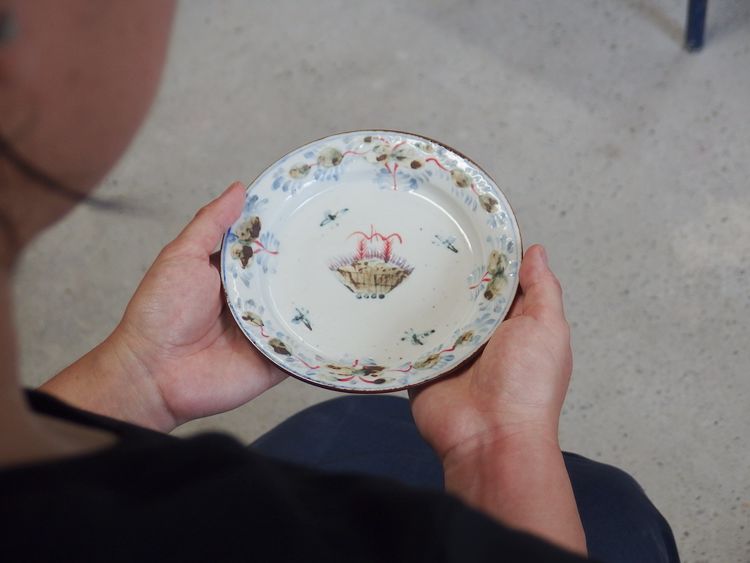
Ikumi Matsumoto : I made them in large and small sizes. This project gave me the chance to develop a brown slip, and it was a lot of fun to make.
Hanada: It feels as though the antiques have been revived in a way that is uniquely yours.
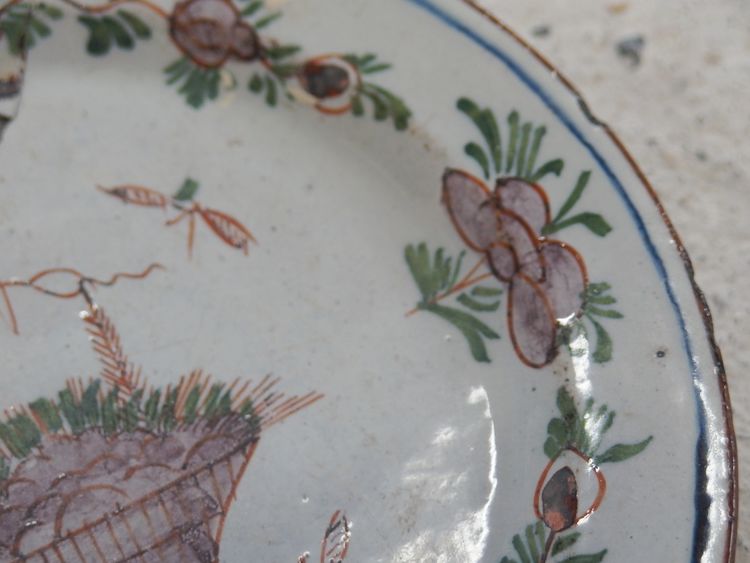
Ikumi Matsumoto : Out of the pieces you brought over, this was my favorite. The blue line works effectively here, and the purplish area is wonderful. I can apply this to my next work as well.
Hanada: I am delighted to hear that.
Café au Lait in a Bajo cup
Hanada: How about this Bajo cup (high-stemmed cup)?
Ikumi Matsumoto : This is a larger version of a Bajo cup. Previously, when I made a standard-sized one, a customer told me, “I want to drink café au lait from this,” which inspired me to create it.
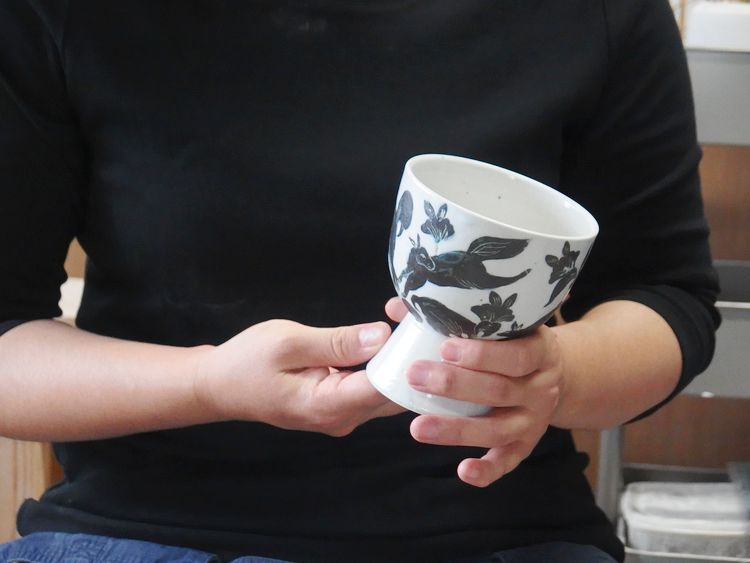
Hanada: Café au lait in a Bajo cup. That sounds refreshing.
Ikumi Matsumoto : I hope it makes tea and coffee times more enjoyable.
Demitasse Cups
Hanada: These demitasse cups are lovely too.
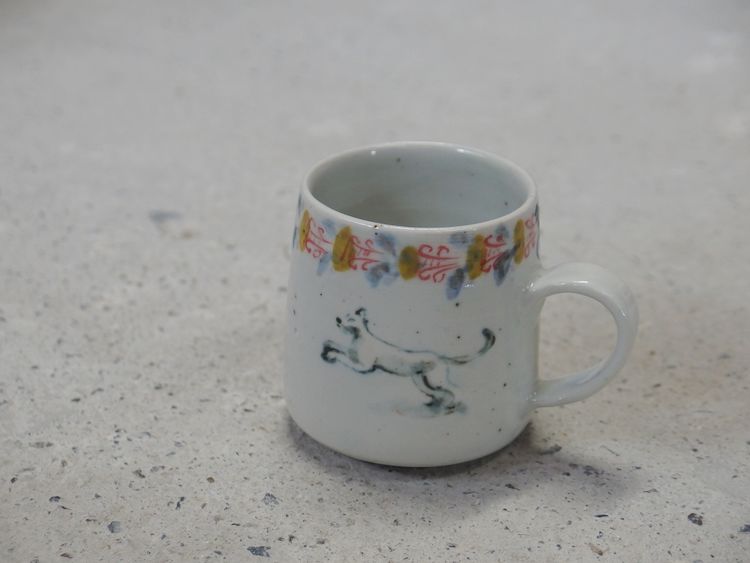
Ikumi Matsumoto : I wanted to make mini cups, so I shaped them using old French milk pitchers as inspiration. The painted designs are based on Delft tiles.
Hanada: Are dogs the only characters that appear? (Laughs)
Ikumi Matsumoto : No, I plan to feature a variety of designs, including ducks and other animals.
Rabbit with a Violin
Hanada: This one features a rabbit playing a violin.
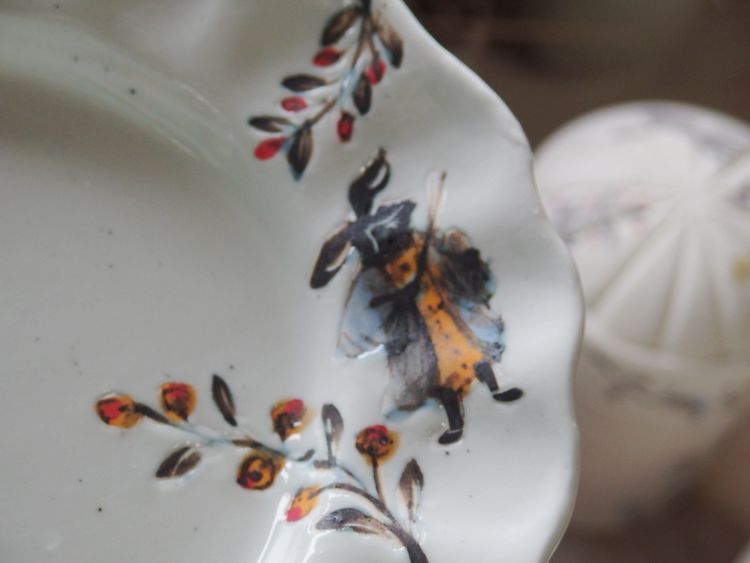
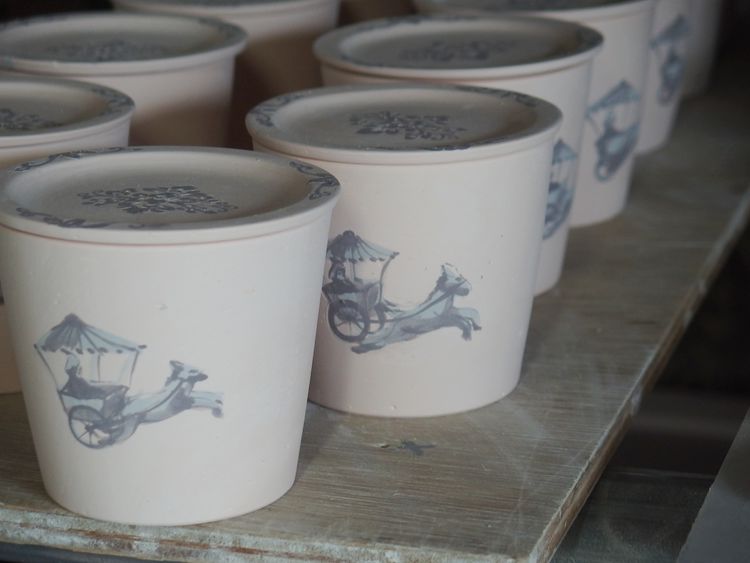
Ikumi Matsumoto : This is a piece I truly want people to use and enjoy. I aimed for something that evokes a story, with animals running around or wearing clothes.
Hanada: Thank you very much. Good luck with the exhibition.
Ikumi Matsumoto : I am a bit nervous (laughs), but I hope many people will come to see my work. Thank you.
≪ END ≫
うつわ作りの始まり
花田:松本さんは、どうやってうつわ作りの仕事に至ったのですか。(以下花田-)
松本:最初はオブジェ作家を目指していて、坪井明日香さんの下で7年間過ごしました。たまたま、うつわを作って見てもらったら、使ってもらえるし、お客さんと近いことを感じたんです。オブジェでは得られない楽しさでした。
しばらくはオブジェとうつわを並行してやっていましたが、現在はうつわに絞っています。
-:坪井明日香さんにはどういういきさつで弟子入りしたのですか。
松本:京都の訓練校の時に、先生のところでのアルバイトの話がありました。
-:OKはすぐ出ましたか。
松本:今もう80歳にもなる方ですが、最初に伺った時、3時間もお話をさせていただいたんです。
話していても、すごくフィーリングが合うことを実感しました。
普段の生活のこととか、家族構成とか、焼き物のこととか…、普通の話題なんですけど、
自分が当時悩んだり、迷ったりしていたことが会話ごとにクリアになっていくんです。
ビックリしました。
で、3時間後「いいよ」って言ってくださって。
-:よかったですね。楽しい7年間だったのではないですか。
松本:厳しい先生だったので、大変なこともありましたが、本当に勉強になりました。
「とにかく小さくまとまるな」と7年間言われ続けました。
私、考えすぎたり、一個のことに悩んですぐ立ち止まったりしてしまうんです。
「もっともっと大きな視野に立って、色々なことを―人間関係も作ることも―好きなようにやることが一番大切だから、楽しみながらやりなさい」って。
今でも心に響いています。
これからもうつわを。
-:松本さんにとって、うつわとオブジェの相違点は何ですか。
松本:うつわは「使う」ところが大きいです。私の中で、オブジェは自分のためでした。
人生の中で残しておきたい日々の思いや考えがあって、それを形にする表現手段として選んだのだと思います。
-:現在はそれをうつわで実現しているということなのでしょうか。
松本:今はそうです。
オブジェは「こう見えるでしょ」って作家が言い切ってしまえば、その設定で見て下さる部分が大きいと思うんですけど、うつわはまた違うというか。
受け取る側の目線に立たないと作れないものです。
うつわもやればやるほど、難しくなってきましたが、それ以上に楽しさを感じています。
食卓に「楽しい感じ」を
-:うつわを作るうえで、現在大事にされていることは何ですか。
松本:色々な作家さんのものがあると思いますが、食卓にあるその色々な器の中に、
私のうつわが「楽しい感じ」を加えられればいいなと思います。
-:うつわ作りもずいぶん軌道に乗ってきて、順調に見えます。
松本:「使うものを作る」という意味で、ここ数年は本当に勉強させてもらっています。
磁州窯に魅せられて
-:先は見えてきたのではないでしょうか。
松本:もともと中国の昔の陶器は好きだったので、そういうものを作っていきたいです。
-:以前にも、宋の頃のものが好きだと伺いました。
松本:10年ほど前に東洋陶磁美術館で見て以来、磁州窯が好きです。
あの白黒のはっきりしたコントラストと、文様のエキゾチックさに魅かれています。
そういう魅力を自分なりに現代風に仕上げたいですね。
あの掻き落としのタッチの強さがいいんですよ。
-:「磁州窯 – 松本郁美バージョン」はどのようなアレンジがかかるのでしょうか。
松本:モチーフを自分の好きなものにしつつ、白黒だけでなく他の色も入れていきたいし。
あと、ここ見てください。少し青っぽくなっているの分かりますか。
ここ、私なりに研究して、窯変するような化粧土を作りました。
ムラを出して、影っぽく見せたいなと思っています。
-:今後について考えていることはありますか。
松本:私はすぐ色々なものをやりたくなってしまいます。
どんなものを作っても、私自身の世界観が表れるように、
自分自身に軸をしっかりと持っていきたいです。
絵付けのお皿
-:展示会用に作ってもらったものについて、伺います。
これは昔のものを模してもらいました。
松本:大小つくりました。
これがきっかけで、茶色化粧もできましたし、作っていて楽しかったです。
-:古物が、松本さんらしく甦った感じです。
松本:松井さんが持ってきてくれたものの中でこれが一番好きでした。
ここの青の線が効いていたり、この紫っぽいところが良かったり、次の仕事にも活かせそうです。
-:そう言っていただけると、嬉しいです。
馬上杯でカフェオレを
-:この馬上杯はいかがですか。
松本:これ馬上杯の大きいバージョンなんです…。
以前、普通の大きさの馬上杯を作った時にお客様から「これでカフェオレ飲みたい」
と言われたのがきっかけです。
-:馬上杯でカフェオレ。新鮮です。
松本:お茶の時間が楽しくなれば、良いなと思います。
デミタス
-:このデミタスもかわいいですね。
松本:ミニカップを作りたかったので、フランスの昔のミルクピッチャーをヒントにかたちを作りました。絵付けは、デルフトのタイルが元になっています。
-:登場するのは犬だけですか(笑)。
松本:いえ、絵替わりにしたいと思っています。アヒルだとかも。
バイオリンのうさぎ
-:これは、バイオリンのうさぎですね。
松本:これはもう本当に楽しんで使ってもらいたい器です。
動物が走り回っていたり、洋服を着ていたり、物語を感じさせるものを目指しました。
-:有難うございます。
展示会、よろしくお願いします。
松本:緊張気味ですが(笑)、色々な人に私の仕事を見てもらいたいなと思います。
よろしくお願いします。
関連記事はこちら