


English version of the interview here.
Pomegranates and Plump Butterflies
Hanada: Today, I would like to talk about the tableware scheduled for your upcoming solo exhibition. First, let’s look at this pomegranate small bowl.
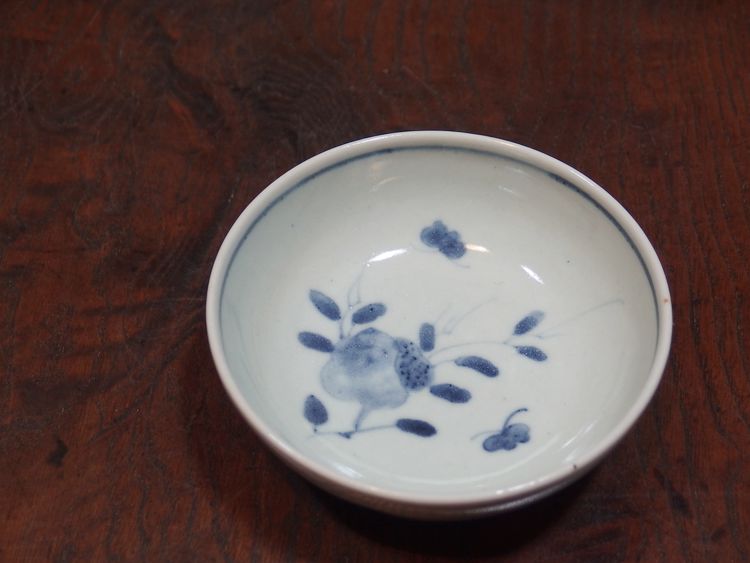
Mitsuo Fujitsuka : I originally saw this pattern on an early Imari plate. At first glance, it doesn’t really look like a pomegranate, does it? You can barely tell by these small dots.
Hanada: Pomegranates are usually depicted a bit more directly in terms of shape.
Mitsuo Fujitsuka : When I first saw it, I almost thought it was a strawberry (laughs). And look at this rather thick, plump butterfly—isn’t it wonderful?
Hanada: Is that plump look, along with the overall composition, exactly like the early Imari piece you saw?
Mitsuo Fujitsuka : The plumpness is identical (laughs). Though I don’t think the original had the circular border lines.
Hanada: The original was a plate, so what made you decide to turn it into a small bowl?
Mitsuo Fujitsuka : I originally wanted to make a small bowl of this size, and when it came to painting, I remembered this pattern I had seen before. Since it was originally a design meant for a plate, you never really know if it will suit a bowl until it comes out of the kiln.
Hanada: Turning it into a bowl adds depth. Is there anything you pay special attention to when painting pieces with depth?
Mitsuo Fujitsuka : The overall balance. When adapting a flat design into a deep bowl, I try to center the composition as if drawing everything inward, and then frame the edge with lines to tighten the look.
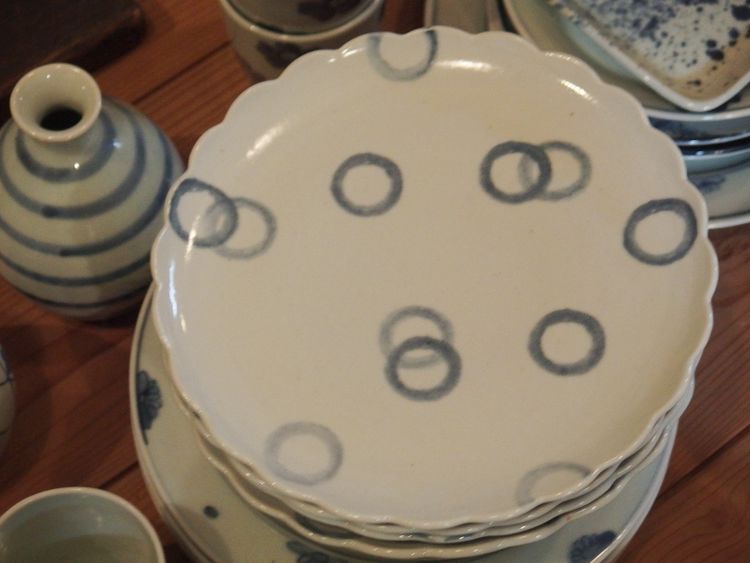
Overlapping Rings Plate
Hanada: Next is the overlapping rings plate.
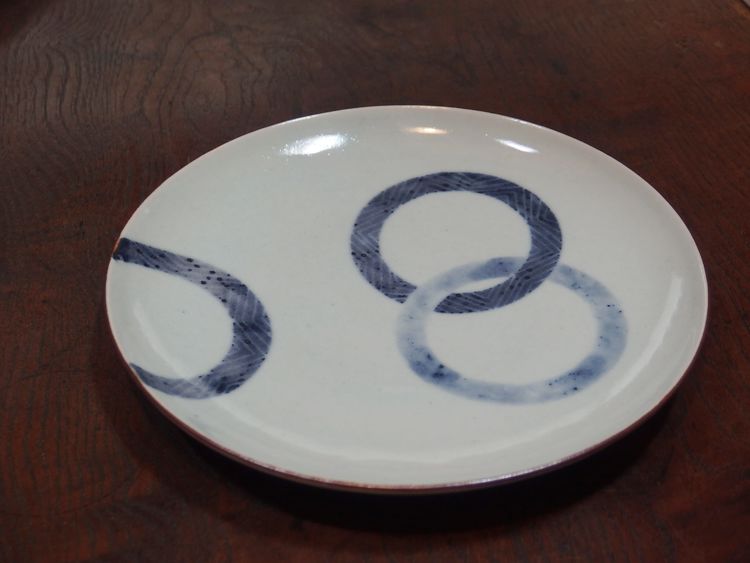
Mitsuo Fujitsuka : The original inspiration comes from Ko-Imari ware in the Shibata Collection.
Hanada: I see.
Mitsuo Fujitsuka : Instead of drawing outlines, I painted the rings using only two different shades of Dami wash painting. If you only use the wash, the design can look flat, so I added some sgraffito scratching techniques as well.
Hanada: That brings out a sense of depth.
Mitsuo Fujitsuka : Yes, and I think it adds a bit of movement too.
Hanada: The way the rings overlap is very eye-catching. The slight bleeding of the lighter blue Gosu pigment is also lovely.
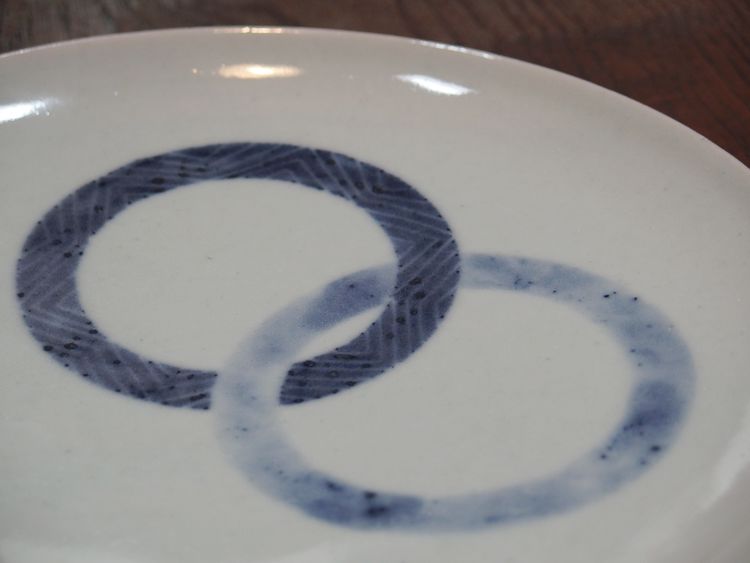
Mitsuo Fujitsuka : Ah, that was entirely accidental (laughs). It looks interesting, but there is no guarantee it will bleed just as nicely the next time (laughs).
Hanada: In terms of composition, keeping the circles from being fully contained within the center creates a sense of openness.
Mitsuo Fujitsuka : That’s true. Applying iron slip to the rim also frames and refines the piece.
What Kind of Flower Is It…?
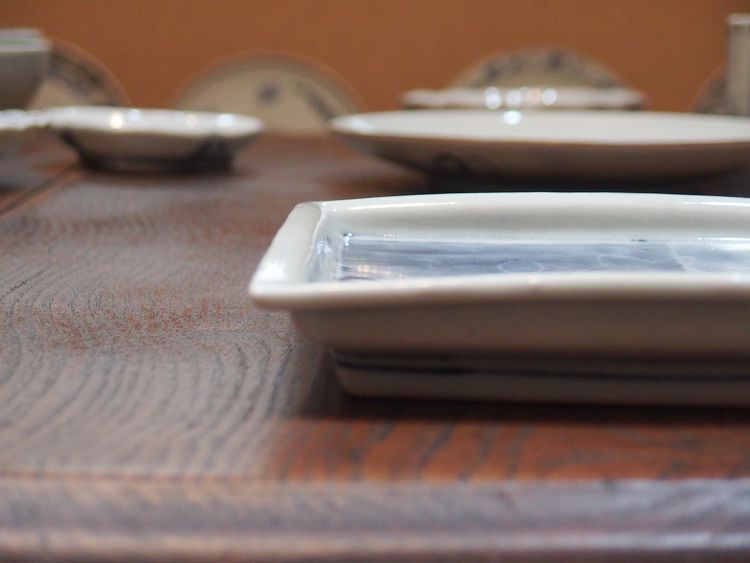
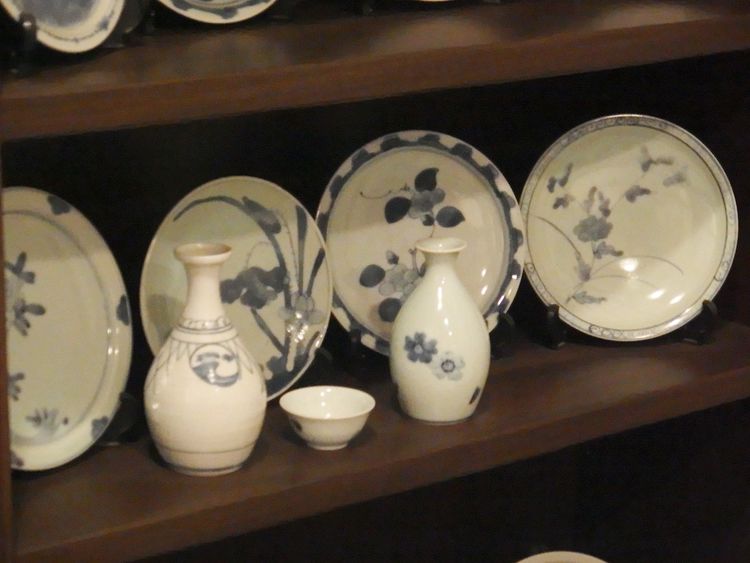
Hanada: The composition of the square plate with wash painting and sgraffito flower patterns is very stylish. Shifting the checkerboard pattern on a square plate and scratching out the flowers…
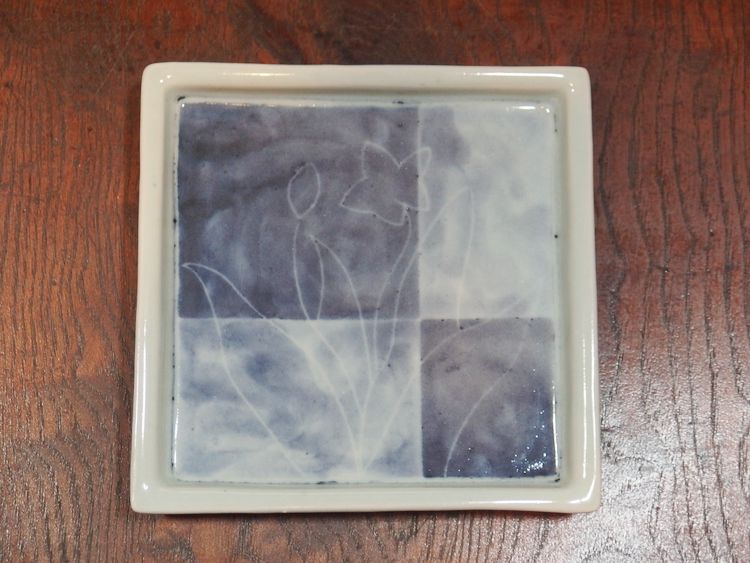
Mitsuo Fujitsuka : The idea was inspired by Korean Pojagi patchwork wrapping cloths.
Hanada: The way the flowers are scratched out across the borders feels wonderfully unconstrained.
Mitsuo Fujitsuka : I originally came across that specific layout on a Pojagi cloth, and because I found it intriguing, I decided to recreate it.
Hanada: So you were drawn to the flower pattern itself, rather than starting with the checkerboard layout?
Mitsuo Fujitsuka : Exactly. I remember thinking, “This is really fascinating.”
Hanada: This type of floral motif isn’t something you often see in pottery.
Mitsuo Fujitsuka : I’ve spent a lot of time wondering what kind of flower it could be. Don’t you think it looks a bit like a tulip?
Hanada: Well, now that you mention it, perhaps.
Mitsuo Fujitsuka : At first, I thought it might be a balloon flower.
Hanada: Looking just at the blossom, it certainly resembles a balloon flower.
Mitsuo Fujitsuka : Yes, if you look only at the bloom. But the leaves are entirely different. That is why I started thinking it must be a tulip.
Hanada: It is always enjoyable to look at antique designs and guess what the motifs represent.
Mitsuo Fujitsuka : It really is. Customers often ask me, “What flower is this?” Sometimes I end up pondering it right along with them (laughs), thinking, “Please don’t ask me any more than that!” (laughs).
Hanada: You also offset the center of the checkerboard.
Mitsuo Fujitsuka : It brings out that Pojagi textile feel. To keep it close to the texture of cloth, I applied it to a flat plate format.
For the First Time in 10 Years
Hanada: Next is the clover-shaped plate with a plum blossom motif.
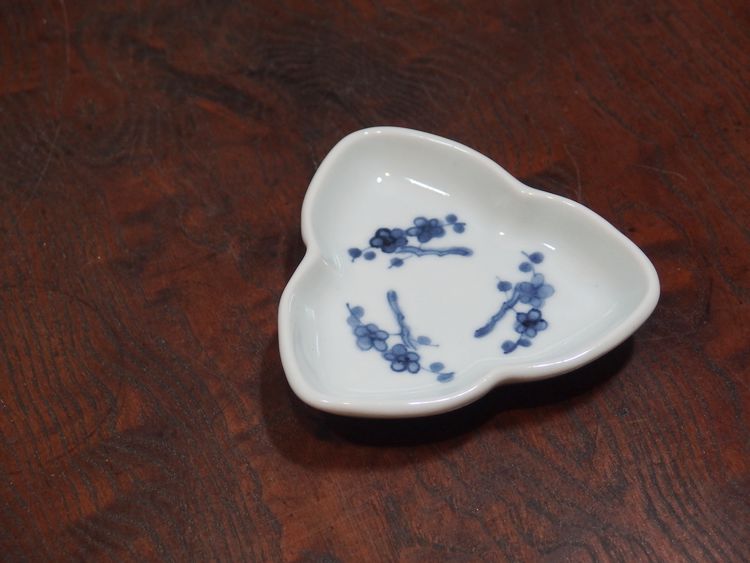
Mitsuo Fujitsuka : I hadn’t made this piece in over a decade, but I decided to bring it back. I was absentmindedly looking over my past work in the studio and thought, “Oh, come to think of it, I haven’t done this one in a long time. Looking at it now, it’s quite interesting” (laughs).
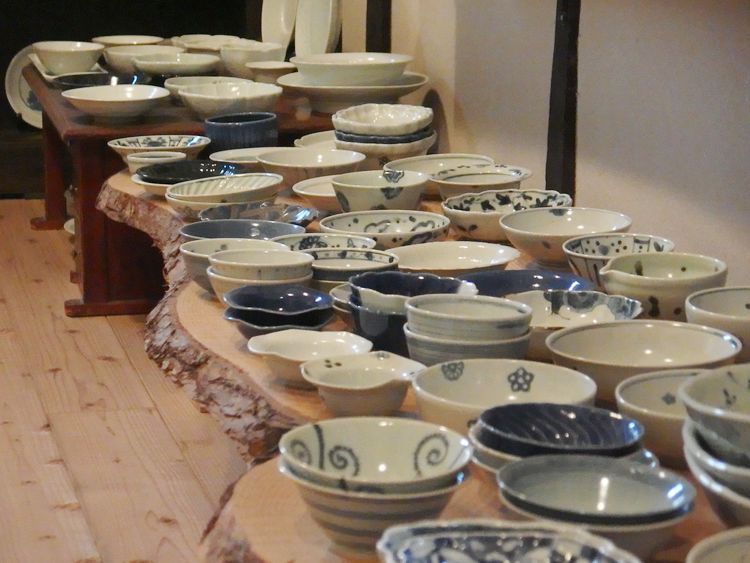
Hanada: It seems this plate was waiting ten years for you to rediscover it.
Mitsuo Fujitsuka : I used to make it consistently for about twenty years from the time I became independent. I have no idea why I stopped making it (laughs). It’s nice to have one of my irregular shapes every now and then, don’t you think?
Hanada: It adds variety, which makes things fun, whether it is for plates or bowls.
Mitsuo Fujitsuka : Even with the same diameter, you can have deep pieces, shallow pieces, flat ones… different shapes serving the same basic purpose as a small dish. That diversity creates so many variations, and I believe that is part of what makes the Japanese dining experience so rich. You have white porcelain, blue and white ware, overglaze pieces, lacquerware, and earthenware. Japanese tableware is incredibly abundant.
Hanada: When you revisit an old design after a long break, does it bring back memories from that time?
Mitsuo Fujitsuka : No, not at all (laughs). I don’t really remember things from that far back. I have my hands full just focusing on the present (laughs).
Flower-Shaped Plate with Shippo and Floral Patterns
Hanada: Could you tell us about this flower-shaped plate with Shippo (cloisonné) and floral patterns?
Mitsuo Fujitsuka : Much like the overlapping rings piece, I found the use of negative space here very compelling.
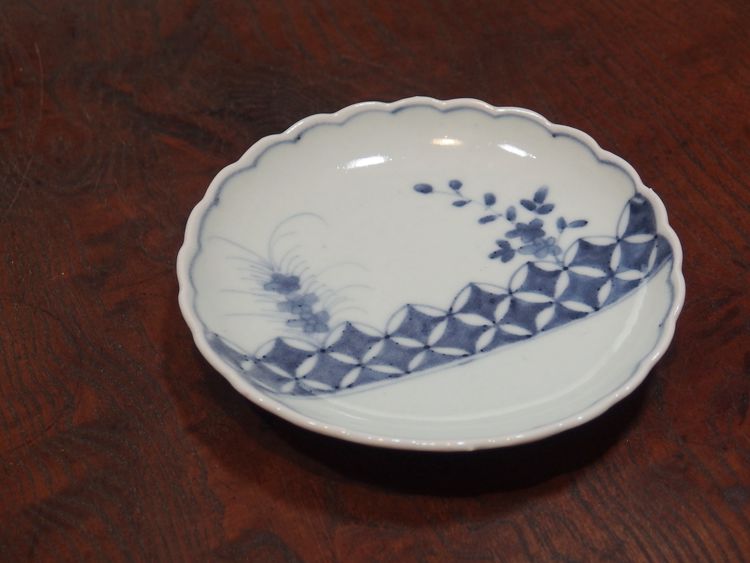
Hanada: Is this one also originally based on Ko-Imari ware?
Mitsuo Fujitsuka : Yes. The original piece was a perfect circle rather than flower-shaped.
Hanada: Is this layout common? I occasionally see pieces where half of the circle is filled with a Shippo pattern.
Mitsuo Fujitsuka : I think this specific pattern is quite rare, which is likely why it caught my eye. The concept of flowers emerging over a Shippo geometric background is also wonderful. So, I decided to paint it onto a flower-shaped plate format that I already had.
Hanada: So you already had this flower-shaped form. With a different pattern, it’s hard to believe it’s the same shape. What made you choose this flower shape for this design?
Mitsuo Fujitsuka : Hmm… purely intuition (laughs). Originally, I used to paint a traditional wandering line pattern on this flower-shaped piece.
Looking Ahead to the Exhibition
Hanada: Thank you so much for sharing all these insights with us. Is there anything else you would like to add?
Mitsuo Fujitsuka : No, if I talk too much, I might reveal my shortcomings, so I think I will leave it at that (laughs).
Hanada: We are very much looking forward to the solo exhibition. Thank you for your time.
Mitsuo Fujitsuka : Thank you as well.
≪ END ≫
ザクロとポチャッとした蝶々
花田:それでは、今回の個展に出品予定のうつわについてお話を伺いたいと思います。
まずは、このザクロの小鉢です。(以下花田-)
藤塚:元々、初期伊万里で、この文様のお皿を見たんです。
一見、ザクロには見えないですよね。
かろうじて、この点々で分かるかな。
-:ザクロは、形がもう少しダイレクトに描かれているものが多いですものね。
藤塚:これ最初イチゴかなって思うくらい(笑)。
で、ちょっと太めのポチャッとした蝶々が、またいいでしょう。
-:「ポチャ」も、文様の構成もご覧になった初期伊万里と一緒ですか。
藤塚:「ポチャ」は一緒(笑)。輪線はとっていなかった気がします。
-:元々お皿だったものを、なぜ小鉢にしたのですか。
藤塚:元々は、これくらいの小鉢を作りたくて、絵付けする際に、以前見たこの文様を思い出しました。
まあ、元々はお皿の図案だから、鉢に落としてみて、合うかどうかは焼いてみないと分からないんだけどね。
-:鉢にするとなると深さが出ます。
絵付けの際、気にされることはありますか。
藤塚:全体のバランスです。
平面に描かれたものを深さのある鉢にする時は、落とし絵的に中央に集めるような構成にして、縁を線で締めるって感じでしょうか。
重ね輪文7寸皿
-:続いて重ね輪文7寸皿です。
藤塚:元は、古伊万里。柴田コレクションです。
-:そうなのですね。
藤塚:線を取らずに、濃淡二種類の濃(だみ)だけで輪を描きました。
で、濃だけでは扁平になってしまうので掻き落としも加えました。
-:立体感が出てくるわけですね。
藤塚:動きも出てくるかなって。
-:重なり方も目を引きます。
薄いほうの呉須が少しにじんでいるのもいいですね。
藤塚:あぁ、これはねえ、たまたまなのよ(笑)。
面白いけど、次もいい具合ににじんでくれるとは限らないからね(笑)。
-:構図としては、丸を全て見込みに入れないことで、広がりが出ますね。
藤塚:そうですね。縁は口紅することで、引き締めています。
一体、何の花なのか…
-:濃掻き落し花文角型皿は構成がとても洒落ていますね。
角皿で、市松をずらしつつ、花を掻き落とし…。
藤塚:韓国のポシャギがヒントになっています。
-:境目を横断して掻き落とされているのが、おおらかですね。
藤塚:元々、その絵をポシャギで見つけて面白かったから作ったんですよ。
-:市松ありきではなく、花文を気に入られたのですね。
藤塚:そうそう。「なんか面白いなあ」って思った記憶があります。
-:この花文様、あまり焼き物では見ない表現ですね。
藤塚:「これは何の花だろう」って色々考えていてね。
「チューリップかなあ」って…思わない?
-:ええまあ、言われてみれば。
藤塚:最初は桔梗かなと思ったんです。
-:花だけ見れば桔梗ですね。
藤塚:そう、花だけ見ればね。でも、葉っぱが違うでしょう。
だからこれ、チューリップじゃないかなと思って。
-:昔のもの見て、何の花だろうって考えるの楽しいですよね。
藤塚:面白いよね。それとね、お客さんに「なんの花ですか」って聞かれるのよ。
「いやあ、何なんでしょう」なんて、一緒に悩んだりして(笑)。
「もうそれ以上聞かんといて」って感じです(笑)。
-:市松の中心もずらしています。
藤塚:ポシャギの感じが出るでしょう。
で、布に近いように、平らなお皿にはめてみました。
10年ぶりに
-:次は梅花文三つ葉型皿です。
藤塚:10年以上作っていなかったのですが、久しぶりに作りました。
見本場で、ボーっと昔の仕事を見ていて「あ、そういえばこれ、長いことやっていないな、あらためて見てみると面白いな」と思って(笑)。
-:このお皿は10年間見つけてもらうのを待っていたのですね。
藤塚:独立時から20年くらいずっと作っていたんですけどね。
なんで作らなくなったか分からないけど(笑)。
たまには僕の変形もいいでしょう?
-:色々あると楽しいですからね。皿にしても、鉢にしても。
藤塚:同じ口径でも、深かったり浅かったり、平があったり…同じ小皿という用途は一緒でも色々なかたちがあったり…、それによってバリエーションも色々あって、そのあたりも日本の食卓の豊かさだと思うしね。
で、白磁があって、染付があって、上絵があって、漆器があって、土物があるわけでしょ。
豊富ですよ、日本のうつわは。
-:昔のものを久しぶりに再開すると、当時を思い出すこともありませんか?
藤塚:…。いやあ、それはないね(笑)。
昔のことってね、そうそう覚えていないですよ。
今で精いっぱい(笑)。
七宝に草花輪花五寸皿
-:七宝に草花輪花五寸皿はいかがでしょうか。
藤塚:これも重ね輪文と一緒で、間(ま)が面白いなと思いました。
-:これも元は古伊万里ですか?
藤塚:はい。元々は輪花ではなく正円でした。
-:こういう構図ってよくあるのでしょうか?丸半分七宝で埋まっているのは見ますけど。
藤塚:このパターンは珍しいと思います。だから目に留まったんだと思う。
で、七宝の上に草花が出てくるという発想も面白いよね。
それで、もともとあった輪花の皿に描くことにしました。
-:もともと、この輪花の形はあったのですね。
文様が違うと、同じ形とは思えません。
輪花にしたのはなぜですか。
藤塚:うーん…、勘だね(笑)。
この輪花には、もともと古染付のよろけを描いていました。
個展に向けて
-:色々お話しいただき、有難うございました。
何か言い残されたことはありますか。
藤塚:いや、あんまり語るとボロが出るから、これくらいにしておきます(笑)。
-:それでは個展、楽しみにしています。
よろしくお願いします。
藤塚:こちらこそ。
関連記事はこちら